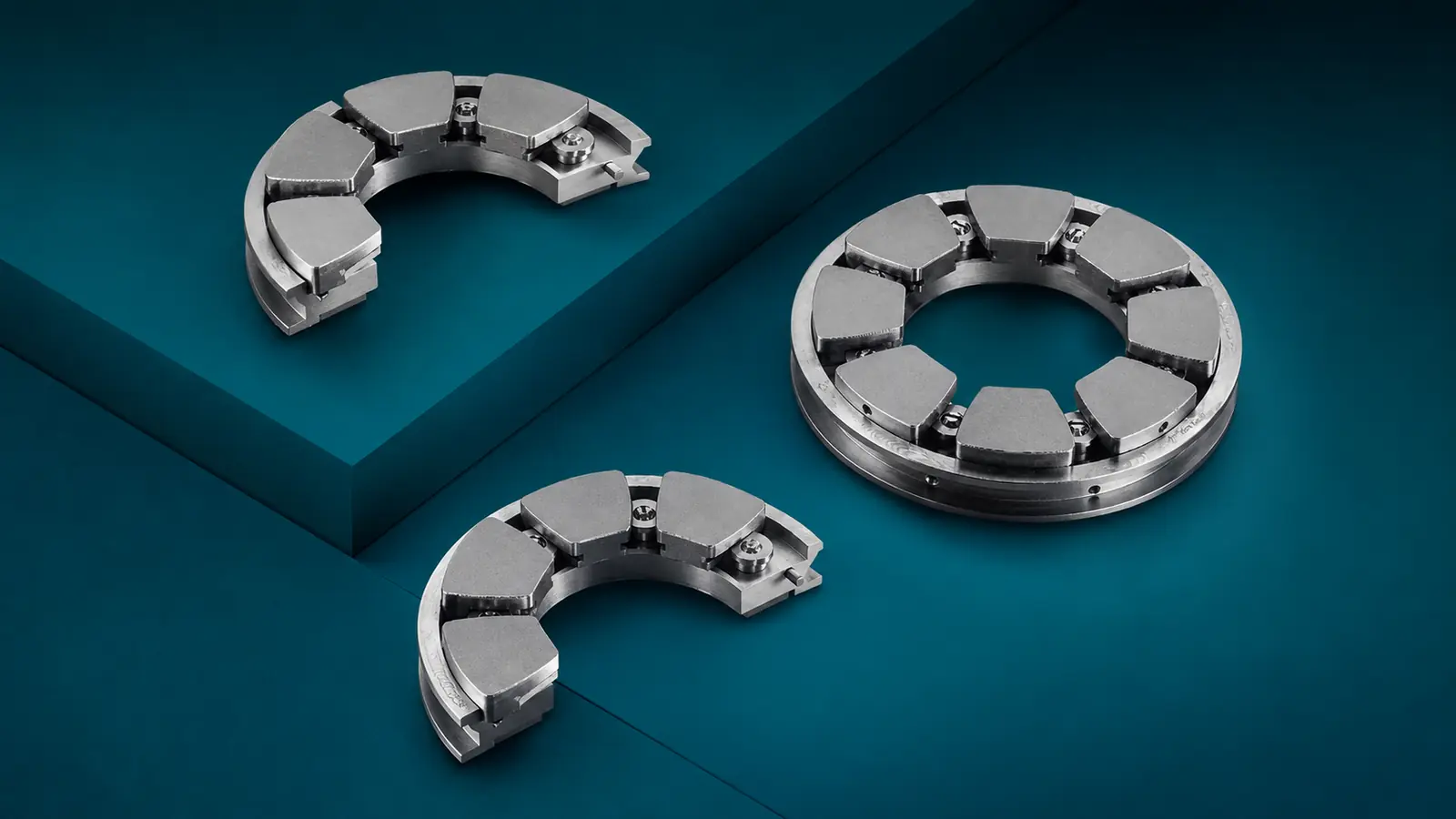
A tilting pad thrust bearing forms a hydrodynamic oil film between rotating thrust collar and pivoted pads. Each pad tilts to create a converging film that carries axial load. Buyers must therefore specify the machine, operating point, lubrication system, geometry, and complete designation rather than ordering by shaft diameter alone.
The main parts are thrust pads, pivots, carrier or base ring, thrust collar, oil passages, and retaining features. Some assemblies also include an equalizing system that redistributes load among pads. Pad freedom, collar condition, and oil supply directly affect film formation.
A center-pivot design can support either rotation direction. An offset-pivot design normally serves one specified direction and can reduce loss or temperature at the intended operating point. Buyers must also distinguish equalizing from non-equalizing arrangements.
Lubrication can be flooded or directed. Flooded designs fill the housing cavity, while directed-lubrication designs deliver oil near pad entry and manage discharge. In addition, bearings may be single-acting or double-acting, split or unsplit, and supplied as cartridge assemblies. These choices change installation and system requirements.
Tilting pad thrust bearings are widely used in power generation, oil and gas, petrochemical processing, and large industrial machinery. Typical applications include steam and gas turbines, centrifugal compressors, turbo gear units, large pumps, and generators. Their pivoting pads develop a hydrodynamic oil film to support substantial axial loads in high-speed rotating equipment.
These machines often operate continuously under varying thrust loads and temperatures. Bearing performance depends on shaft speed, load direction, oil supply, and operating conditions. Engineers must also evaluate transient loads and reverse thrust, as these may require a dedicated bearing arrangement.
For critical equipment, operators may monitor pad and oil temperatures, axial position, vibration, oil pressure, and flow. The approved machine and bearing design should determine the monitoring requirements and alarm limits.
First, confirm single or double arrangement, pad count, pivot type, rotation direction, equalization, lubrication method, split construction, and cartridge scope. Then verify inside diameter, outside diameter, axial width, collar geometry, clearances, and mounting interfaces.
Next, submit load, speed, oil viscosity, inlet condition, and thermal limits for performance review. Power loss, oil flow, film thickness, and pad temperature depend on the combined operating point. Therefore, published dimensions alone cannot validate a selection.
Finally, check pad and backing materials, pad-surface or lining condition, instrumentation provisions, piping interfaces, and required documentation. If the design uses a babbitt lining, its condition and acceptance limits should also be defined. A legacy code may describe an older configuration, so current availability and drawing revision should be confirmed before release.
The examples below show current and legacy tilting-pad thrust bearing references from different manufacturers. They are identification examples only and do not indicate interchangeability. Legacy references should be checked against the current manufacturer or successor product documentation before ordering.
| Brand / reference source | Product family or configuration | Model or configuration example |
| Legacy John Crane Bearings Technology | Tilting-pad thrust bearing references with flooded or directed lubrication and different thrust configurations | 8_8T KD 103/215.85×36.56 |
| Kingsbury | LEG, SlimLine LEG, EQH, and G-MD thrust-bearing families | EQH-B Equalizing Flooded Thrust Bearing |
Legacy John Crane Bearings Technology references use a structured code covering thrust sections, journal section, split arrangement, rotation direction, product configuration, and dimensions. The industrial bearing business later became part of Miba, so buyers reviewing an older John Crane reference should confirm the current technical source and drawing revision. Kingsbury uses named product families and configuration identifiers. In either case, retain the complete reference, manufacturer or successor information, drawing, and revision.
Legacy reference 8_8T KD 103/215.85×36.56 identifies a double tilting-pad thrust bearing in the former John Crane Bearings Technology designation system.
| Code | Code section | Meaning |
| 8 | First Thrust part | 8 Thrust tilting pad |
| _ | Journal part | No journal part |
| 8 | Second thrust part | 8 Thrust tilting pad |
| T | Shape and direction | Split, rotation in both directions |
| KD | Series | Directed-lubrication configuration with the specified spacer and shim arrangement |
| 103/215.85×36.56 | Dimensions | 103 mm inside diameter, 215.85 mm outside diameter, 36.56 mm width |
This decoding is specific to the John Crane designation system. It does not define every material, clearance, performance limit, or accessory. Therefore, buyers should retain the complete reference and use the approved drawing as the controlling technical document.
Before assembly, verify thrust-collar finish, flatness, runout, and cleanliness. Clean oil passages and confirm that pad pivots move freely. Preserve pad, carrier, shim, and instrumentation positions when the drawing assigns them.
Install the bearing without damaging the pad sliding surfaces or lining. For babbitt-lined pads, avoid scraping, denting, or contaminating the babbitt surface. Confirm axial clearance, collar location, oil-supply direction, drain path, and sensor connections. Then pre-lubricate as required and monitor temperature, pressure, flow, vibration, and axial position during commissioning.
During removal, mark each component’s side and orientation. Protect pads and collar surfaces from impact. Finally, inspect wiping, scoring, edge loading, pivot fretting, varnish, debris, and abnormal temperature patterns before deciding whether parts can return to service.
HSN can review the manufacturer, complete code, drawing revision, pad arrangement, pivot, rotation direction, equalization, and lubrication method. The review can also cover dimensions, collar data, load, speed, oil condition, instrumentation, quantity, and machine before sourcing begins. For a legacy unit, clear nameplate photos and dimensional records can support an initial identification review, but an engineering release still requires controlled technical data.
Agreed checks can cover markings, dimensions, pad count, split features, visible pad-surface or lining condition, oil passages, sensors, packaging, and traceability. For babbitt-lined designs, the agreed inspection can also include the visible condition of the babbitt surface. HSN can coordinate further material or dimensional inspection when acceptance criteria are defined. Before discussing a replacement, HSN compares the full hydrodynamic design, operating point, mounting interfaces, oil system, thermal limits, and documentation rather than matching only inside and outside diameters.
Can a center-pivot bearing run both ways?
It can support either rotation direction when the complete bearing and lubrication arrangement are designed accordingly.
Why is oil inlet temperature important?
It affects viscosity, film formation, power loss, flow requirement, and pad operating temperature.
Does the model code prove performance?
No. Performance still depends on load, speed, oil, geometry, clearances, and the approved design calculation.
What information should buyers send?
Send the full code, drawing, loads, speed, rotation, dimensions, oil data, sensors, quantity, and machine details.
For detailed tilting pad thrust bearing models not listed above, or for other bearing types, contact HSN with the reference, photos or drawing, dimensions, quantity, application, and working conditions.
This article is based on independent analysis of publicly available technical information and industry understanding for knowledge sharing. All brand names and trademarks belong to their respective owners. HSN Bearing Group is an independent bearing supplier and technical service provider.
Tel: +86 156 6578 7336 Email: service@hsnindustrial.com Website: www.rollingparts.com www.hsnbearings.com