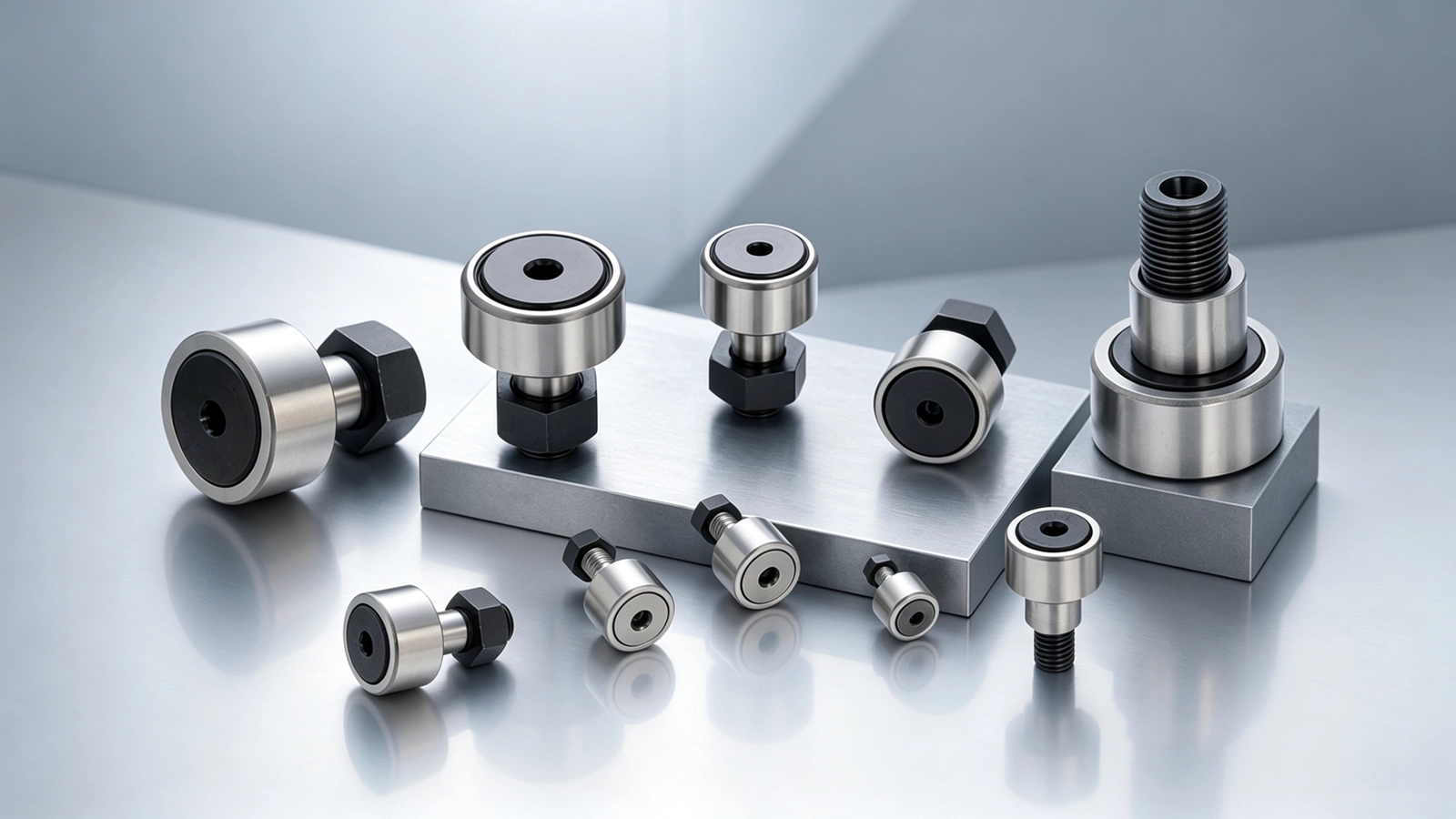
Cam followers are track rollers with thick outer rings designed to run on cams, rails, or guide surfaces. The thick ring limits deformation under concentrated contact. Buyers must still match mounting style, roller profile, track condition, load, speed, sealing, and lubrication to the machine.
A stud-type cam follower has an integral threaded stud for cantilever mounting. A yoke-type track roller has an inner ring and mounts on a pin or bolt supported at both ends. Therefore, yoke cam followers generally suit arrangements that can provide straddle support.
Internal designs may use a caged needle roller set, a full complement of needles, or rows of cylindrical rollers. Caged designs reduce roller interaction and can support higher speed. Full-complement designs increase roller count and load capacity, but speed and lubrication requirements differ.
Outer rings can be crowned or cylindrical. A crowned profile helps reduce edge stress when alignment is imperfect. A cylindrical profile needs accurate alignment and full-width track contact. Eccentric studs permit position adjustment, while seals help retain lubricant and exclude contamination.
V-groove cam followers use a profiled running surface designed to match the corresponding track geometry. They are not automatically equivalent to standard crowned or cylindrical rollers. Likewise, guide wheels may use different profiles, materials, and internal bearings. Buyers should specify the track geometry.
Cam followers are commonly used in industrial automation, packaging machinery, material handling, and manufacturing equipment. Typical applications include cam drives, indexing machines, conveyors, automated doors, transfer lines, and linear guidance systems. Their thick outer rings roll along cams or tracks to guide movement and support radial loads in compact mechanisms.
These applications often involve repeated motion, intermittent indexing, shock loads, or continuous operation. Buyers should consider load, speed, lubrication, contamination, and track conditions. Track hardness, surface finish, and profile also affect performance, as the bearing’s published load rating may exceed the allowable track contact load.
For stud-type cam followers, mounting rigidity and overhang require particular attention. A flexible support can increase stud bending and reduce usable capacity. Engineers should therefore evaluate the stud, mounting structure, and track alongside the bearing itself.
First, confirm stud or yoke construction, roller outside diameter, width, stud or bore size, threaded length, outer-ring profile, internal rolling element, seals, and lubrication features. Then check radial capacity, track capacity, limiting speed, and required relubrication interval for the exact reference.
Next, review whether the stud is concentric or eccentric. An eccentric stud aids adjustment, but the final position and locking torque must follow the manufacturer instructions. For yoke rollers, confirm pin fit, side support, axial location, and whether the assembly permits relubrication.
Finally, retain every prefix and suffix. Seals, hex sockets, crowned or cylindrical profiles, eccentricity, and inch-series features can appear in the code. A shared roller diameter does not prove that two complete models fit or perform alike.
The following examples show established international series and code styles. They should not be treated as cross-brand replacements.
| Brand / reference source | Series examples | Model example |
| ISchaeffler / INA | KR caged; KRE eccentric; KRV full-complement needle roller; NUKR cylindrical roller | KRE 22 PP |
| THK | CF standard; CF-A variants; CFH eccentric series | CF 20-1R-AB |
| IKO | CF/CFKR standard; CFKRE eccentric; separate C-Lube cam follower series | CFKR22 |
| Legacy Torrington / Timken | Historical metric stud-type track roller references | KRE22.2RS |
IKO CFKR references belong to the standard double-hex-hole cam follower family, while C-Lube cam followers form a separate product group. Therefore, a CFKR model should not be identified as a C-Lube execution unless the complete manufacturer reference confirms it.
Model conventions differ by manufacturer and by publication period. For example, legacy Torrington/Timken references can use .2RS, while current Schaeffler/INA series commonly use suffixes such as PP. Buyers should not transfer suffix meanings between brands or between legacy and current references. Preserve all spaces, punctuation, prefixes, and suffixes from the applicable manufacturer record.
Legacy reference KRE22.2RS illustrates an older metric stud-type track roller designation used in Torrington/Timken-era documentation. Buyers should treat it as a historical identification example and verify any current replacement against the present manufacturer’s drawing and designation system.
| Code | Code section | Meaning |
| KR | Series prefix | Stud-type track roller / cam follower family in the legacy designation |
| E | Stud execution | Eccentric stud execution for adjustment |
| 22 | Size section | Nominal 22 mm roller outside-diameter group |
| .2RS | Legacy seal suffix | Two-sided sealed execution in the applicable legacy reference system |
In current Schaeffler/INA references, KRV identifies a full-complement needle roller design, while NUKR identifies a full-complement cylindrical roller track-roller design. These current series should not be treated as the same designation system as the legacy KRE22.2RS example. Buyers should confirm the applicable manufacturer table because internal design, mounting dimensions, speed, sealing, and lubrication can differ.
Provide a flat, rigid mounting face and support the stud shoulder fully. Hold the specified hex feature during tightening and apply the approved nut torque. Do not turn or hammer the outer ring to tighten the stud.
For an eccentric model, rotate the eccentric section to set track contact before locking it. Avoid excessive preload. For a yoke roller, support the pin at both ends and retain the inner ring without clamping the outer ring. Then check alignment, smooth rolling, seal clearance, and lubrication supply.
Relubricate through the specified feature and use compatible grease. During removal, unload the track first and protect the stud thread. Finally, inspect the outer-ring path, rollers, seals, stud shoulder, mounting face, track wear, and grease for edge loading, brinelling, looseness, or contamination.
HSN can review the complete current or legacy designation, stud or yoke construction, roller profile, dimensions, load, speed, track material, support rigidity, seals, lubricant, quantity, and application before sourcing begins. When an older reference is involved, the review should first identify the original manufacturer or successor designation system before comparing replacement options. When the code is incomplete, photos of all markings, the mounting arrangement, and measured dimensions can support an initial series review, but the approved product drawing remains necessary for release.
Agreed checks can cover markings, dimensions, stud thread, eccentricity, outer-ring profile, seal condition, smooth rotation, visible surface quality, packaging, and traceability. HSN can arrange further hardness or dimensional inspection when acceptance criteria are specified. Before discussing a replacement, HSN compares the full envelope, track capacity, stud strength, internal design, suffixes, lubrication path, and mounting method rather than matching only roller diameter.
What is the main stud-versus-yoke difference?
A stud model mounts cantilevered; a yoke roller uses an inner ring and a pin supported by the machine.
When should buyers choose a crowned outer ring?
It helps reduce edge stress from small alignment errors, but the permitted misalignment still requires verification.
Is a V-groove guide wheel a standard cam follower?
Not necessarily. Its groove, track angle, materials, and internal bearing must match the complete application.
What information should buyers send?
Send the full code, dimensions, load, speed, track, mounting, lubrication, quantity, and operating conditions.
For detailed cam follower models not listed above, or for other bearing types, contact HSN with the reference, photos or drawing, dimensions, quantity, application, and working conditions. For U.S. orders, also provide the delivery destination and required shipping terms if you need a freight-inclusive quotation.
This article is based on independent analysis of publicly available technical information and industry understanding for knowledge sharing. All brand names and trademarks belong to their respective owners. HSN Bearing Group is an independent bearing supplier and technical service provider.
Tel: +86 156 6578 7336 Email: service@hsnindustrial.com Website: www.rollingparts.com www.hsnbearings.com