
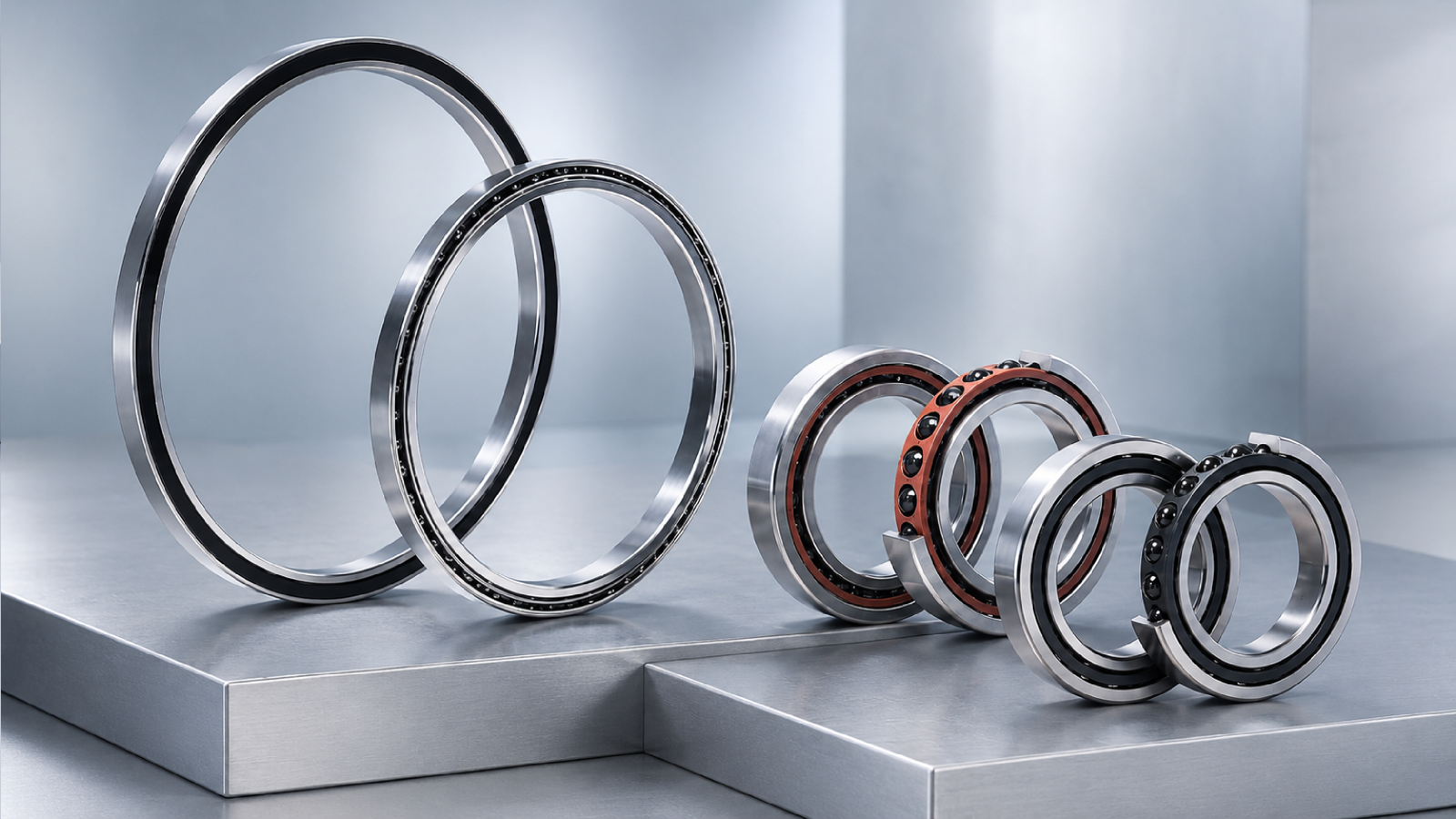
Engineers select an aerospace bearing for a specific load, motion, temperature range and aircraft position. They cannot treat it as a standard industrial bearing with a more demanding label. A suitable design may need to manage high speed, shock, vibration, weight limits, temperature changes or restricted lubrication while maintaining precise motion.
Therefore, the complete designation is only the starting point. Procurement teams should also confirm the bearing structure, material, accuracy, cage, lubrication, traceability and applicable approval requirements. This is especially important when discussing replacement, repair or custom production for a critical aircraft system.
Aircraft use several bearing families because loads and movements vary across engines, transmissions, controls and landing systems. The following categories provide a procurement starting point rather than a direct selection rule.
| Bearing type | Main characteristic | Typical applications |
|---|---|---|
| Aerospace ball bearings | Low friction; radial or combined-load capability depends on design | Turbine accessories, transmissions and control mechanisms |
| Aerospace spherical bearings | Support oscillation, articulation or angular movement | Flight controls, landing gear joints and linkages |
| Cylindrical roller bearings | High radial capacity in a compact section | Engine shafts, transmissions and gear drives |
| Tapered roller bearings | Support combined radial and axial loads | Landing wheels and selected gearbox positions |
| Needle roller bearings | Compact radial section | Actuators, accessories and limited-space mechanisms |
| Thin-section bearings | Large bore with a relatively small cross-section | Gimbals, instruments and weight-sensitive assemblies |
For example, the term aerospace spherical bearings can cover different constructions. Some products are rolling bearings, while others are spherical plain bearings for oscillating or articulating motion. Likewise, aerospace ball bearings may use deep-groove, angular-contact or other precision arrangements. Buyers should identify the exact structure instead of relying on a general product name.
Aerospace operating conditions can change between takeoff, flight, landing and ground operation. Temperature variation can affect internal clearance, lubricant behavior and ring stability. In addition, high speed increases the importance of cage control, heat generation and raceway finish.
Vibration and shock also influence selection. A landing-wheel bearing, an engine-shaft bearing and a flight-control bearing do not experience the same loading pattern. As a result, their materials, internal geometry and inspection requirements may differ even when their basic dimensions appear similar.
A dimensional match alone does not prove application suitability. Before ordering, buyers should review the complete aircraft position and its technical requirements.
Several international manufacturers maintain dedicated aerospace product or service capabilities. This comparison is not a quality ranking; it shows documented technical directions and the checks a buyer should make.
| Manufacturer | Aerospace product focus | Documented technical strength | Buyer verification point |
|---|---|---|---|
| SKF | Aeroengine, gearbox and airframe solutions | Broad coverage of bearings, seals and specialized airframe products | Confirm the exact aircraft position and approved reference |
| Timken | Ball, cylindrical, tapered and hybrid technologies | Products for turbine engines, transmissions and landing wheels | Check product approval, material and full designation |
| Schaeffler | Aircraft-engine bearing systems | Engineering and repair programs for selected engine types | Confirm whether the program covers the engine and bearing position |
| NTN/SNR | Precision aerospace bearings | Application-specific designs, coatings and heat-treatment options | Confirm design, documentation and supply status |
However, brand recognition alone is not enough. Aircraft manufacturers may approve one bearing design for one position while rejecting a visually similar product elsewhere. HSN remains independent of the listed manufacturers and uses brand names only for technical and model-reference discussions.
When sourcing aerospace-related bearings from China, buyers should evaluate the actual manufacturer’s machining, heat-treatment, inspection, traceability, and documentation capabilities rather than relying on country of origin alone. Some suppliers may discuss special bearings from drawings, samples, or defined technical requirements, but manufacturing capability does not by itself establish approval for a flight-critical aerospace position.
Therefore, a buyer should evaluate manufacturing capability through specific evidence rather than a broad country-of-origin claim:
For non-flight-critical mechanisms, test equipment or industrial systems used in aerospace manufacturing, buyers may discuss custom production under their own drawings and acceptance criteria. By contrast, flight-critical products require the applicable approval, validation and traceability process.
Supplier evaluation should begin with the application, not a price comparison. A responsible supplier should identify missing technical information and avoid promising interchangeability from a partial code.
| Designation level | Possible information | Buyer action |
|---|---|---|
| Basic designation | Bearing type, dimensional series and bore reference | Confirm the complete basic number and dimensions |
| Prefix | Component, special construction or manufacturer-specific feature | Read it only under the original manufacturer system |
| Suffix | Cage, clearance, seals, lubricant, material or special specification | Do not omit any suffix when requesting a replacement |
| Drawing or approval reference | Application-specific geometry, revision or acceptance requirement | Confirm the latest revision and required traceability |
Because designation systems vary by manufacturer, buyers should not transfer one brand’s prefix or suffix meaning to another brand. In addition, they should send the complete model, markings, drawings, critical dimensions, aircraft position, operating data, quantity and document requirements.
HSN can support bearing model review, sourcing communication, drawing-based customization discussions, and agreed pre-shipment inspection for suitable projects. These checks may include dimensions, hardness, clearance, and other specified items, but they do not replace aviation certification, approved validation procedures, or an aircraft manufacturer’s approval process.
Are all aerospace bearings specially designed?
Many use application-specific materials or geometry. The exact design depends on the aircraft position and approval requirements.
Can aerospace bearings be selected by size alone?
No. Buyers must also confirm load, speed, temperature, accuracy, lubricant, cage, material and traceability.
Can a Chinese bearing replace an aerospace brand?
Only after technical review and all required approval, testing and traceability requirements have been satisfied.
What information should buyers send first?
Send the complete model, markings, drawings, dimensions, application, quantity and document requirements.
For detailed aerospace bearing models not listed above, please contact HSN for model confirmation and supply discussion. Send the complete model, photos, dimensions, quantity, application and working conditions.
This article is based on independent analysis for knowledge sharing. All brand names and trademarks belong to their respective owners. HSN Bearing Group is an independent bearing supplier and technical service provider.
Tel: +86 156 6578 7336 Email: service@hsnindustrial.com Website: www.rollingparts.com www.hsnbearings.com