
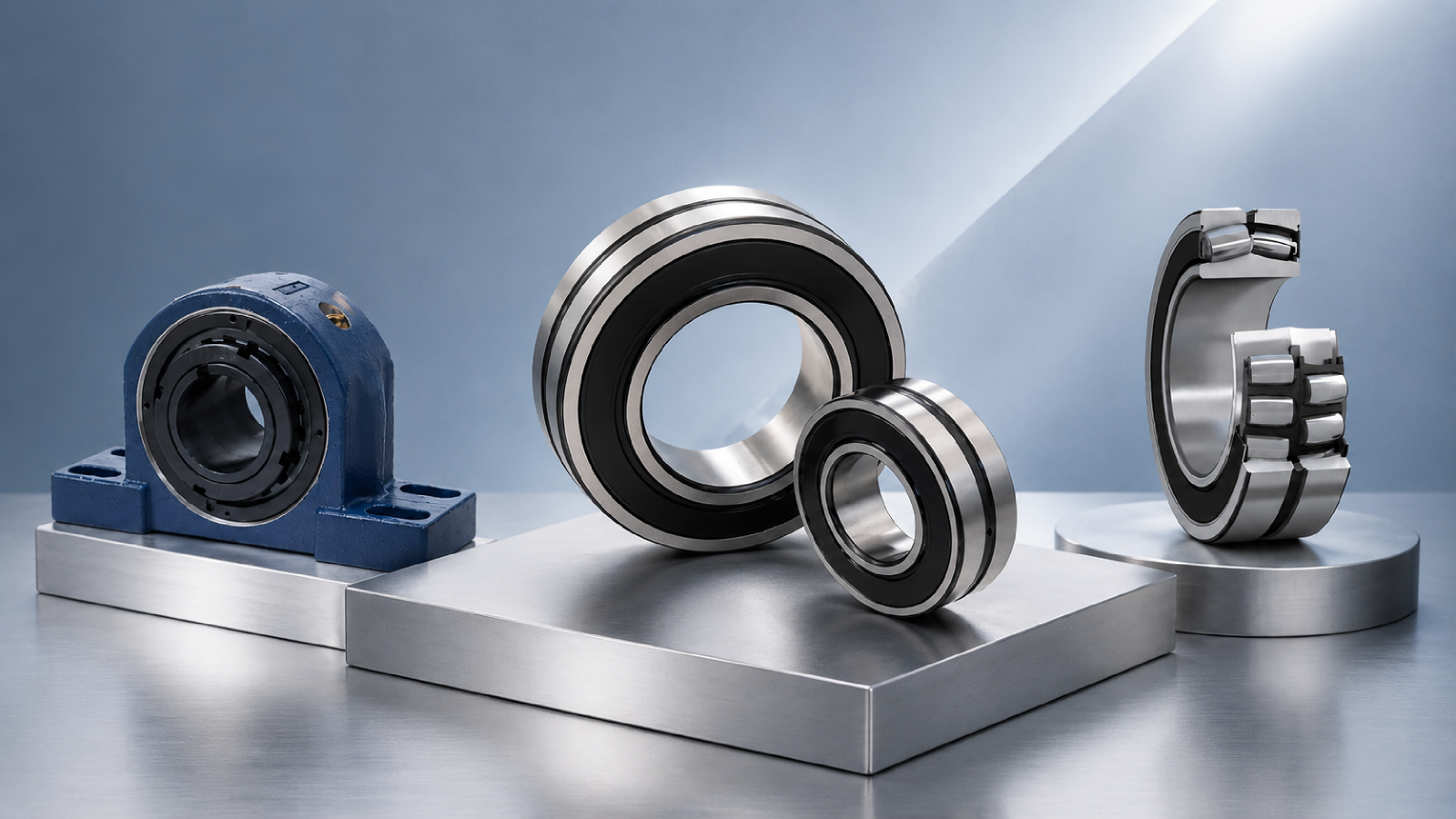
Conveyor roller bearings support rotating components that move bulk material between mining, crushing, screening, storage and loading stages. However, the term can refer to two different positions: bearings inside carrying or return idler rollers, and bearings supporting head, tail, bend or take-up pulleys.
These positions require different structures. Idler rollers commonly use sealed deep-groove ball bearings or purpose-designed idler bearings. By contrast, pulley shafts often use spherical roller bearings with housings, seals and locating or non-locating arrangements. Buyers should identify the exact position before comparing models.
For a wider comparison of bearing types, equipment positions, brand references and supplier checks, see the Mining Equipment Bearings and Supplier Guide.
Mining conveyors move ore, aggregate, overburden and processed material across plant sections or long overland routes. A stoppage at one critical pulley or roller can interrupt several upstream and downstream processes.
Therefore, buyers should record whether a bearing comes from an idler, pulley, motor or gearbox. That position determines which parameters matter most during replacement.
Mining conveyors may operate in hot, cold, wet, dry or dusty locations. Fine particles can pass through an unsuitable seal and contaminate the lubricant. In addition, water and washdown can reduce lubricant effectiveness or promote corrosion.
| Operating condition | Possible effect | Selection or inspection direction |
|---|---|---|
| Abrasive dust | Raceway indentation and lubricant contamination | Seal system, housing condition and grease cleanliness |
| Moisture or washdown | Corrosion and lubricant degradation | Seal compatibility and corrosion protection |
| Heavy belt tension | High radial load and ring stress | Load rating, shaft fit and housing strength |
| Material impact | Shock and vibration | Bearing type, cage and mounting stability |
| Shaft deflection | Edge loading or misalignment | Self-aligning capability and arrangement |
| Continuous operation | Heat and lubricant deterioration | Speed, grease life and relubrication interval |
A larger bearing alone does not solve contamination. Instead, the seal, housing surface, grease path and maintenance practice must work together.
First, buyers should separate idler requirements from pulley requirements. Idler bearings need low drag, effective integral sealing, suitable shaft fit and resistance to dust or moisture. Their dimensions must also match the roller tube, shaft and end-cap arrangement.
Pulley bearings require a broader system check. Buyers should determine bearing loads from belt tensions, pulley mass, transmitted forces, and the complete conveyor operating condition. They should also identify axial forces caused by tracking, drive arrangements, or other machine effects. Spherical roller bearings are common where heavy radial load and misalignment exist, but load calculations and machine design govern the final choice.
An interference fit can reduce the remaining radial internal clearance after mounting. Therefore, for bearings with a specified clearance class, buyers should not change a C3, C4, normal, or other manufacturer-specified clearance without reviewing the shaft and housing fits, mounting method, and operating temperature. They should also measure worn pulley shafts and housing bores before installing a new bearing.
The full designation may specify a cage, internal design, seal or lubrication feature. For pulley positions, an open bearing may operate inside a protected housing with multi-stage external seals. For idlers, the integral bearing and end-seal arrangement often controls contamination and running resistance. In both cases, use the specified lubricant type and quantity. Too little lubricant can cause lubricant starvation, increased friction, and premature wear, while excessive grease can increase churning losses and operating temperature.
Maintenance teams should inspect a failed bearing before ordering its replacement. Otherwise, the same operating cause may damage the new product.
| Failure sign | Possible cause | Recommended action |
|---|---|---|
| Overheating | Incorrect lubrication, excessive load or insufficient clearance | Check grease, load, fits and mounted clearance |
| Grinding noise | Contamination or internal surface damage | Inspect seals, lubricant and raceways |
| Repeated seal failure | Shaft wear, misalignment or excessive movement | Measure the shaft and review the seal arrangement |
| Raceway indentation | Hard particles or installation impact | Improve cleanliness and mounting practices |
| Ring creep | Incorrect shaft or housing fit | Measure tolerances and restore worn surfaces |
| Uneven wear | Misalignment, shaft deflection or housing distortion | Check alignment, support and housing installation |
| Early fatigue | Overload, contamination or unsuitable selection | Review load calculations and application conditions |
However, visible damage does not always identify one root cause. Temperature history, vibration data, grease condition and mounting records can help separate lubrication, contamination and alignment problems.
Before requesting a replacement, identify whether the product comes from an idler or a pulley. Then provide the information that matches that position.
| Replacement area | Information to provide | Why it matters |
|---|---|---|
| Idler roller bearing | Complete code, roller tube, shaft, end-cap, seal, speed and environment | Confirms dimensions, drag, fit and contamination protection |
| Pulley bearing | Complete code, shaft, housing, pulley position, load, speed, seal and lubrication | Confirms bearing arrangement and system compatibility |
| Drive bearing | Motor or gearbox position, full model, load direction, speed and lubricant | Prevents the drive position from being treated as an idler or pulley |
For pulley positions, buyers should also confirm the locating or non-locating function, bearing bore type, and whether the arrangement uses an adapter sleeve or another shaft-locking method. Available installation and removal space should also be recorded. For idlers, they should inspect the roller shell, shaft and sealing parts rather than focusing only on the bearing boundary dimensions.
HSN can review brand references, dimensions, photographs, and operating information. For suitable orders, HSN can discuss stock supply, replacement after technical confirmation, or drawing-based customization. Agreed pre-shipment checks can cover dimensions, hardness, clearance, visible condition, and other specified inspection items.
Which bearings are used inside conveyor idlers?
Sealed deep-groove ball bearings or special idler bearings are common, depending on the roller and environment.
Which bearings are common on conveyor pulleys?
Spherical roller bearings are common, but load, alignment, housing and seal conditions determine the final choice.
What should buyers check for replacements?
Confirm the model, dimensions, load, speed, lubrication, and whether the original equipment uses inch or metric sizes.
How does HSN control conveyor bearing quality?
HSN can arrange agreed dimensional, clearance, material, and appearance checks before shipment.
For detailed conveyor roller bearing models not listed above, please contact HSN for model confirmation and supply discussion. Send the complete model, photos, dimensions, quantity, application and working conditions.
This article is based on independent analysis for knowledge sharing. All brand names and trademarks belong to their respective owners. HSN Bearing Group is an independent bearing supplier and technical service provider.
Tel: +86 156 6578 7336 Email: service@hsnindustrial.com Website: www.rollingparts.com www.hsnbearings.com