
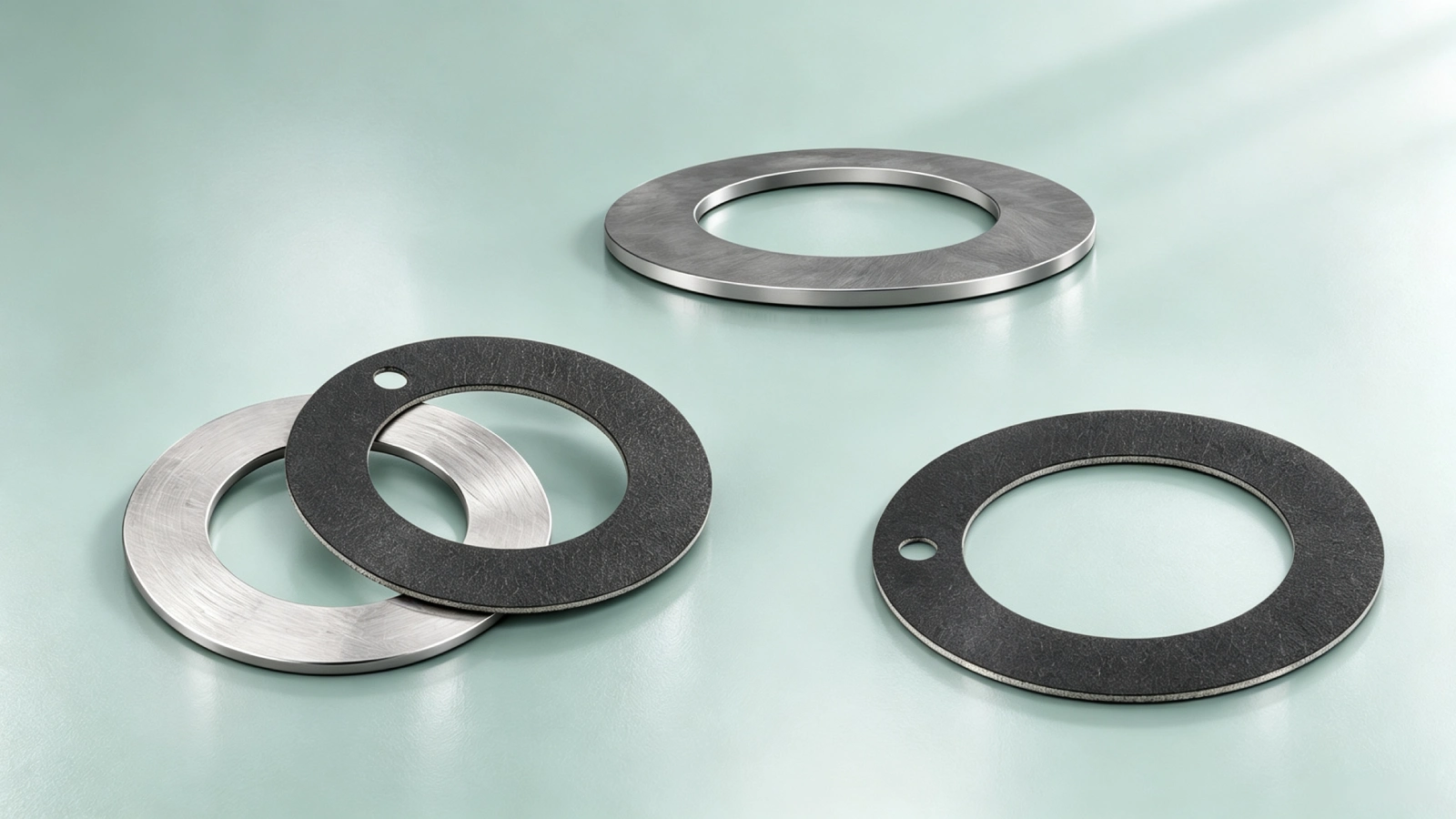
A thrust washer provides a compact, low-profile sliding surface that supports axial loads during rotation or oscillation. Unlike rolling thrust bearings, thrust washers use sliding contact without balls or rollers. They are commonly used in gearboxes, pumps, automotive assemblies, and industrial machinery where installation space is limited.
Selecting the right thrust washer requires more than matching its dimensions. Buyers should consider material, axial load, sliding speed, counterface condition, and lubrication requirements. They should also confirm the mounting arrangement and operating environment to ensure the selected washer meets the application’s performance and service-life requirements.
SKF composite thrust washers use a steel backing, a porous bronze intermediate layer, and a sliding layer. The backing gives mechanical support. Meanwhile, the sliding layer controls friction and wear against the mating thrust surface.
SKF PCMW … E washers use a PTFE composite sliding layer. They support rotating or oscillating movement and operate without relubrication in suitable conditions. SKF PCMW … M washers use a POM composite layer with lubricant-retaining pockets. They require initial lubrication and suit low-maintenance operation where occasional lubrication is possible.
A thrust bearing washer in a rolling-bearing assembly serves as a raceway. By contrast, a composite washer works as a plain sliding element. The phrase thrust washer bearing can describe the complete sliding arrangement, but buyers should state whether they need a composite plain washer or a rolling-bearing washer.
Thrust washers are commonly used in industrial machinery, agricultural equipment, construction machinery, material handling, and hydraulic systems. Typical applications include pivots, articulated joints, valve mechanisms, actuators, gear assemblies, and other compact mechanisms that require axial load support within limited installation space.
In these applications, thrust washers provide a sliding surface between moving components and support axial loads during rotation or oscillation. A separate journal bearing or bushing typically handles radial loads. Buyers should consider axial load, sliding speed, movement frequency, lubrication, and contamination when selecting the appropriate washer material and design.
Reliable operation also depends on the mating surface and mounting arrangement. The counterface needs suitable hardness, surface finish, and alignment, while the supporting surface must remain flat and rigid. Some designs also require an anti-rotation pin to prevent washer movement during operation.
First, confirm inside diameter, outside diameter, thickness, material suffix, and location-hole details. Then compare the permissible pressure and sliding-speed guidance for the exact material. Pressure and speed interact, so neither value should be considered alone.
Next, check whether the application allows dry operation or needs initial and periodic lubrication. PTFE composite and POM composite products have different lubrication behavior. Therefore, replacing an E suffix with an M suffix changes more than the surface color.
Finally, review operating temperature, lubricant compatibility, corrosion protection, housing support, and counterface specification. Keep the complete model on purchase documents. Similar dimensions do not establish material or performance equivalence.
SKF PCMW composite thrust washers are available in two principal material families. The E execution uses a PTFE composite sliding layer, while the M execution uses a POM composite sliding layer. The following table lists five complete size variants from these two families.
| Series or size variant | Material configuration | Complete model example |
| PCMW .. E, 10 × 20 × 1.5 mm | PTFE composite thrust washer | PCMW 102001.5 E |
| PCMW .. E, 14 × 26 × 1.5 mm | PTFE composite thrust washer | PCMW 142601.5 E |
| PCMW .. E, 18 × 32 × 1.5 mm | PTFE composite thrust washer | PCMW 183201.5 E |
| PCMW .. M, 20 × 36 × 1.5 mm | POM composite thrust washer | PCMW 203601.5 M |
| PCMW .. M, 52 × 78 × 2 mm | POM composite thrust washer | PCMW 527802 M |
In each complete model, the numerical section identifies the nominal inside diameter, outside diameter, and thickness. The final letter identifies the sliding-material system. Consequently, buyers must not omit the E or M suffix. Selection should also consider pressure, sliding speed, motion type, temperature, lubrication regime, counterface material, surface finish, and available axial space.
SKF model PCMW 142601.5 E shows how type, dimensions, and material appear in one designation.
| Code | Code section | Meaning |
| PCMW | Product prefix | Plain bearing, composite, metric thrust washer |
| 14 | Bore section | 14 mm nominal inside diameter |
| 26 | Outside diameter | 26 mm nominal outside diameter |
| 01.5 | Thickness section | 1.5 mm nominal washer thickness |
| E | Material suffix | PTFE composite sliding material |
Model PCMW 142601.5 M uses the same nominal envelope, but the M suffix identifies POM composite material. Consequently, procurement records must retain the final letter.
Clean and deburr the shaft shoulder, supporting face, and mating thrust surface. Mount the steel-backed side against the supporting surface and the sliding layer toward the moving counterface. If a retaining pin is used, keep it below the sliding surface so it cannot score the mating part.
Apply the lubricant required for the selected material and application. Then confirm washer seating, counterface alignment, axial clearance, and unrestricted movement. Do not hammer the sliding layer or bend the washer during assembly.
During removal, lift the washer without gouging the support. Inspect the sliding layer, backing, counterface, location hole, and lubricant distribution. Uneven polishing, edge wear, delamination, overheating, or scoring can indicate misalignment, excessive pressure, poor finish, or inadequate lubrication.
HSN can review the complete SKF code, inside diameter, outside diameter, thickness, sliding material, pressure, motion, speed, temperature, lubricant, counterface, support face, quantity, and application before sourcing begins. Photos and measured dimensions can support an initial review when markings are incomplete, but the material suffix and approved drawing still need confirmation.
Agreed checks can cover designation, dimensions, location-hole position, backing condition, sliding-layer appearance, flatness, packaging, and traceability. HSN can arrange further material or dimensional verification when the purchase specification defines the test method and acceptance limits. Before discussing an alternative, HSN compares material system, envelope, counterface requirements, lubrication regime, and operating limits rather than matching only diameter and thickness.
Is a thrust washer a rolling bearing?
No. A composite thrust washer is a plain sliding element without balls or rollers.
Can PCMW E and M use the same lubrication plan?
Not automatically. PTFE and POM composite materials have different lubrication requirements and operating guidance.
What does the E suffix mean on SKF PCMW?
It identifies SKF PTFE composite sliding material in the PCMW thrust-washer designation.
What information should buyers send?
Send the full code, dimensions, load, motion, speed, counterface, lubricant, quantity, and operating conditions.
For detailed thrust washer models not listed above, or for other bearing types, contact HSN with the reference, photos or drawing, dimensions, quantity, application, and working conditions.
This article is based on independent analysis of publicly available technical information and industry understanding for knowledge sharing. All brand names and trademarks belong to their respective owners. HSN Bearing Group is an independent bearing supplier and technical service provider.
Tel: +86 156 6578 7336 Email: service@hsnindustrial.com Website: www.rollingparts.com www.hsnbearings.com