
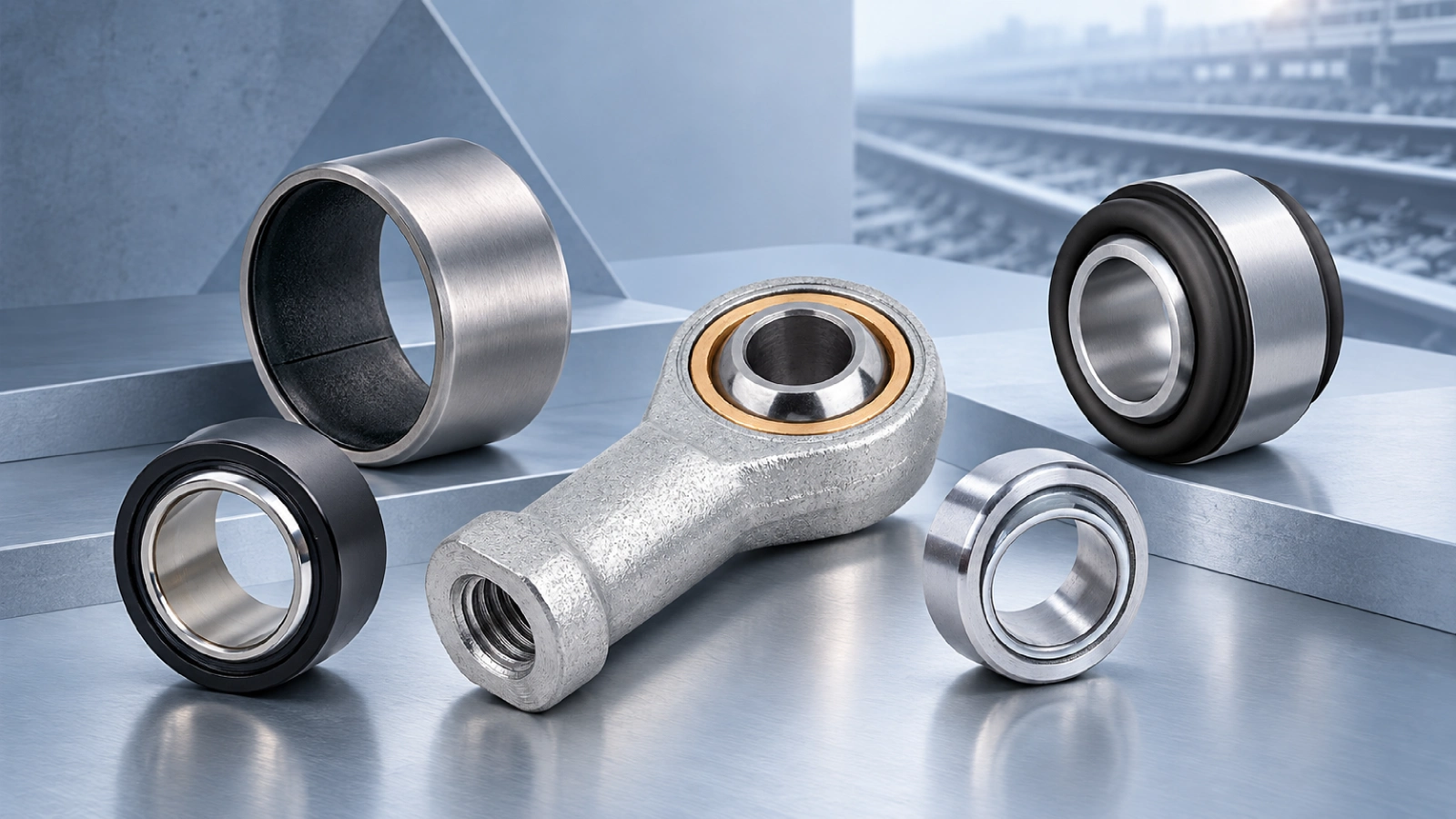
The railway sliding bearing market includes spherical plain bearings, cylindrical bushings, flanged bushings, thrust washers, and other low-friction components. These products support oscillating, pivoting, or limited sliding motion in railway vehicles and related equipment.
However, similar dimensions do not confirm that two bearings can operate under the same conditions. Buyers must compare the application position, load direction, sliding material, lubrication method, temperature range, and complete designation before selecting a brand or model.
Railway sliding bearings are commonly used at joints where motion is slow, oscillating, intermittent, or affected by misalignment. They can support high loads within a compact installation space while reducing friction between connected components.
Typical application positions include:
The bearing design must match the motion at each position. For example, a traction linkage may need a spherical plain bearing that accommodates angular movement. In contrast, a door mechanism may use a cylindrical bushing for repeated low-load sliding motion.
Buyers should not treat these products as wheelset bearings. Railway wheelsets and traction motors commonly use rolling bearings with different structures, speeds, and qualification requirements.

Railway equipment experiences repeated starting, braking, vibration, impact, and load reversal. These conditions can increase contact pressure and cause wear at sliding surfaces, especially when the bearing moves through only a small oscillation angle.
Dust, water, salt, cleaning chemicals, and temperature changes can also affect the bearing. Contamination may enter an unsealed joint, while corrosion can damage the shaft, inner ring, or housing. Meanwhile, insufficient lubrication can increase friction and accelerate surface wear in steel-on-steel designs.
Misalignment is another important factor. Spherical plain bearings can accommodate angular movement, but the permitted angle depends on the bearing design and surrounding components. Excessive housing deformation or shaft deflection may still create edge loading.
Therefore, buyers should define normal and peak loads, motion frequency, oscillation angle, temperature, contamination, and maintenance access before comparing railway bearing models.
The correct type depends on the load, motion, available space, expected service life, and maintenance plan.
| Bearing type | Typical materials | Main selection considerations |
| Steel-on-steel spherical plain bearing | Hardened steel rings | High loads, shock resistance, lubrication, and sealing |
| Maintenance-free spherical plain bearing | Steel with PTFE-based sliding layer | Low friction, limited maintenance access, permitted load, and temperature |
| Wrapped metal-polymer bushing | Steel backing with bronze and polymer layer | Compact installation, low friction, shaft finish, and running clearance |
| Bronze or bimetal bushing | Bronze or steel-backed bearing alloy | High load capacity, lubrication, wear allowance, and corrosion |
| Composite or engineered-polymer bushing | Fiber-reinforced composite or polymer | Corrosion resistance, low weight, temperature, and dimensional stability |
| Thrust washer or sliding strip | Metal-polymer, bronze, or composite | Axial guidance, surface pressure, and mounting geometry |
A maintenance-free designation does not mean that the entire joint requires no inspection. Buyers must still check contamination, shaft condition, mounting security, wear, and surrounding structural components.
Material descriptions also vary between brands. Therefore, procurement teams should compare the specified sliding contact combination instead of relying only on general terms such as self-lubricating or composite.
Start with the complete dimensions: bore diameter, outside diameter, inner-ring width, outer-ring width, and any flange or seal dimensions. The shaft and housing fits must also match the manufacturer’s recommendations.
Next, confirm the operating parameters:
Load rating alone is not enough. A bearing with sufficient static capacity may still experience premature wear if the shaft surface, lubrication, or oscillating motion does not suit the sliding material.
For replacement orders, buyers should also measure the installed component. A shortened marking or basic series number may not identify the seal arrangement, clearance, lubrication features, or sliding contact material.
Begin with the manufacturer’s current catalog or official product database. Compare complete designations rather than matching only the bore and outside diameter.
Representative examples include SKF GE 20 ES-2LS, a sealed radial spherical plain bearing requiring maintenance, and Schaeffler GE20-DO-2TS, a maintenance-required steel-on-steel spherical plain bearing. GGB also offers metal-polymer, bimetal, engineered-plastic, and fiber-reinforced composite bearing families.
These examples illustrate different naming systems; they do not establish interchangeability or confirm suitability for a railway position.
| Comparison item | Why buyers should verify it |
|---|---|
| Complete brand and designation | Suffixes can identify seals, materials, clearance, or design generation |
| Dimensions and tolerances | Similar basic codes may have different widths or mounting requirements |
| Sliding contact material | Determines lubrication, friction, wear, and temperature limits |
| Load and motion data | Ratings may use different calculation conditions |
| Railway approval or project specification | A standard industrial bearing may not meet a railway project requirement |
| Product availability | A current series may replace an older series without being dimensionally identical |
| Inspection documentation | Certificates and reports must match the purchase specification |
Avoid converting suffixes directly between manufacturers. For example, seal and material codes used by SKF do not necessarily have the same meaning in a Schaeffler or GGB designation. Any proposed replacement requires a technical comparison of dimensions, loads, materials, movement, and operating environment.
A clear inquiry should include the manufacturer, complete model, quantity, application position, equipment type, and operating conditions. Photos of the marking and installed position can help when the designation is incomplete.
For replacement or custom requirements, provide:
HSN can review the submitted model, dimensions, sliding material, seals, and working conditions before preparing a quotation. Agreed inspections can cover dimensions, surface condition, material or hardness verification, clearance, marking, and packaging. However, any railway certification or project-specific approval must be confirmed separately.
Are sliding bearings used as railway wheel bearings?
No. Modern wheelsets normally use rolling bearings; sliding bearings are more common in bogie joints, brakes, couplings, and pivots.
Can similar models from two brands be interchanged?
Not automatically. Compare dimensions, sliding materials, ratings, seals, lubrication, clearance, and application requirements.
Do maintenance-free bearings require no maintenance?
They may not need relubrication, but the joint still requires checks for wear, contamination, corrosion, and loose mounting.
What information is needed for a quotation?
Send the complete brand and model, quantity, dimensions, photos or drawing, application, loads, motion, temperature, and lubrication.
For detailed railway sliding bearing models not listed above, please contact HSN for model confirmation and supply discussion. For other bearing types, send the complete model, photos, dimensions, quantity, application, and working conditions for review.
This article is based on independent analysis of publicly available technical information and industry understanding and is intended for knowledge sharing. All brand names and trademarks belong to their respective owners. HSN Bearing Group is an independent supplier and technical service provider.
Tel: +86 156 6578 7336 Email: service@hsnindustrial.com Website: www.rollingparts.com www.hsnbearings.com