
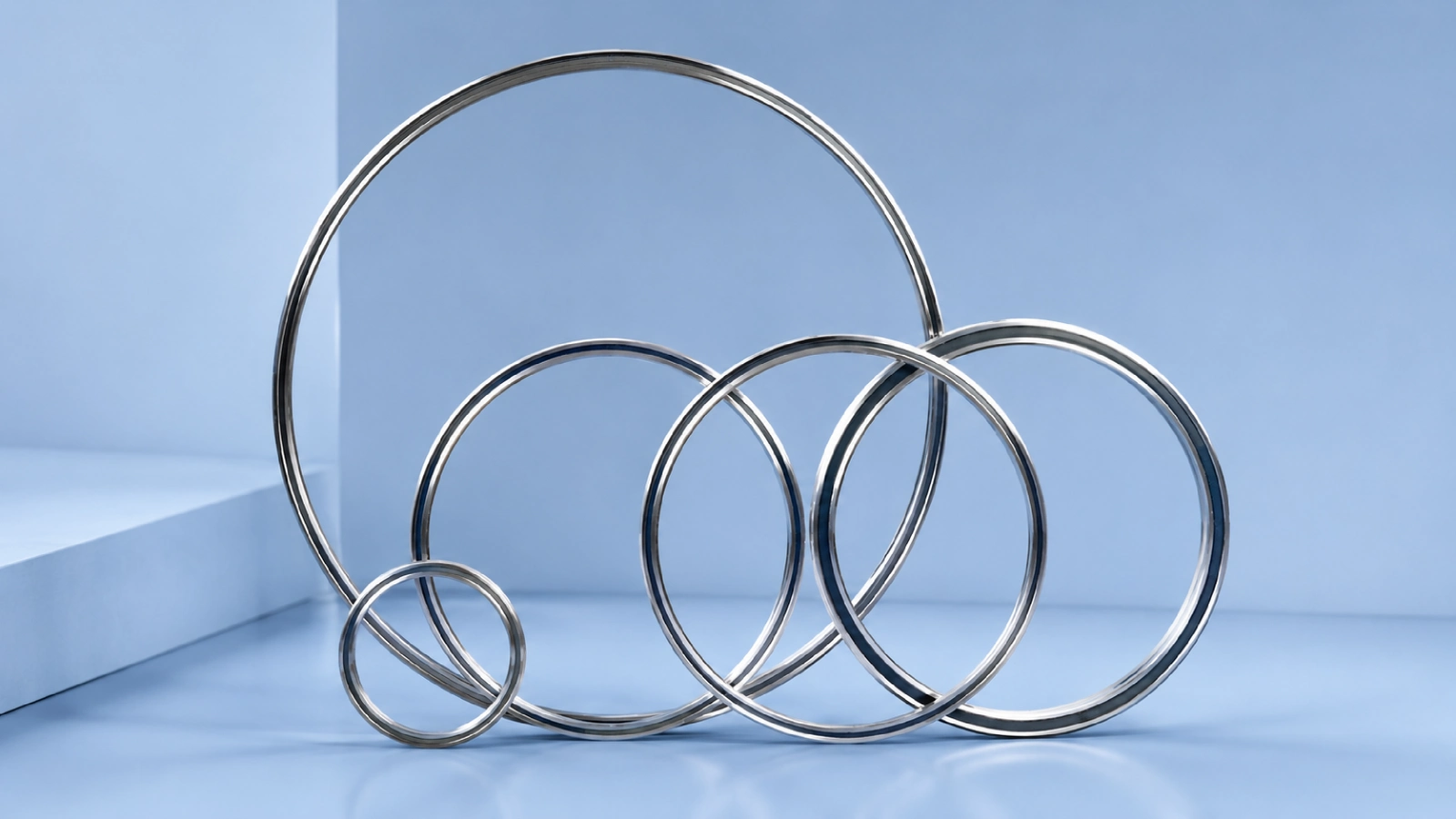
Thin section bearings provide a large bore with a compact radial cross section, helping equipment designers reduce weight and installation space while maintaining controlled rotation. Their flexible rings, however, make bearing type, support rigidity, fits, preload, lubrication, and mounting accuracy especially important. This guide explains the main Kaydon Reali-Slim contact types and series, common application requirements, model-code checks, installation controls, and the technical information buyers should confirm before requesting a quotation.
Each Reali-Slim series uses a constant radial cross section as bore diameter increases. This allows designers to standardize related shaft and housing concepts across several machine sizes without the section growing like a conventional bearing series.
Buyers should first distinguish the three main contact types:
The open range includes KAA, KA, KB, KC, KD, KF, and KG series. The standard sealed range includes JHA, JA, JB, JU, and JG series; stock sealed bearings are generally supplied in Type C and Type X configurations. These bearings are factory greased, with nitrile rubber seals as the standard option. Available executions may include standard bearing steel, stainless steel, or corrosion-resistant coatings. Hybrid or other special constructions require confirmation against the approved specification.
| Series example | Series description | Complete model example |
| KAA | Open, 3/16 × 3/16 in cross section | KAA10CL0 |
| KA | Open, 1/4 × 1/4 in cross section | KA020CP0 |
| KC | Open, 3/8 × 3/8 in cross section | KC040XP0 |
| JA | Double-sealed, 1/4 × 1/4 in cross section | JA020CP0 |
| JG | Double-sealed, 1 × 1 in cross section | JG070CP0 |
Robotics and automation systems use thin section bearings in joints, end effectors, rotary axes, and compact positioning mechanisms. A large hollow bore can provide space for cables, air lines, or optical paths, while low mass and controlled torque support fast, repeatable movement. Buyers should check stiffness, moment load, positioning accuracy, oscillation, and running torque rather than selecting by bore alone.
Semiconductor, medical, and optical equipment often places greater emphasis on smooth rotation, low particle generation, low noise, and precise runout. Wafer handling systems, inspection stages, imaging devices, scanners, and camera mounts may also need special lubrication, corrosion resistance, or controlled preload. For vacuum or clean environments, lubricant and separator compatibility must be confirmed for the exact operating conditions.
Aerospace mechanisms, radar and antenna systems, packaging machines, rotary tables, and other lightweight industrial equipment use these bearings where installation space is restricted. In these applications, temperature variation, vibration, duty cycle, contamination, speed, and mounting orientation can affect performance. The surrounding structure is equally important because flexible thin rings follow shaft or housing distortion more readily than heavy-section rings.
Before ordering, confirm the complete model, dimensional series, bore, outside diameter, width, contact type, material, separator, precision, and internal clearance or preload. Then compare radial, axial, and moment loads, required life, speed, lubricant, seal material, temperature, and environmental exposure with the data for the exact bearing execution.
The mounting design can change the operating condition of a thin section bearing. Define shaft and housing tolerances, roundness, shoulder geometry, fillet radii, support stiffness, and clamping method. Excessive interference, uneven fastener loads, or flexible supports can distort the races, remove clearance, increase torque, or create uneven preload.
Arrangement choice must follow the load case. Use a Type C bearing mainly for radial loading, an opposed Type A pair when thrust capacity and directional control are important, or one Type X bearing when radial, axial, and moment loads must be supported in a compact envelope. Kaydon does not recommend two Type X bearings on a common shaft because the arrangement can create objectionable friction torque.
The complete designation identifies more than bore size. Model KA020CP0, for example, is an open Type C radial-contact bearing with a nominal 2-inch bore. The following table provides a practical reading of the code; buyers should still confirm current manufacturer data and the approved drawing before ordering.
| Code | Code section | Meaning |
| K | Material and family | AISI 52100 steel rings and balls, open Reali-Slim execution |
| A | Series | 1/4 x 1/4 inch standard cross section |
| 020 | Size | Nominal 2.0 inch bore, expressed as bore x 10 |
| C | Bearing type | Type C radial-contact bearing |
| P | Cage code | One-piece, snap-type, stamped brass or non-metallic composite cage |
| 0 | Tolerances | Tolerance to Kaydon class 1 (ABEC 1F) |
Additional designation positions may identify a specified internal clearance or preload. Material, sealing, separator, precision, clearance, and preload options can also change the code. Keep every character from the bearing marking and compare it with the latest designation table rather than ordering from a shortened reference.
At incoming inspection, check the complete code, quantity, packaging, corrosion protection, visible damage, separator, seals, and traceability. Measure the agreed bore, outside diameter, width, runout, and specified clearance or preload with a method suitable for flexible thin rings. The inspection plan should define support conditions and measuring force because free-state readings can change after clamping.
Before installation, verify shaft and housing roundness and clean every mating surface. Support the bearing uniformly, and apply mounting force only through the ring being fitted. Do not transmit force through the balls. Use evenly spaced fasteners and a controlled tightening sequence so the housing does not distort the races. For a Type A pair, preserve the approved orientation, spacer arrangement, and preload method.
After mounting, check running torque, axial and radial movement, runout, seal contact, and smooth rotation before applying full speed. When torque or preload is critical, record the assembly method and acceptance range. During removal, release clamps gradually, support the ring around its circumference, and avoid prying at one point. Inspect the raceways, balls, separator, lubricant, fits, and support geometry before approving reuse or replacement.
HSN can review the complete bearing code, cross-section series, bore, contact type, material, separator, precision, internal fit, load, stiffness, speed, lubricant, seals, quantity, and application before sourcing begins. When an installed bearing has incomplete markings, photos and careful measurements can support an initial series review, but the final choice still requires the approved drawing.
Agreed checks can cover markings, dimensions, runout, internal fit, separator and seal condition, visible surface quality, hardness, and packaging. HSN can arrange material, torque, or other verification when specified. Before discussing an alternative, HSN compares the complete envelope, contact type, load data, precision, support rigidity, suffixes, and acceptance criteria rather than matching only bore and width.
Can one Type X bearing carry all load types?
Yes. It can carry radial, axial, and moment loads, but the combined load case and support rigidity still require analysis.
Can two Type X bearings share one shaft?
Kaydon does not recommend this arrangement because it can produce objectionable friction torque.
Does a larger bore change the series cross section?
No. Within one Reali-Slim series, the standard radial cross section remains constant as bore increases.
What information should buyers send?
Send the complete code, drawing, loads, speed, fits, precision, lubricant, quantity, application, and working conditions.
For detailed thin section bearing models not listed above, or for other bearing types, contact HSN with the reference, photos or drawing, dimensions, quantity, application, and working conditions.
This article is based on independent analysis of publicly available technical information and industry understanding for knowledge sharing. All brand names and trademarks belong to their respective owners. HSN Bearing Group is an independent bearing supplier and technical service provider.
Tel: +86 156 6578 7336 Email: service@hsnindustrial.com Website: www.rollingparts.com www.hsnbearings.com