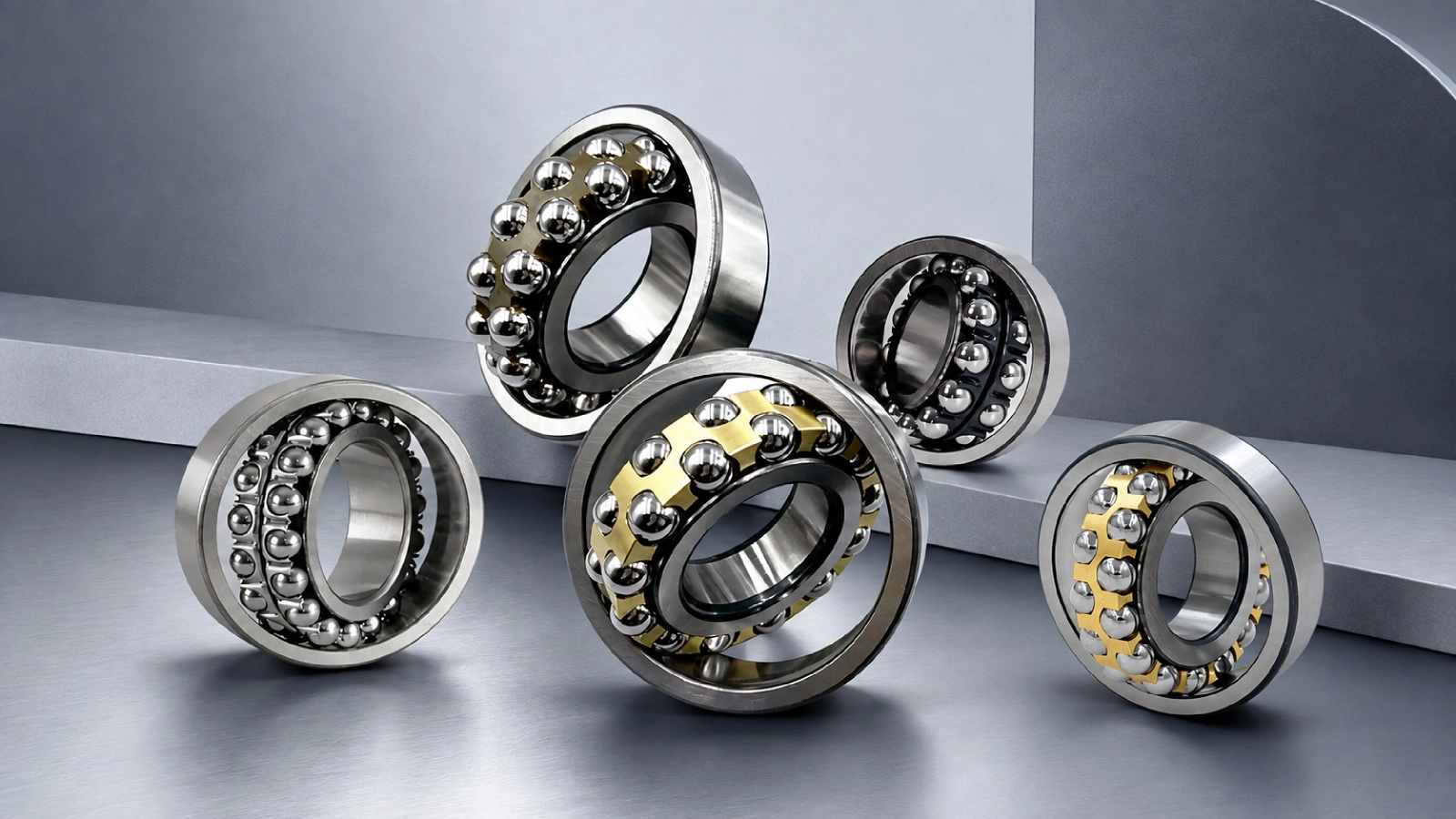
A spherical ball bearing is more commonly called a self-aligning ball bearing in international product literature. It has two rows of balls and a spherical outer-ring raceway, allowing the inner assembly to align itself within defined limits. Buyers should use the complete model because a cylindrical bore, tapered bore, cage execution, seal, or clearance suffix changes the ordered product.
Do not confuse this product with a spherical roller bearing or a spherical plain bearing. Engineers generally select Self-Aligning Ball Bearings for lighter radial loads and higher-speed operation when the arrangement must accommodate shaft or housing misalignment.
The inner ring has two ball raceways, while the outer ring provides one common spherical raceway. The balls, cage, and inner ring can shift relative to the outer ring to accommodate a defined amount of misalignment caused by shaft deflection, housing inaccuracy, or fitting error.
Spherical ball bearings have limited axial load-carrying capacity. Therefore, engineers should choose another design when the position carries significant thrust force. Surrounding components, seals, and operating load can also reduce the permissible misalignment.
Series and bore style are the most useful starting points. The 12 and 13 series are familiar basic families, while the 22 and 23 series offer wider cross-sections. Exact availability and cage design depend on brand and size.
| Configuration | Main feature | Ordering check |
| 12 and 13 series | Standard self-aligning ball bearing families | Dimensions, rating, cage, and speed |
| 22 and 23 series | Wider series for a given bore range | Width, load rating, and housing space |
| Cylindrical bore | Direct shaft-seat mounting | Shaft fit and final operating clearance |
| Tapered bore | Mounting on a tapered shaft or adapter sleeve | Taper ratio, sleeve, drive-up, and clearance |
For sealed variants, confirm the exact seal code, lubricant, temperature, and speed.
Self-aligning ball bearings are commonly used in material handling, textile production, agriculture, ventilation systems, and general industrial machinery. Typical equipment includes conveyors, fans, textile machines, agricultural equipment, line shafts, and light-duty industrial drives. Their self-aligning design makes them useful where shaft deflection or mounting inaccuracy may cause moderate misalignment between the shaft and housing.
For each application, buyers should review load, speed, shaft deflection, mounting span, temperature, contamination, lubrication, and duty cycle. Where shock loads, high radial loads, or significant axial forces dominate, engineers should compare other bearing types before making the final selection.
Start with bore, outside diameter, and width. Then compare load ratings, speed, minimum load guidance, and misalignment limits. A self aligning bearing cannot correct a loose shaft seat, distorted housing, damaged shoulder, or excessive deflection.
Fit and temperature affect operating clearance. A tight shaft fit or temperature difference between rings can reduce it. For tapered-bore models, drive-up also reduces clearance, so the mounting method and residual clearance must follow the manufacturer’s guidance.
These complete international model examples retain brand-specific cage and bore suffixes.
| Brand | Series examples | Complete model example |
| NTN | 12, 13, 22, and 23 series; S cylindrical bore and SK tapered-bore references | 1205SK |
| SKF | 12, 13, 22, and 23 series; ETN9 and EKTN9 executions | 1205 ETN9 |
| NSK | 12, 13, 22, and 23 series; cylindrical and K tapered-bore variants | 1205K |
Do not treat these examples as automatic equivalents. Compare dimensions, ratings, speed, cage, taper, clearance, tolerance, lubrication, and installation requirements before approving a change of brand or execution.
NTN model 1205SK shows the series, bore code, NTN designation element, and tapered-bore suffix.
| Code | Code section | Meaning |
| 12 | Series section | Self-aligning ball bearing series 12 |
| 05 | Bore section | Bore code corresponding to a 25 mm nominal bore |
| S | NTN designation element | Product-series marker retained in this NTN reference |
| K | Bore suffix | Tapered bore with a 1:12 taper ratio |
For comparison, NTN lists 1205S as the cylindrical-bore execution. Preserve the complete marking because omitting K changes the mounting arrangement and can require a different shaft seat or adapter sleeve.
Keep the bearing and mounting surfaces clean. Apply force only to the ring with the interference fit, and never transmit mounting force through the balls. A tapered-bore bearing should be driven to the approved position while monitoring the specified mounting criterion; excessive drive-up can remove necessary internal clearance.
NTN recommends an adapter for tapered-bore self-aligning ball bearings where easier installation and removal are required. Confirm the adapter, nut, and locking device as part of the assembly. After mounting, check rotation, axial location, clearance, lubricant, and interference with surrounding components.
For a bearing inquiry, HSN reviews the complete model, brand, dimensions, photos or drawing, quantity, load, speed, fit, clearance, bore type, adapter, lubrication, application, and working conditions. HSN confirms availability for each exact reference. If an older model is difficult to source, HSN discusses a replacement or customized option only after technical comparison.
Before shipment, HSN focuses on dimensional tolerances, hardness, and clearance. According to the order requirements, the inspection plan can also include rotation accuracy, vibration, noise, material verification, or flaw detection. Every brand alternative requires confirmation of the critical parameters rather than comparison of the basic number alone.
Is this the same as a spherical roller bearing?
No. The self-aligning ball design uses balls and generally serves lighter-load, higher-speed positions than a spherical roller bearing.
What does K mean in 1205SK?
K identifies a tapered bore with a 1:12 taper ratio in this NTN model.
Can this bearing carry heavy axial load?
No. Its axial capacity is limited; check another bearing type when thrust load is significant.
What should a buyer provide for confirmation?
Send the complete model, dimensions, photos or drawing, quantity, load, speed, bore type, adapter, clearance, and working conditions.
For detailed spherical ball bearing models beyond those listed above, or for other bearing types, contact HSN with the complete reference and technical requirements.
This article is based on independent analysis of publicly available technical information and industry understanding for knowledge sharing. All brand names and trademarks belong to their respective owners. HSN Bearing Group is an independent bearing supplier and technical service provider.
Tel: +86 156 6578 7336 Email: service@hsnindustrial.com Website: www.rollingparts.com www.hsnbearings.com