
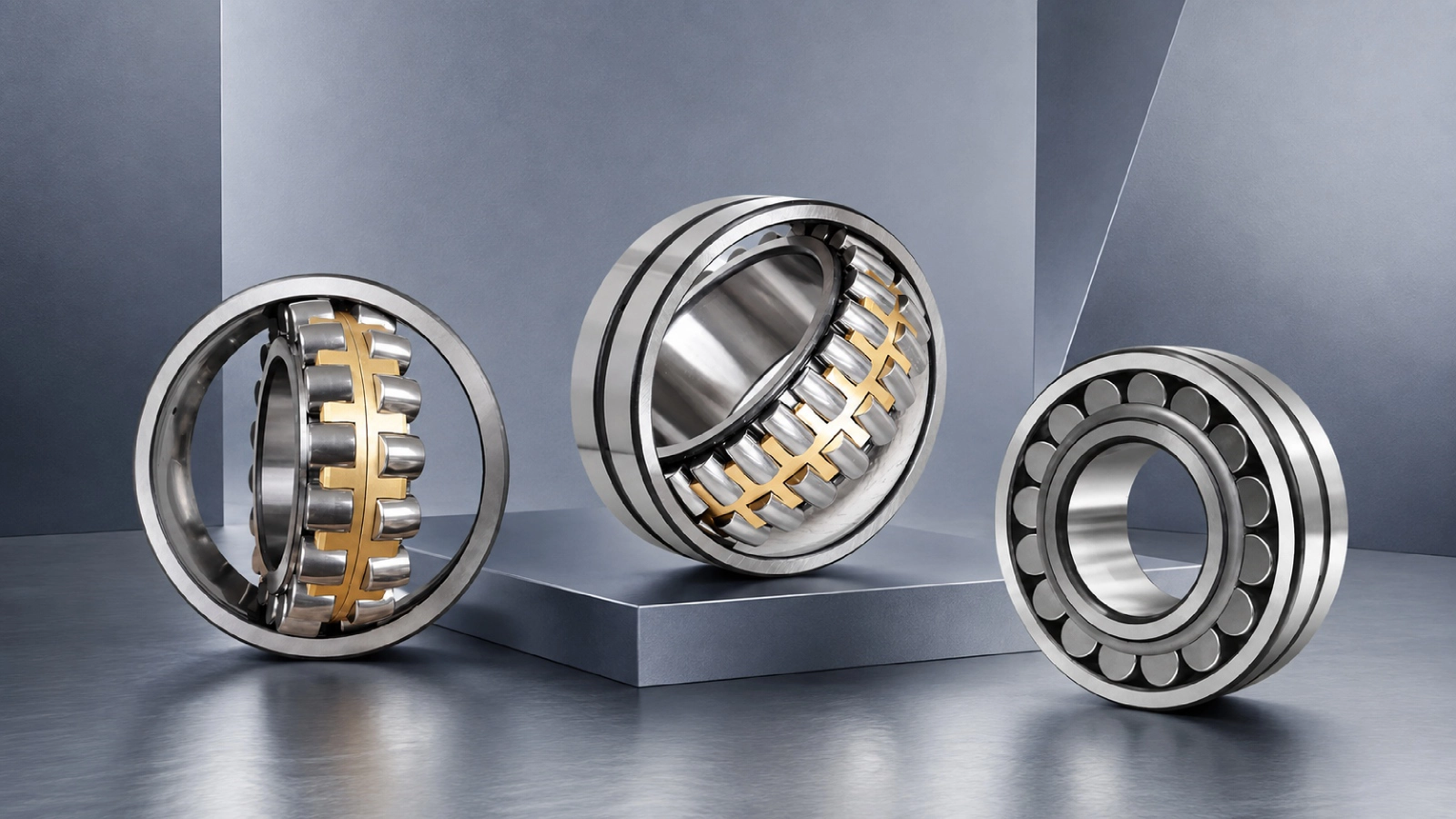
A spherical roller bearing combines two rows of barrel-shaped rollers with a common spherical outer-ring raceway. This geometry can accommodate heavy radial load, axial load in both directions, and a defined amount of misalignment. Buyers still need the complete model because bore taper, cage, internal clearance, lubrication features, and dimensional series can change the supplied product.
The inner ring, rollers, cage, and outer ring form a self-aligning rolling system. The spherical raceway allows the roller assembly to follow moderate shaft deflection or housing misalignment without forcing the rings into the same angular position.
Self-alignment is not a remedy for an incorrect fit, a bent shaft, a distorted housing, or excessive deflection. The permitted angular displacement depends on the series, load, sealing arrangement, and surrounding components. A buyer should therefore compare the manufacturer’s current limit with the actual application.
Series, bore style, and cage design provide useful ways to classify spherical roller bearings. These classifications define different dimensional, mounting, and operating characteristics that buyers should check together before ordering.
| Classification | Main feature | Buyer check |
| Series – 213, 222, and 223 | Different cross-sections and capacity ranges for general and heavier-duty positions | Envelope, load rating, speed, and shoulder dimensions |
| Series – 230, 231, 232, and 239 | Low-section or broad-bore designs for applications with different space and capacity requirements | Width, load rating, shaft deflection, and housing space |
| Series – 240, 241, and 242 | Wider, higher-capacity designs for applications requiring larger bearing sections | Dimensions, load rating, bore configuration, and mounting requirements |
| Bore style – Cylindrical bore | Mounts directly on a cylindrical shaft seat | Shaft fit, shoulder dimensions, temperature, and operating clearance |
| Bore style – Tapered bore | Mounts on a tapered seat or with an adapter or withdrawal sleeve | Taper ratio, sleeve reference, drive-up, and residual clearance |
| Cage design – Steel cage | Steel cage construction; design and availability vary by bearing series | Cage suffix, speed, lubrication, temperature, and operating conditions |
| Cage design – Brass cage | Robust brass cage construction available for specified bearing designs | Cage suffix, speed, temperature, lubrication, and manufacturer specification |
These classifications are not separate bearing types. A bearing from the same series may be supplied with different bore, cage, and internal clearance options. Therefore, buyers should check the complete designation and relevant suffixes when confirming a bearing.
Typical applications include conveyors, crushers, vibrating screens, paper machines, gearboxes, fans, mining equipment, steelmaking machinery, and material-handling systems. Engineers often choose these bearings when radial load is high, axial load acts in either direction, and the arrangement must accommodate shaft deflection or mounting error.
Before selection, record the radial and axial load spectrum, shock level, speed, duty cycle, temperature, contamination, lubrication method, shaft arrangement, and expected misalignment. A spherical roller design is not automatically suitable for every high-load position; minimum load, heat generation, and available speed still matter.
Begin with bore, outside diameter, width, and shoulder geometry. Then evaluate dynamic and static load ratings against the actual load cases. For shock or oscillating service, include peak load and load direction rather than using only an average value.
Next, calculate the remaining clearance after fitting and temperature changes. A tight fit or a hotter inner ring can reduce operating clearance. Drive-up also reduces clearance in a tapered-bore bearing. Therefore, follow the manufacturer’s mounting method instead of setting the final position by distance alone. Confirm the required C2, normal, C3, or other clearance class from the original model and application data.
The examples below show recognizable international series. A similar basic number does not prove interchangeability.
| Brand | Series examples | Complete model example |
| Timken | 222, 223, 230, 231, 232, 239, 240, and 241 families; steel and brass cage executions | 22220KEMW33C3 |
| SKF | 213, 222, 223, 230, 231, 232, 239, 240, and 241 series; cylindrical and tapered-bore executions | 22220 EK/C3 |
| FAG | 213, 222, 223, 230, 231, 232, 239, 240, and 241 series; E1 and XL executions | 22220-E1-XL-K-C3 |
Compare dimensions, ratings, cage, bore taper, clearance, lubrication groove, speed, tolerance, shoulders, and mounting instructions before approving another brand.
Timken model 22220KEMW33C3 illustrates how a complete code identifies series, bore, tapered mounting, cage execution, lubrication features, and clearance.
| Code | Code section | Meaning |
| 222 | Series section | Spherical roller series 222 |
| 20 | Bore section | Bore code corresponding to a 100 mm nominal bore |
| K | Bore suffix | Tapered bore, 1:12 taper for this series |
| EM | Design/cage section | Timken brass-cage execution |
| W33 | Lubrication suffix | Annular groove and lubrication holes in the outer ring |
| C3 | Clearance suffix | Radial internal clearance greater than normal |
The code should be verified against the current manufacturer record. Omitting K changes the shaft interface, while omitting C3 changes the clearance specification.
Keep the bearing, shaft, housing, and lubricant clean. Apply mounting force only through the ring receiving the interference fit; never transmit force through the rollers. For tapered bores, use the specified drive-up, reduction in clearance, or hydraulic method and confirm the correct adapter or withdrawal sleeve.
During removal, support the bearing and control the release of stored force. Hydraulic nuts, oil injection, or suitable pullers may be required for large or tightly fitted bearings. After installation, verify axial location, remaining clearance, free rotation, lubrication path, seal condition, and operating temperature during commissioning.
HSN reviews the complete bearing model, brand, dimensions, photos or drawing, quantity, load, speed, bore style, sleeve, clearance, cage, lubrication, application, and working conditions. It confirms availability for the exact reference. If the requested model is unavailable, HSN discusses an alternative only after technical comparison.
Before shipment, HSN focuses on dimensional tolerances, hardness, and internal clearance. According to the order requirements, the inspection plan can also include rotation accuracy, vibration, noise, material verification, or flaw detection.
Is every spherical bearing a spherical roller bearing?
No. The term can also refer to spherical plain or self-aligning ball products. This article covers the spherical roller type only.
What does K mean in 22220KEMW33C3?
K identifies a tapered bore. The taper ratio must be confirmed for the applicable series.
Can C3 be replaced by normal clearance?
Not automatically. Fit, temperature, speed, and mounting method determine the required operating clearance.
What information should a buyer send?
Send the full code, brand, dimensions, photos or drawing, quantity, load cases, speed, shaft arrangement, lubrication, and environment.
For detailed spherical roller bearing models beyond those listed above, or for other bearing types, contact HSN with the complete reference and technical requirements.
This article is based on independent analysis of publicly available technical information and industry understanding for knowledge sharing. All brand names and trademarks belong to their respective owners. HSN Bearing Group is an independent bearing supplier and technical service provider.
Tel: +86 156 6578 7336 Email: service@hsnindustrial.com Website: www.rollingparts.com www.hsnbearings.com