Timken ball bearings are widely used in industrial equipment, mechanical systems, and maintenance applications. Although many models appear similar, differences in bearing structure, row count, seal design, precision grade, bore code, and suffix can significantly affect load capacity, speed, installation, and service performance. Therefore, buyers should avoid identifying a bearing only by its appearance or an incomplete reference number.
For overseas distributors, repair companies, engineers, and equipment buyers, accurate sourcing requires more than checking price and availability. The bearing model must also match the load direction, operating speed, mounting space, and working environment. This guide introduces Timken ball bearings from a purchasing perspective, covering common structures, product series, model code examples, application industries, and the information needed for an accurate inquiry.
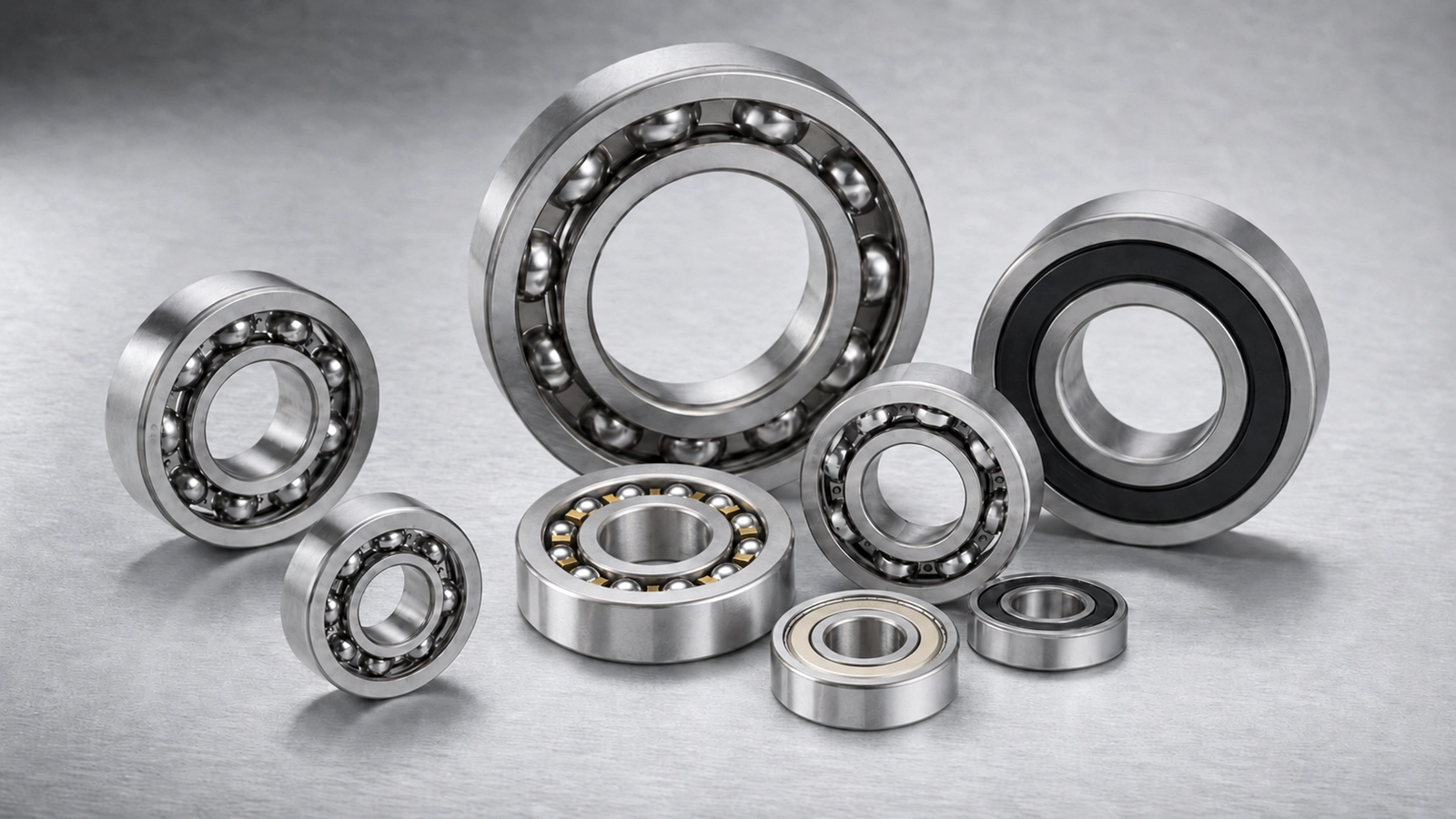
Timken ball bearings cover several structures. Each structure solves a different load, speed, or mounting problem.
Radial ball bearings are designed for high-speed operation and light to medium radial loads. Their deep raceway geometry also allows them to accommodate radial and axial loads in both directions. Buyers should check whether the model has an open, shielded, sealed, or snap-ring design.
Angular contact ball bearings are designed for combined radial and axial loads. Single-row angular contact bearings can support thrust load mainly in one direction. They may also be mounted in pairs when higher axial rigidity is required. For this type, buyers should check contact angle, mounting arrangement, precision, and whether the bearing is suitable for the shaft position.
Double-row angular contact bearings provide higher rigidity in a compact space. They can support radial load and moderate thrust load in both directions. This structure is useful when equipment needs stronger support but has limited axial space.
Some Timken ball bearing families include wide inner ring, flanged, hex bore, agricultural, or housed unit designs. These are often used where mounting convenience, sealing, or shaft connection is important.
Timken ball bearings include several series groups. Buyers should first identify the structure, then compare the series and suffix.
Common series groups include 30 and 33 extra-small series, 200 light series, 300 medium series, 9100 extra-light series, and 9300 ultra-light series. Angular contact families include 7200, 7300, and 7400 series. Double-row angular contact families include 5200 and 5300 series.
The W200 and W300 wide-type series are used where wider inner and outer rings are required. Some agricultural or special equipment applications may also use R-seal, tri-ply seal, or hex bore bearing variants.
For sourcing, the series name should be checked together with bore code, suffix, sealing type, clearance, and precision requirement.
Timken ball bearing codes may include prefixes, series numbers, bore codes, suffixes, and additional feature codes. Buyers should read the full number, not only the middle digits.
A code such as W305KLL can be understood in sections.
| Code | Code section | Meaning |
| W | Prefix | Wide-type single-row design |
| 3 | Basic type series | single-row inch, extra small |
| 05 | Bore-size code | Bore size 25 mm |
| K | Suffix | Conrad, non-filling slot type |
| LL | Additional feature | Two Mechani-Seals |
This example shows why letters matter. A bearing with the same bore code may perform differently if it has another sealing suffix or construction type.
For many metric ball bearing codes, 04 and above usually indicate bore size by multiplying the last two digits by 5.
For example:
Small bore codes are exceptions:
Prefixes can indicate material, fit, precision, or ring design. For example, A may indicate stainless steel, F may indicate a flanged outer ring, M may indicate ABEC 3 precision, and V may indicate ABEC 5 precision.
Suffixes and feature codes can indicate shields, seals, retainers, or snap rings. For example, D means one shield, DD means two shields, P means one seal, PP means two seals, R means one land-riding rubber seal, and RR means two land-riding rubber seals.
Therefore, two bearings with similar numbers may not be suitable for the same position if their suffixes are different.
Timken ball bearings are used in many markets, including aircraft, construction, agriculture, machine tools, and general industry. In electric motors, pumps, fans, conveyors, and gearboxes, radial ball bearings are often selected for speed and compact structure.
Angular contact ball bearings are used where combined loads and shaft positioning are important. Machine tools and precision equipment may require higher accuracy, controlled runout, and proper mounting arrangement. Agricultural machinery often needs sealed or protected designs because dust, mud, and outdoor working conditions can affect bearing life.
When selecting ball bearings for industrial use, buyers should check speed, load direction, sealing, lubrication, precision, and temperature.
Before sending an inquiry, buyers should prepare clear product and application details.
| Confirmation item | Why it matters |
| Complete model number | Confirms structure and suffix |
| Bearing series | Helps identify the product family |
| Bore, OD and width | Confirms dimensional fit |
| Shield or seal type | Affects contamination protection |
| Precision or clearance | Affects speed and mounting |
| Application and load | Helps judge suitability |
Buyers should also provide photos, drawings, quantity, delivery requirement, and any special inspection requirements.
HSN Bearing Group supports overseas B2B buyers with ball bearing model confirmation, sourcing discussion, and quality inspection before shipment. When a buyer provides a Timken reference, HSN can help check the structure, series, suffix, and possible supply option.
For stock models, HSN can confirm availability according to model and quantity. For difficult-to-source or special requirements, HSN can discuss a technically confirmed replacement option based on dimensions, drawings, samples, and working conditions.
Are all ball bearings suitable for axial loads?
No. Radial ball bearings mainly support radial loads, while angular contact designs are more suitable for combined radial and axial loads.
Can a sealed bearing replace an open bearing?
Not always. Sealing type, speed, lubrication, and temperature should be checked first.
What does the bore code 05 mean?
In many metric ball bearing codes, 05 indicates a 25 mm bore.
Why do suffixes matter?
Suffixes may indicate shields, seals, retainers, snap rings, precision, or internal construction. These details affect fit and performance.
For detailed Timken ball bearing models not listed above, please contact HSN for model confirmation and supply discussion. For difficult-to-source references, you can also send the complete model number, photos, dimensions, quantity, and working conditions for review.
This article is based on independent analysis of publicly available technical information and industry understanding for knowledge sharing. All brand names and trademarks mentioned belong to their respective owners. HSN Bearing Group is an independent bearing supplier and technical service provider.