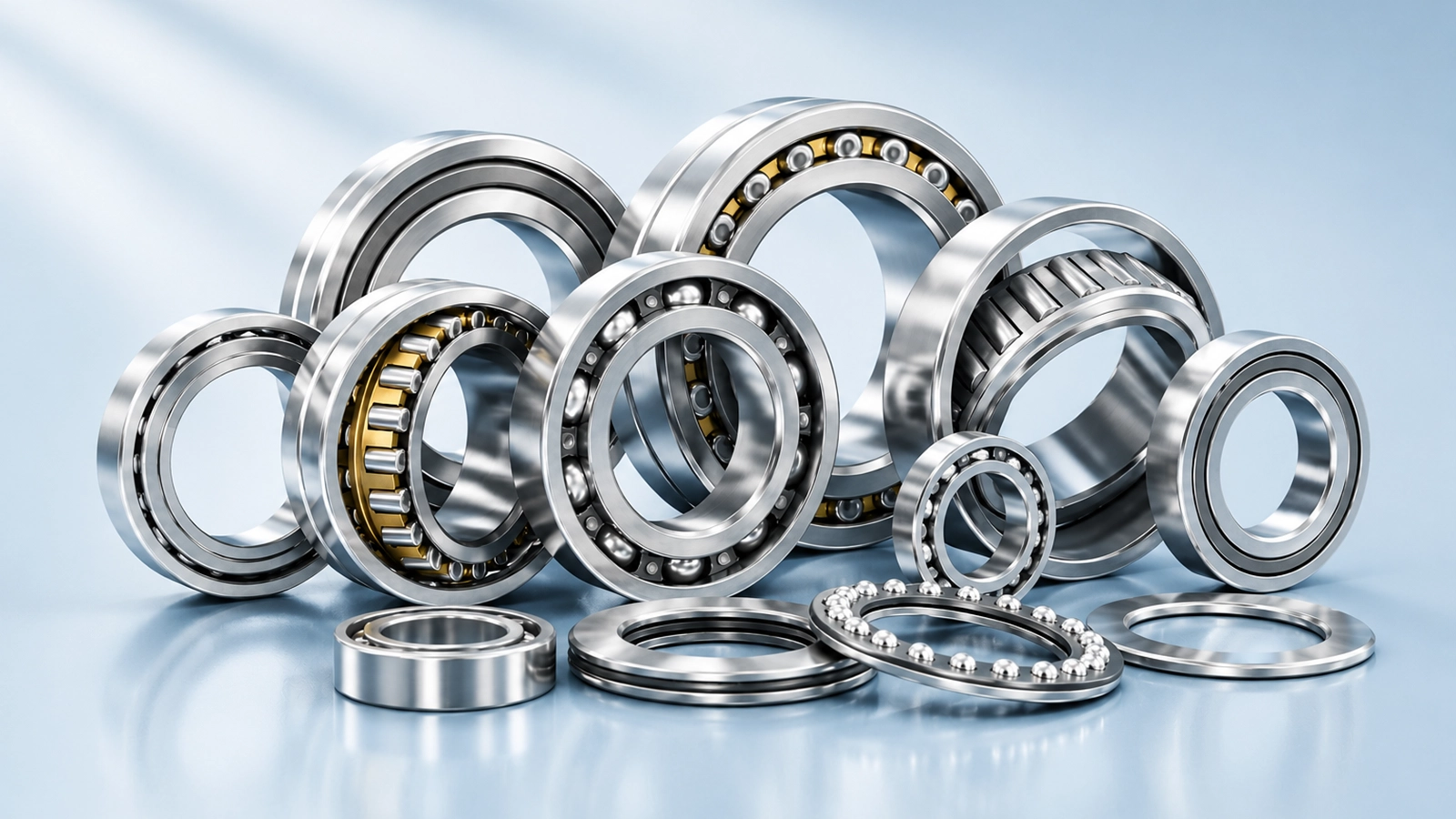
When buyers search for radial and thrust bearings, they are usually not looking for one single bearing model. They are trying to understand which bearing type matches the load direction, equipment position, and replacement requirement. In rolling bearings, this classification is important because a bearing that works well under radial load may not be suitable for heavy axial force.
For purchasing teams, engineers, and maintenance companies, the key question is simple: does the bearing mainly carry radial load, axial load, or a combined load? The answer affects bearing type, arrangement, clearance, cage, lubrication, and inspection requirements before ordering.
Radial bearings are designed mainly for loads acting perpendicular to the shaft. These loads appear in motors, gearboxes, pumps, conveyors, agricultural machines, automotive components, and general rotating equipment. Common radial bearing types include deep groove ball bearings, angular contact ball bearings, cylindrical roller bearings, tapered roller bearings, spherical roller bearings, needle roller bearings, and self-aligning ball bearings.
Thrust bearings are designed mainly for axial loads acting along the shaft direction. They are used where a shaft, screw, gear, vertical motor, crane hook, or heavy industrial mechanism produces strong pushing force. Common thrust bearing types include thrust ball bearings, cylindrical roller thrust bearings, needle roller thrust bearings, tapered roller thrust bearings, and spherical thrust roller bearings.
However, the distinction is not always absolute. Some bearings can support both radial and axial loads. For example, angular contact ball bearings and tapered roller bearings are often selected for combined loads. Spherical roller bearings can also carry radial load and axial load in both directions, depending on the design and application.
Different radial and thrust bearing types solve different equipment problems. The table below gives a practical purchasing view.
| Bearing Type | Classification | Main Load Direction | Typical Applications | Purchasing Notes |
| Deep groove ball bearings | Radial | Radial load and limited axial load | Motors, pumps, fans, agricultural equipment | Check seals, shields, clearance, speed, and noise requirements. |
| Angular contact ball bearings | Radial / combined load | Radial load plus axial load in one or both directions by arrangement | Machine tool spindles, compressors, pumps | Confirm contact angle, preload, arrangement, and precision class. |
| Cylindrical roller bearings | Radial | High radial load; some designs support limited axial load | Motors, reducers, generators, industrial equipment | Confirm NU, NJ, NUP, N, NN or NNU structure. |
| Tapered roller bearings | Radial / combined load | Radial load plus axial load | Automotive, construction machinery, reducers, rolling mills | Confirm single-row, double-row, or four-row design and setting. |
| Spherical roller bearings | Radial / combined load | Heavy radial load and axial load in both directions | Mining, cement, steel, crushers, screens | Check bore type, clearance, cage, lubrication groove, and seals if required. |
| Thrust ball bearings | Thrust | Axial load | Machine tool spindles, vertical shaft positions | Normally not used for radial load. |
| Spherical thrust roller bearings | Thrust / combined load | Heavy axial load and some radial load | Vertical motors, coal mills, screw-down reducers | Oil lubrication and mounting direction should be confirmed. |
Deep groove ball bearings are common in electric motors, pumps, fans, small gearboxes, agricultural equipment, and many standard machines. They are often selected when speed, simple mounting, and moderate loads are important.
Angular contact ball bearings are often used where radial load and axial load appear together. Machine tool spindles, high-speed motors, pumps, compressors, and automotive transmission positions may use this type when accuracy, speed, or axial support is required.
Cylindrical roller bearings are suitable for heavy radial load positions, including motors, traction motors, generators, reducers, machine tool spindles, and industrial equipment. NU and N types are often considered for free-side bearing positions where shaft expansion must be allowed.
Tapered roller bearings are widely used in automotive wheels, transmissions, construction equipment, agricultural machinery, speed reducers, rolling mill roll necks, and railway applications. They are useful where radial load and axial load must be managed together.
Spherical roller bearings are often found in mining, cement, steel, paper, crushers, vibrating screens, plummer blocks, and heavy-duty reducers. Their self-aligning capability helps in positions with shaft deflection, mounting error, impact load, or vibration.
Thrust ball bearings and thrust roller bearings are used where axial force is the main concern. Spherical thrust roller bearings are especially relevant for heavy axial load positions such as vertical motors, hydroelectric generators, coal mills, screw-down reducers, propeller shafts, and heavy industrial mechanisms.
Many international bearing brands provide radial and thrust bearing products. Buyers often use these brands as technical references when checking model numbers, suffixes, dimensions, and equivalent options. Brand names should be treated as reference information unless a genuine original bearing supply is specifically confirmed.
| Brand | Common Bearing Coverage | Buyer Reference Use | Official Website |
| KOYO / JTEKT | Ball and roller bearings, bearing units, special-purpose bearings | Model series, technical classification, brand reference | koyo.jtekt.co.jp/en/ |
| SKF | Rolling bearings, seals, lubrication and related products | Product type reference and technical comparison | skf.com/group/products/bearings |
| Schaeffler / FAG / INA | Rolling and plain bearings for industrial applications | FAG and INA series reference, suffix review | schaeffler.com/en/divisions-products/industrial/ |
| TIMKEN | Tapered, spherical, cylindrical, thrust, ball and housed units | Heavy-duty bearing reference and model comparison | timken.com/products/timken-engineered-bearings/ |
| NSK | Ball bearings, roller bearings, bearing units, special environment bearings | Bearing family and application reference | nsk.com/products/ |
| NTN | Bearings, driveshafts and precision equipment | Industrial and automotive bearing reference | ntnglobal.com/en/index.html |
| NACHI | Ball and roller bearings, precision bearings, spherical roller thrust bearings | Product type and model reference | nachi-fujikoshi.co.jp/eng/products/en-jik.html |
Model series help buyers quickly identify the general bearing family. Still, the series alone is not enough for purchasing. The complete designation, suffixes, dimensions, clearance, cage, and application conditions must also be confirmed.
In most bearing designations, the numbers help identify the bearing type, dimension series, and bore size. For example, a 62 series bearing usually indicates a deep groove ball bearing family, while a 302 or 322 series often points to a tapered roller bearing family. A 222 or 223 series normally indicates a spherical roller bearing family.
Letters and suffixes usually describe structural details. They may indicate a seal, shield, snap ring groove, tapered bore, cage material, internal clearance, precision class, lubrication groove, or matched arrangement. For example, K or K30 often relates to a tapered bore in certain roller bearing series, while C3 commonly refers to internal clearance larger than normal. However, suffix meanings are not always identical between brands.
Therefore, buyers should not judge a replacement only by the first numbers or by one familiar suffix. Before ordering, the complete marking should be checked together with the actual dimensions, load direction, mounting position, speed, lubrication, and working conditions.
A practical selection process should begin with the load direction. When the equipment mainly applies force across the shaft, a radial bearing family is usually the first choice. For applications where the force mainly acts along the shaft, a thrust bearing family should be considered. In systems subjected to both radial and axial forces, buyers should select a bearing type or arrangement designed for combined loads.

HSN Bearing Group supports overseas buyers with industrial bearing supply, model confirmation, replacement discussion, and customization communication. For buyers who need radial and thrust bearings, HSN can review the bearing type based on model number, brand reference, drawing, sample photo, dimensions, application, and working conditions.
HSN maintains 2000+ tons of bearing inventory, mainly covering spherical roller bearings, cylindrical roller bearings, tapered roller bearings, thrust roller bearings, deep groove ball bearings, angular contact ball bearings, and thrust ball bearings. This inventory structure helps support buyers who need commonly demanded industrial bearing types and urgent model checking.
For brand reference projects, HSN can discuss alternative options after technical confirmation. This is useful when original brand delivery time is long, old models are difficult to source, standard stock structures do not meet the working conditions, or the buyer needs a cost-performance review. Any replacement discussion should be based on dimensions, suffixes, material, cage, clearance, lubrication, and operating conditions, not only on a model number.
Before shipment, HSN focuses on key inspection items such as dimensional tolerance, hardness, and clearance. Additional checks such as material verification, rotation accuracy, vibration range, noise range, and ultrasonic flaw detection can be discussed according to customer requirements.
To help HSN confirm the correct bearing more efficiently, buyers can send the following information when making an inquiry:
Are radial and thrust bearings the same?
No. Radial bearings mainly support loads perpendicular to the shaft, while thrust bearings mainly support axial loads along the shaft. Some bearing types can support combined loads.
Can a radial bearing support axial load?
Some radial bearings can support axial load to a certain degree. Deep groove ball bearings, angular contact ball bearings, tapered roller bearings, and spherical roller bearings may support axial load depending on structure and arrangement. The actual application must be checked before ordering.
Which bearing type is suitable for combined radial and axial load?
Angular contact ball bearings, tapered roller bearings, and spherical roller bearings are commonly reviewed for combined load conditions. The correct choice depends on load direction, speed, rigidity, mounting space, and operating environment.
Can HSN help identify a bearing from a model number or photo?
Yes. HSN can review model numbers, markings, drawings, sample photos, and working conditions to help identify the bearing type and discuss suitable supply or customization options.
Send HSN your bearing model, brand reference, drawing, sample photo, quantity, application, and working conditions. Our team can help review the bearing type, confirm key technical details, and discuss suitable supply or customization options.