
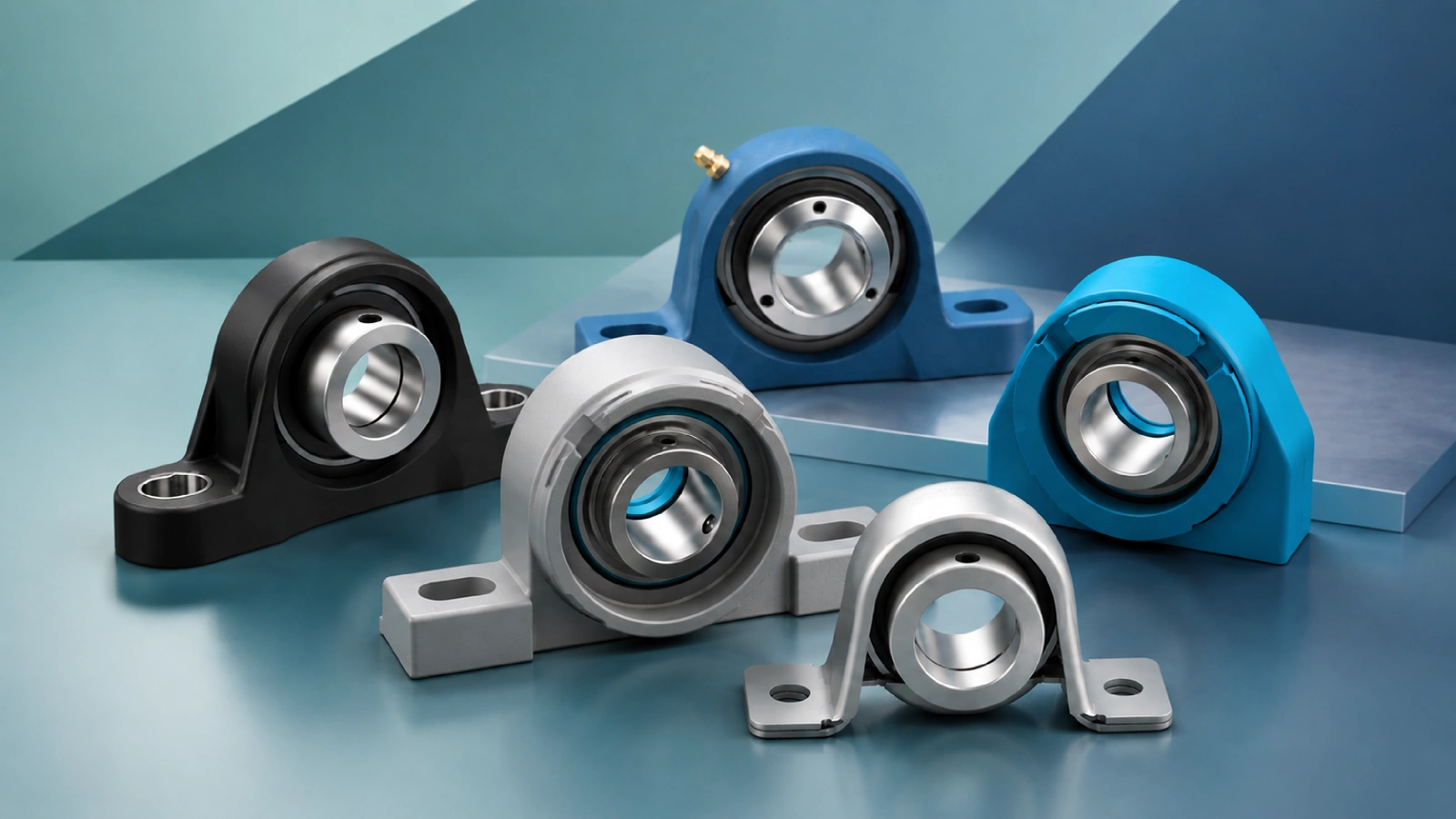
Pillow blocks combine a bearing insert, pedestal housing, shaft-locking parts, seals, lubricant, and mounting interfaces into one operating unit. Therefore, a purchasing request for a pillow block with bearing should identify the complete assembly. An insert code or casting mark alone may describe only one component.
This distinction becomes critical during maintenance. A cast iron pillow block bearing may have a common 205 size label, but the insert seat, center height, grease path, seal position, or shaft bore can still differ.Ordering only the insert number can result in mismatched center heights or misaligned grease paths, making the new part unusable without additional machining. Buyers should first determine whether they need a complete unit, a replacement insert, an empty housing, or specific accessories.
A complete unit connects the rotating shaft to the machine frame. The insert carries the load, while the housing supports and positions the insert. Meanwhile, seals, lubricant, the shaft-locking device, grease fitting, and housing base affect how the assembly operates.
| Purchasing scope | Normally included | Main identification risk |
| Complete pillow block unit | Insert, housing, seals, locking parts, lubricant, and grease fitting | A shortened code may omit the bore or execution suffix |
| Replacement insert | Bearing insert with its inner ring, rolling elements, seals, and shaft lock | The insert may not match the existing housing seat or grease path |
| Empty housing | Pedestal casting or housing body without the operating insert | A casting mark may not identify the complete assembled unit |
| Accessories | End covers, collars, sleeves, fittings, fasteners, or seals | Accessories can depend on the exact brand and unit execution |
A complete unit code links these components within one manufacturer’s system. For example, UCP205 refers to an assembled pillow unit, while UC205 commonly identifies an insert and P205 identifies a housing. Buyers should still confirm the exact brand documentation before separating or recombining these references.
SKF, Timken, and NTN publish complete unit references under their own designation systems. The following examples illustrate purchasing boundaries; they do not establish automatic interchangeability.
| Brand | Complete model example | Purchasing interpretation |
| SKF | UCP 205 | Complete cast-iron set-screw pillow unit in the metric 205 size group |
| Timken | UCP205 | Complete two-bolt U Series pillow unit for a 25 mm shaft |
| NTN | UCP205-100D1 | Complete 1-inch set-screw unit using a UC205-100D1 insert and P205D1 housing |
| NTN | UELP205-100D1 | Complete 1-inch eccentric-collar unit; the locking family differs from UCP |
Spaces, hyphens, bore codes, and execution suffixes must remain intact. For instance, the NTN suffix -100 identifies a 1-inch bore in the cited unit, while D1 remains part of the execution. A buyer who requests only “205” leaves the unit scope, shaft size, and locking arrangement uncertain.
An insert-only repair may be reasonable when the original housing code remains identifiable and the housing passes inspection. The base should remain flat and free from cracks, severe corrosion, pulled bolt holes, or impact damage. In addition, the spherical seat must hold the insert correctly without excessive polishing, fretting, or deformation.
Buyers must also confirm the new insert’s outside surface, width, grease entry, seal position, and anti-rotation feature. The housing grease passage must align with the insert. Moreover, removal of the old insert must not damage the seat. A correct shaft bore alone does not prove that a new insert belongs in the existing housing.
Replace the complete unit when the housing no longer provides reliable location or support. Warning signs include a cracked base, distorted feet, damaged bolt holes, a loose spherical seat, blocked lubrication passages, missing locating features, or corrosion around the insert interface. Repeated insert movement inside the housing also indicates that the housing requires investigation.
Complete replacement is usually safer when the housing origin is unknown, component markings conflict, or previous repairs combined unmatched parts. A change in shaft size, sealing requirement, operating temperature, or washdown environment may also require another unit execution. In these cases, retaining the old housing can preserve the original mismatch instead of correcting it.
Before removal, photograph the complete unit, insert markings, housing marks, seal orientation, grease fitting, shims, and shaft-locking arrangement. Release the set screws, eccentric collar, or adapter mechanism before applying extraction force. Do not hammer the housing or transmit removal force through the rolling elements.
For an insert-only repair, follow the specified method for rotating or removing the insert from its spherical seat. During reassembly, align the lubrication passage and anti-rotation feature before seating the insert. When installing a complete unit, clean the base, position both supports loosely, align the shaft, and then tighten the base and shaft-locking parts in the correct sequence.
Complete pillow block units support shafts in conveyors, fans, blowers, agricultural machines, packaging lines, textile equipment, and bulk-handling systems. Their assembled format reduces the number of separately specified interfaces, which helps maintenance teams restore common shaft supports with less fitting work.
However, application conditions determine whether the old housing can remain in service. Dust may damage seals and grease paths, while washdown may corrode the base or fasteners. Long shafts may also need locating and expansion positions. Therefore, buyers should report load, speed, shaft direction, temperature, contamination, cleaning method, thermal movement, and maintenance history before choosing an insert-only repair or a complete unit.
First identify whether the request covers a complete unit, insert, housing, or accessory. Then provide enough evidence to confirm every component interface:
Avoid cleaning away all failure evidence before taking photos. Wear marks, grease paths, corrosion patterns, and insert movement can help determine whether an insert-only repair remains appropriate.
HSN Bearing Group reviews pillow blocks as complete bearing-and-housing arrangements. Buyers should send the assembled code, component markings, shaft size, mounting dimensions, photos, quantity, and working conditions. HSN can then compare the unit scope, locking method, housing geometry, insert interface, grease path, seals, load, speed, and environment.
For obsolete or uncertain units, HSN can review samples and controlled drawings before discussing a replacement or custom option. Agreed checks may cover dimensions, housing material, hardness, clearance, surface condition, assembly fit, and rotation. However, HSN will not combine an insert and housing solely because both references contain the same size number.
Does pillow block mean the housing only?
In many purchases it means the complete unit. State clearly whether you need the assembly, insert, or housing.
Can a UC205 insert fit every P205 housing?
Not automatically. Compare the spherical seat, width, grease path, seals, and brand-specific execution.
What does -100 mean in an NTN unit?
For the cited 205 unit, -100 identifies a 1 in bore. Keep D1 and all other suffixes in the inquiry.
Are all cast-iron units interchangeable?
No. Center height, bolt spacing, base dimensions, locking, seals, and load ratings can differ.
For pillow block models not listed above, contact HSN for confirmation. Send the complete unit, insert and housing codes, photos, dimensions, quantity, and working conditions.
This article is based on independent analysis of publicly available technical information and industry understanding for knowledge sharing. All brand names and trademarks belong to their respective owners. HSN Bearing Group is an independent bearing supplier and technical service provider.
Tel: +86 156 6578 7336 Email: service@hsnindustrial.com Website: www.rollingparts.com www.hsnbearings.com