
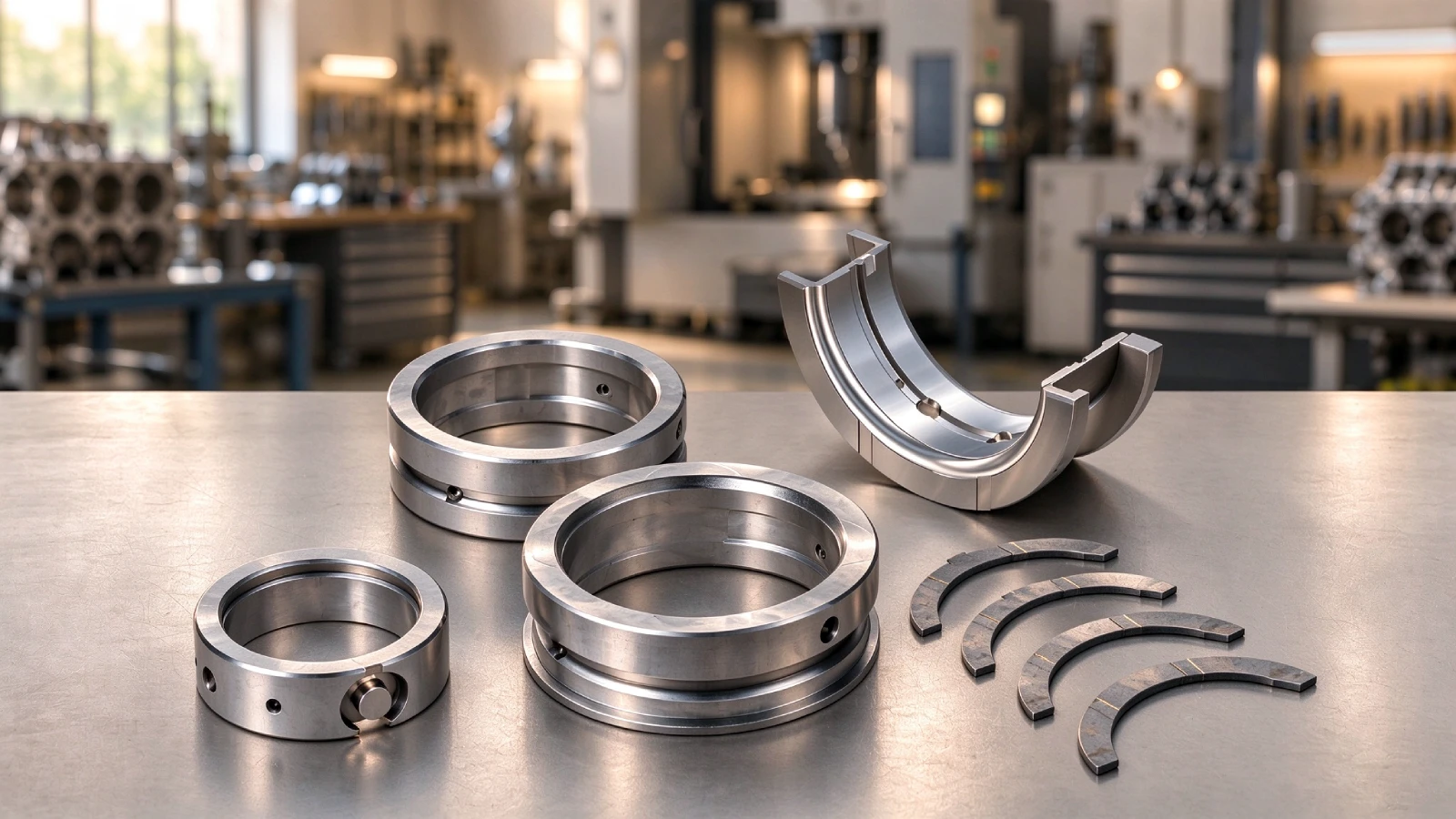
A request for a crank thrust bearing concerns the part that controls the crankshaft’s movement along its axis. Depending on the engine, that function may come from separate thrust washers or flanged main bearing shells. A shop cannot order the correct part by journal diameter alone: thrust location, face geometry and measured endplay also matter.
The buyer’s immediate question is whether the worn part, crankshaft thrust face or surrounding assembly caused the axial clearance problem. A thicker replacement cannot repair every damaged flange. The shop must identify the engine’s approved repair grade and measure the assembled result before release.
An engine has a designated main bearing position that restrains crankshaft axial travel. There, thrust faces bear against crankshaft cheeks when axial force acts on the shaft. A manual clutch can impose such force during actuation. The ordinary main and rod journal surfaces primarily support radial loads, so their dimensions do not describe the thrust faces.
Some engines use separate semicircular thrust washers fitted beside a main bearing. Others use flanged shells with the thrust surfaces integrated into the bearing halves. The exact position, number of faces and retaining method depend on the engine. A buyer must compare the removed components and engine identification before treating these constructions as equivalent.
Axial location is also related to components beyond the bearing. A rough crankshaft face, misaligned cap or excessive external thrust can overload a correctly sized washer. Inspect the interacting surfaces and the source of axial force before selecting a replacement.
The phrase crankshaft thrust bearing often describes the function rather than a single universal part shape. An engine thrust bearing may be a separate washer set or the flanges of a main bearing shell. When a buyer searches for a thrust bearing in an engine, the required order code depends on that construction and the engine’s specific thrust position.
| Design | What the buyer orders | Main verification |
| Separate thrust washers | The specified washer set in the required thickness | Washer dimensions, quantity, locating features and specified installation orientation |
| Flanged main shells | The specified flanged bearing or main bearing set | Main journal diameter, bearing size, thrust width and set contents |
Repair sizes require a separate check. A bearing size specified for a reground main journal does not automatically identify the required thrust thickness or width. Where repair options exist, confirm them against the engine service information and supplier catalog. Do not select a thicker washer solely because the old assembly has excessive endplay.
For these conventional engine applications, the thrust surfaces slide against the crankshaft and receive lubrication from the engine oil system. Match the material, oil-groove layout and locating features to the specified design.
On the purchase order, state the main bearing size and thrust dimensions separately where applicable. After installation, the repair shop should verify crankshaft endplay against the engine specification.
The axial clearance, often called crankshaft endplay, is measured between the thrust faces after the engine is assembled as specified. Too little clearance can trap the oil film and raise contact heat. Excessive clearance lets the shaft move beyond its design range and can accelerate thrust-face wear. The engine maker’s limits, not a generic internet number, govern acceptance.
Oil must reach the sliding faces. Grooves or relief features can help distribute it, but their layout varies. A washer installed backward or an obstructed oil path may starve the contact. The assembly procedure should identify the correct orientation and lubrication method; visual symmetry is not sufficient proof.
The crankshaft flange width, face flatness and surface finish also influence the working clearance. A rough or damaged thrust cheek can abrade a new bearing. Meanwhile, sustained external axial force can squeeze oil from the contact. Ask the builder to investigate those forces, especially after a repeat failure, rather than assuming a stronger material will fix the system.
Inspect the old washer or flange for scoring, wiped lining, cracking or uneven wear. Measure endplay and the crankshaft’s thrust-face condition. A damaged component may justify replacement, but the shop also needs to check cap location, oil supply and any unusually high axial load. The wear pattern alone does not identify one proven cause.
Some repair parts provide additional thrust width to suit a specific reworked crankshaft and restore the specified axial clearance. That option must be matched to the actual crankshaft geometry and engine-approved procedure. Never select a thicker grade simply because the old part has visible wear; insufficient clearance can produce an immediate failure.
For a custom request, capture each washer’s outside and inside profile, thickness distribution, oil features, locating detail and material system. For a flanged shell, add journal dimensions, overall flange width and shell geometry. The shop needs an agreed drawing and final assembled-clearance check. HSN can discuss a defined supply option, while the builder approves the finished engine fit.
Provide the engine code and serial information, the precise thrust-bearing position and the existing part number. State whether the current design uses washers or flanged shells. Send photos, a drawing or sound sample, quantity, crankshaft flange measurements and the shop’s measured endplay. Identify any prior machining or repair-size grade.
For a U.S. engine remanufacturer scheduling a line changeover, note the date when measured parts must be on hand for trial assembly. The required receipt date can differ from the final engine completion date. Inch and metric dimensions should be labeled on every drawing and quote, especially when the thrust-width allowance is small.
HSN can review the complete bearing designation, dimensional drawing and application requirements for stock or a technically assessed custom route. Request inspection of relevant widths, profiles and surface features as appropriate. The engine builder then measures final endplay and verifies free rotation under the correct assembly procedure. No bare part number can establish those results on its own.
Can I replace a thrust washer with a flanged shell?
Only if the engine design specifies that construction. Confirm the exact thrust position and parts.
Does more thrust width always fix excess endplay?
No. Measure the crankshaft faces and use an approved repair grade, then verify assembled clearance.
What should a U.S. engine shop send for a quote?
Send the engine code, thrust design, face dimensions, endplay, units, quantity and trial-assembly date.
How can HSN help with an unusual thrust part?
Send a complete code, drawing or sound sample for a stock or custom review with agreed checks.
For detailed crankshaft thrust bearing models not listed above, please contact HSN for model confirmation and supply discussion. When checking other bearing references, you can also send the complete model, photos, dimensions, quantity, application, and working conditions.
This article is based on independent analysis of publicly available technical information and industry understanding for knowledge sharing. All brand names and trademarks mentioned belong to their respective owners. HSN Bearing Group is an independent bearing supplier and technical service provider.
Tel: +86 156 6578 7336 Email: service@hsnindustrial.com Website: www.rollingparts.com www.hsnbearings.com