A crankshaft bearing inquiry can mean a main bearing at the block or a connecting rod bearing at a crankpin. Both are plain bearing shells, yet their sizes, locations and oil feed paths differ. Before quoting, the buyer needs the engine identification and the machine shop’s measured journal and housing dimensions. An old shell marking alone may no longer describe a crankshaft that has been reground.
The purchase decision is therefore more precise than selecting a nominal engine model. It must distinguish bearing position, size grade, material and the clearance the rebuilt assembly will achieve. These checks are especially important when an older engine needs a hard-to-find service size or a drawing-based replacement.
Main bearing shells support the crankshaft in the engine block and caps. Connecting rod bearing shells support each rod’s big end as it moves around a crankpin. The two locations see different loading cycles and may use different shell designs, even within one engine. A buyer should identify the specific main position or rod journal, rather than request a generic set for the entire crankshaft.
Combustion loads pass through the cranktrain and into the bearing’s oil film. During normal running, the rotating journal pulls oil into a narrowing clearance to separate the surfaces. At start-up, shutdown or under disturbed lubrication, that separation may be reduced. The shell material and surface finish matter, but they cannot compensate for a blocked oil gallery or incorrect assembly clearance.
Automotive engines, commercial powertrains and stationary engines all use this principle. Application examples do not establish shared part numbers. A single engine family can have production revisions, selected shell grades and different crankshaft repair sizes. Use the exact engine code and build information to narrow the application.
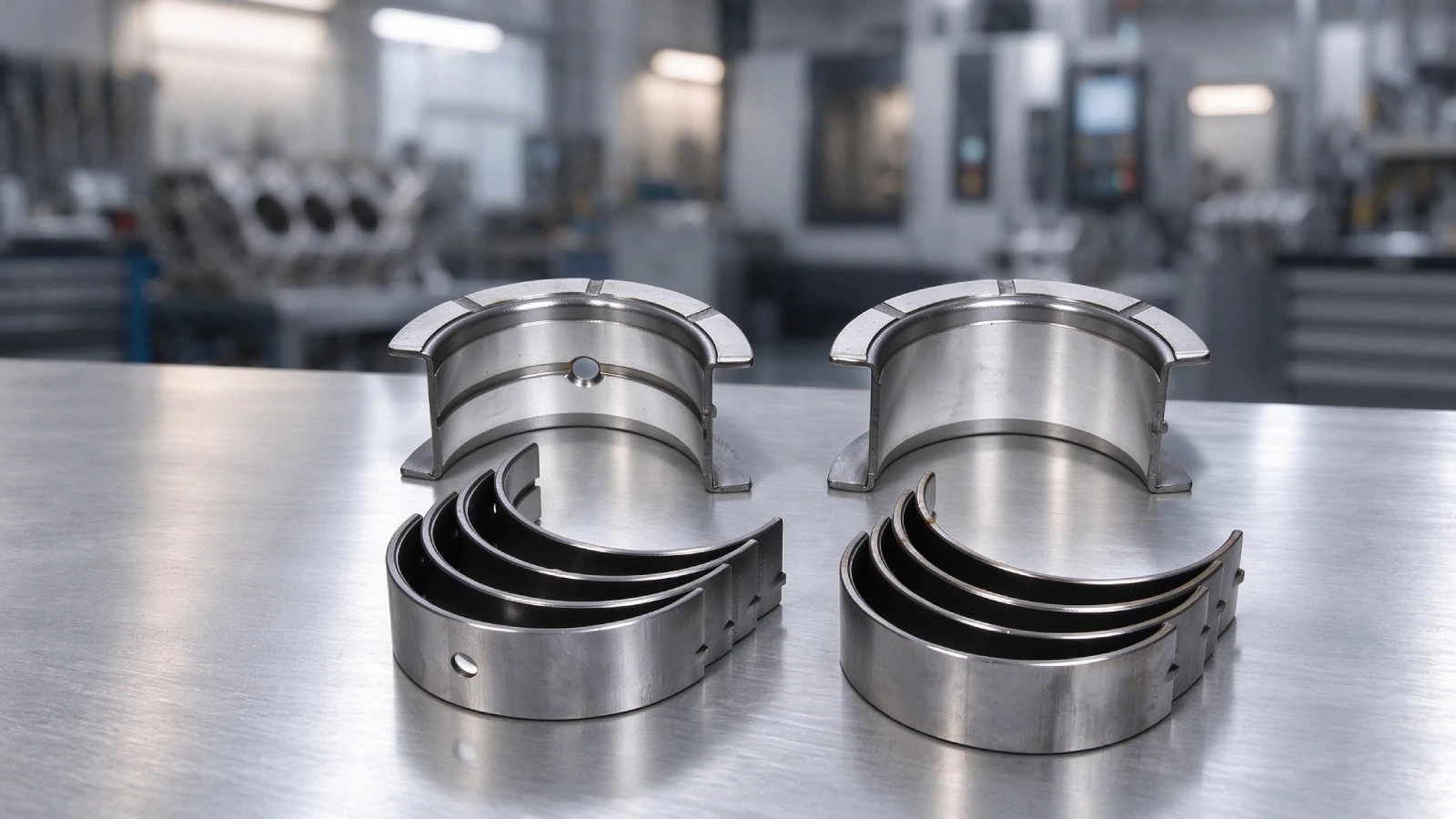
The plural phrase crankshaft bearings often covers both the main and connecting rod sets. A main bearing may have a groove or oil hole in a specific half, while another half is solid. Rod shells can have their own width, tang position and chamfer requirements. Swapping visually similar upper and lower shells can obstruct oil flow or create a fit problem.
| Identification question | Main bearing shell | Rod bearing shell |
| Housing | Block saddle and main cap | Connecting rod and rod cap |
| Shaft surface | Main journal | Crankpin journal |
| Purchase check | Position, oil feed and main bore | Rod code, crankpin and big-end bore |
These distinctions guide the quote; they do not replace the engine maker’s fitment information. A flanged main bearing may additionally guide the crankshaft axially, but its radial running surface still requires the correct main-journal clearance. The thrust geometry must be checked as its own requirement.
For a complete set, ask whether the builder wants all main positions, all rods or only one diagnosed position. The bill of materials should state which shells and size grades are included. A part number for a full set may not identify each individual half without its application details.
Running clearance is the difference between the installed bearing bore and the actual journal diameter under the specified cap assembly conditions. It cannot be inferred reliably from loose shell thickness alone. Shells have designed eccentricity and relief near the parting lines; measure them by the approved method and at the appropriate locations. The engine builder must use the engine’s clearance limits.
Oil viscosity, temperature and flow interact with that clearance. Too little clearance can restrict the oil film or increase heat; excessive clearance can reduce film support or alter oil flow. Journal taper, out-of-roundness, roughness and housing alignment can undermine a suitable nominal bearing size. Thus, the crankshaft and assembled housing need inspection before the final grade is approved.
The shell also needs the correct crush and seating in its housing. Dirt trapped behind a shell changes its position and reduces local clearance. Clean oil holes and galleries, and verify that groove and hole patterns match the required location. There is no independent external seal on each main or rod shell; the engine’s oil system and surrounding seals manage lubricant and contamination at assembly level.
A damaged bearing may show scoring, wiped material, fatigue or embedded debris. Those patterns suggest lines of investigation, not a conclusive cause by themselves. Check lubrication supply, oil contamination, journal condition, cap fit and engine operating history. Installing new shells against a damaged journal can repeat the failure.
Repair-size terminology deserves care. When a crankshaft journal is ground smaller, the replacement shell grade is selected to achieve the specified installed clearance. The designation used for that journal or bearing grade varies by manufacturer. Do not translate a stamped number into an assumed dimension without the relevant product listing and measurements.
A custom shell request needs more than bore, outside diameter and width. It also needs backing and lining requirements, groove and oil-hole geometry, locating details, wall profile, tolerances and a validated application. The engine builder must approve the proposed material and geometry. HSN can investigate a technical supply route, but cannot certify an engine rebuild from a bearing sample alone.
Send the engine maker, full engine code, build or serial information and exact bearing position. Include the installed part number, photographs of markings, quantity and whether the request is for a set or individual shells. Add the crankshaft journal measurements, assembled housing bore, desired clearance range and any repair-size history supplied by the builder.
For a U.S. engine rebuild shop working to a scheduled installation date, separate the machining approval from the parts receipt date. The shop may need to finish grinding and measuring the journal before the final shell grade can be released. State the required measurement units and tolerances explicitly, particularly when drawings and quotations mix inch and metric values.
HSN can review a confirmed shell model, drawing or sound sample for stock or a defined custom discussion. Agree on dimensional and material inspection before ordering. The builder then confirms assembled clearance, oil passage alignment and engine operation under the applicable service procedure. A matching part number starts that review; it does not prove a suitable finished assembly.
Is a main bearing the same as a rod bearing?
No. They occupy different housings and journals; identify the exact position and engine code.
Can I order from the old shell marking alone?
Not safely. Check the actual journal, housing and repair-size history before approving a grade.
What should a U.S. rebuilder include in its RFQ?
Send the engine code, position, measured sizes, units, quantity and required receipt date.
How can HSN review a hard-to-find shell?
Provide a complete code, drawing or sound sample; HSN can discuss sourcing and agreed inspection checks.
For detailed crankshaft bearing models not listed above, please contact HSN for model confirmation and supply discussion. When checking other bearing references, you can also send the complete model, photos, dimensions, quantity, application, and working conditions.
This article is based on independent analysis of publicly available technical information and industry understanding for knowledge sharing. All brand names and trademarks mentioned belong to their respective owners. HSN Bearing Group is an independent bearing supplier and technical service provider.
Tel: +86 156 6578 7336 Email: service@hsnindustrial.com Website: www.rollingparts.com www.hsnbearings.com