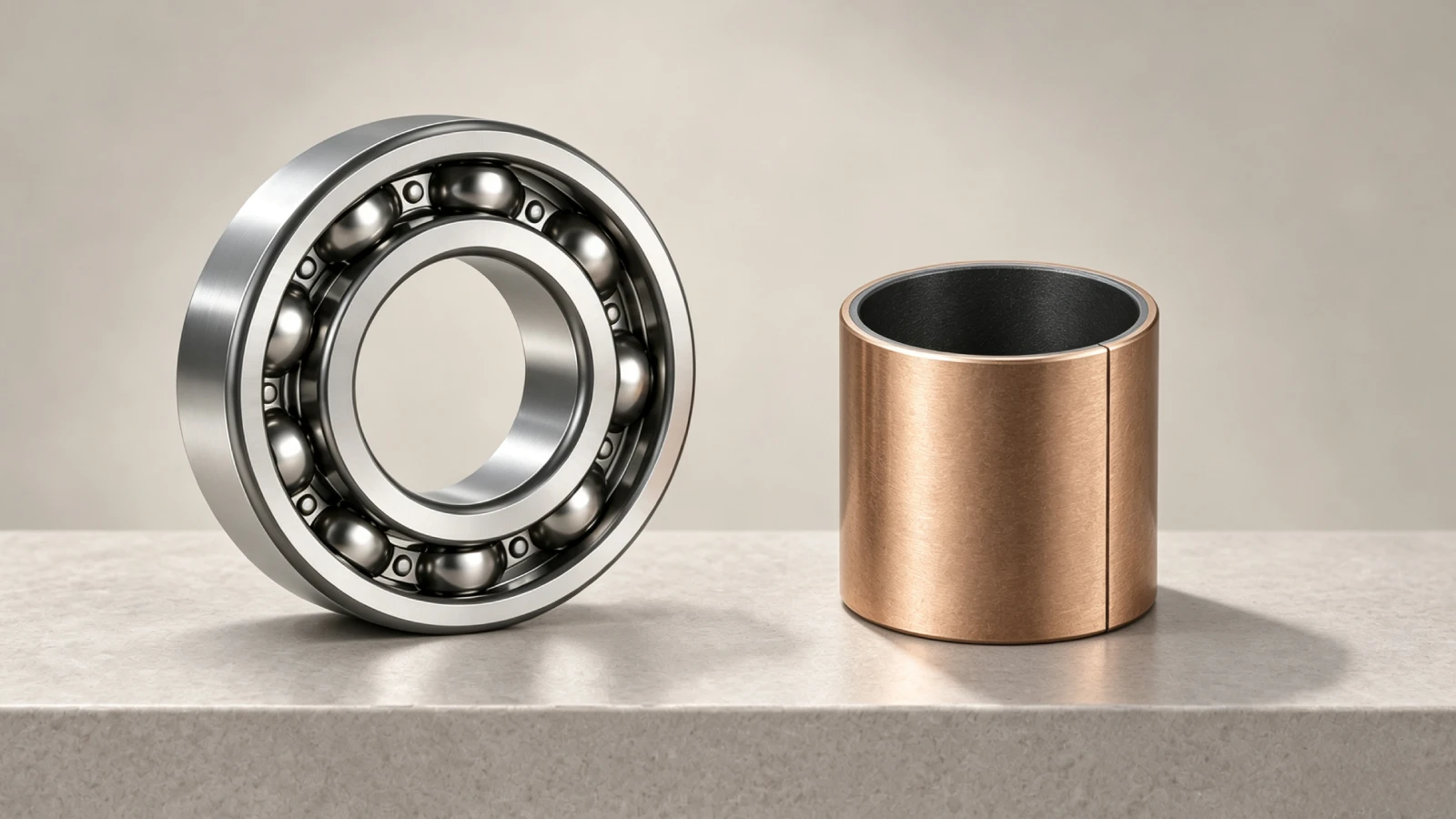
A bearing vs bushing decision should start with the required motion, load, speed, and accuracy. A rolling bearing separates moving rings with balls or rollers. A bushing supports a shaft or pin through sliding contact with a plain-bearing surface. Both reduce friction through different structures and operating principles.
In this comparison, bearing refers mainly to a rolling-element bearing, while a bushing means a cylindrical or flanged plain bearing. Neither design is universally better. The correct choice depends on the shaft, housing, lubricant, environment, space, and maintenance plan.
A rolling bearing normally includes an inner ring, outer ring, rolling elements, and often a cage. First, raceway geometry guides the balls or rollers and establishes the internal load path. Depending on the design, the bearing can support radial, axial, or combined loads while maintaining controlled shaft location.
By contrast, a bushing has no rolling elements. The shaft, pin, or guide slides against its bore or sliding layer. Bushings may be solid, wrapped, split, cylindrical, or flanged. Common materials include bronze, sintered metal, steel-backed metal-polymer, engineered plastic, and fiber-reinforced composite.
Both products can support rotation. However, bushings are also common in oscillating pivots, hinges, linkages, and reciprocating guides. Their performance depends strongly on the pairing between the bushing material and counterface. Therefore, shaft hardness, roughness, alignment, clearance, lubricant, and contamination form part of the complete system.
Consequently, a bushing vs bearing inquiry should define the contact type, motion, axial location, housing fit, and operating environment.
Rolling bearings generally provide low starting and running friction, predictable accuracy, and a broad range of standardized sizes. They suit continuous rotation and applications that need reliable shaft positioning. However, they contain several precision components and can be sensitive to contamination, impact, incorrect fit, and inadequate lubrication.
Bushings use a simpler structure and can fit into a thin radial space. Their larger contact area can suit shock, slow oscillation, and heavily loaded pivot positions. Some materials can run dry or with limited maintenance. Nevertheless, friction, wear, clearance growth, shaft condition, and heat generation must be checked for the actual material and duty.
| Selection point | Rolling bearing | Bushing |
| Friction | Usually low and predictable when correctly lubricated | Depends on material, lubricant, load, speed and counterface |
| Accuracy | Suitable for controlled shaft location and low runout | Clearance and wear can reduce positioning accuracy |
| Shock and vibration | Requires protection from denting and local stress | Conformal materials may absorb shock and damp vibration |
| Installation space | Needs space for rings and rolling elements | Thin-wall designs can reduce radial space and weight |
| Lubrication | Grease or oil is normally required | Dry-running, self-lubricating or externally lubricated options exist |
| Maintenance | Depends on seals, lubricant and service conditions | Some materials reduce relubrication, but wear still needs review |
These are general differences. Material, geometry, manufacturing accuracy, and installation can change the result.
First, identify the type of motion. Continuous high-speed rotation often favors a rolling bearing because it can provide low friction and accurate shaft guidance. By contrast, slow rotation, small oscillation angles, or intermittent pivot movement may favor a bushing, especially where shock, dirt, or limited space matters.
Next, evaluate the relevant performance data. For a rolling bearing, buyers normally review radial and axial load, speed, required life, basic ratings, internal clearance, fit, lubrication, and minimum-load requirements. For a bushing, the review should cover projected bearing pressure, sliding speed, the combined pressure-velocity or PV limit, temperature, wear allowance, and counterface condition.
Moreover, load distribution affects both designs. Shaft deflection or misalignment can create edge loading in a bushing, while similar errors can concentrate stress on a rolling-bearing raceway. Therefore, nominal bore size alone cannot confirm suitability.
Before selection, compare:
Finally, do not apply one universal speed or load boundary. Use technical data for the exact rolling bearing or bushing material under consideration.
Rolling bearings are widely used in motors, pumps, fans, gearboxes, machine spindles, conveyors, and driven shafts. These positions often require continuous rotation and controlled shaft location.
By contrast, bushings commonly support equipment pivots, hydraulic-cylinder pins, hinges, agricultural linkages, valve mechanisms, and sliding guides. These positions may combine low speed, shock, oscillation, and contamination.
| Application condition | Common starting point | Main confirmation |
| High-speed motor or fan shaft | Rolling bearing | Speed, accuracy, lubricant, heat and electrical conditions |
| Gearbox or pump shaft | Rolling bearing | Combined load, axial location, fit and alignment |
| Hydraulic-cylinder or linkage pivot | Bushing | Pressure, oscillation, pin finish, contamination and grease access |
| Compact hinge or adjustment point | Bushing | Wall thickness, clearance, wear and corrosion |
| Linear or reciprocating guide | Either design | Accuracy, stroke, friction, load direction and environment |
However, some machines use both designs: rolling bearings support rotating shafts, while bushings guide external pivots or linkages. Therefore, the industry or machine name alone should not determine the product.
Current development focuses on controlling friction, maintenance, weight, and environmental exposure. For bushings, metal-polymer layers, engineered plastics, composites, corrosion-resistant backings, and specialized surface materials expand the available dry-running or low-maintenance options. However, each material still has specific limits for pressure, speed, temperature, chemical exposure, and shaft finish.
Meanwhile, rolling-bearing development includes improved steels, coatings, cage materials, seals, lubricants, and electrically insulated or hybrid constructions. In rotating equipment, temperature and vibration monitoring can reveal changes in lubrication, alignment, load, or surface condition before severe damage develops.
Nevertheless, monitoring supports maintenance rather than replacing correct selection. Buyers should determine whether the application allows practical checks of wear, clearance, temperature, or vibration.
HSN can discuss rolling-bearing supply and selected sliding-bearing requirements using the model, drawing, sample, dimensions, load, motion, material, and working conditions. Any proposed alternative still requires confirmation of the shaft, housing, fit, lubricant, environment, quantity, and inspection requirements.
Is a Bushing a Type of Bearing?
Yes. A bushing is a plain bearing that supports sliding, rotating, oscillating or reciprocating motion.
Which Design Is Better for High-Speed Rotation?
Rolling bearings are often preferred, but speed, load, accuracy, lubrication, heat and the exact design must be checked.
Can a Bushing Replace a Rolling Bearing Directly?
Not automatically. The shaft, housing, clearance, friction, load, speed, lubrication and axial location may need redesign.
Does HSN support shipping and customs clearance for U.S. customers?
Yes. HSN supports flexible trade terms, shipping arrangements, customs documentation, and delivery coordination for U.S. orders.
For detailed bearing or bushing models not listed above, please contact HSN for model confirmation and supply discussion. For other bearing types, send the complete model, photos, dimensions, quantity, application, and working conditions.
This article is based on independent analysis of publicly available technical information and industry understanding and is intended for knowledge sharing. All brand names and trademarks belong to their respective owners. HSN Bearing Group is an independent bearing supplier and technical service provider.
Tel: +86 156 6578 7336 Email: service@hsnindustrial.com Website: www.rollingparts.com www.hsnbearings.com