Timken wheel hub bearings are often searched by vehicle brand, model, year, and axle position. However, a similar number or vehicle name does not always mean the bearing will fit. A reference may point to a separate wheel bearing, a wheel bearing kit, or a complete hub assembly.
For buyers, the priority is to confirm the correct bearing reference and vehicle fitment before comparing prices or checking stock availability. This guide explains how to check Timken wheel bearings by vehicle type, bearing structure, vehicle brand reference, model number, and inquiry information.
Timken wheel bearings are used across different vehicle categories. However, each vehicle type has different wheel-end requirements, load conditions, and fitment risks.
Passenger cars usually require accurate fitment because the same model family may have different front and rear wheel-end designs. A small difference in ABS sensor design, flange shape, or mounting hole position may affect installation.
For passenger car applications, buyers should confirm the vehicle make, model, production year, engine type, and front or rear position before requesting a quotation.
Light commercial vehicles often carry higher loads than passenger cars. Their wheel bearings may need stronger support for repeated braking, cargo weight, and road impact. For these applications, the bearing or hub assembly should be checked according to the axle position and actual working conditions.
4x4s and SUVs may use different wheel-end structures depending on whether the vehicle is front-wheel drive, rear-wheel drive, or four-wheel drive. A wheel bearing hub assembly for one version may not fit another version, even when the vehicle name looks similar.
Trailer wheel bearings usually need careful confirmation of bearing size, seal arrangement, and hub structure. For maintenance buyers, it is important to check whether they need a single bearing, a matched bearing set, or a kit with related components.
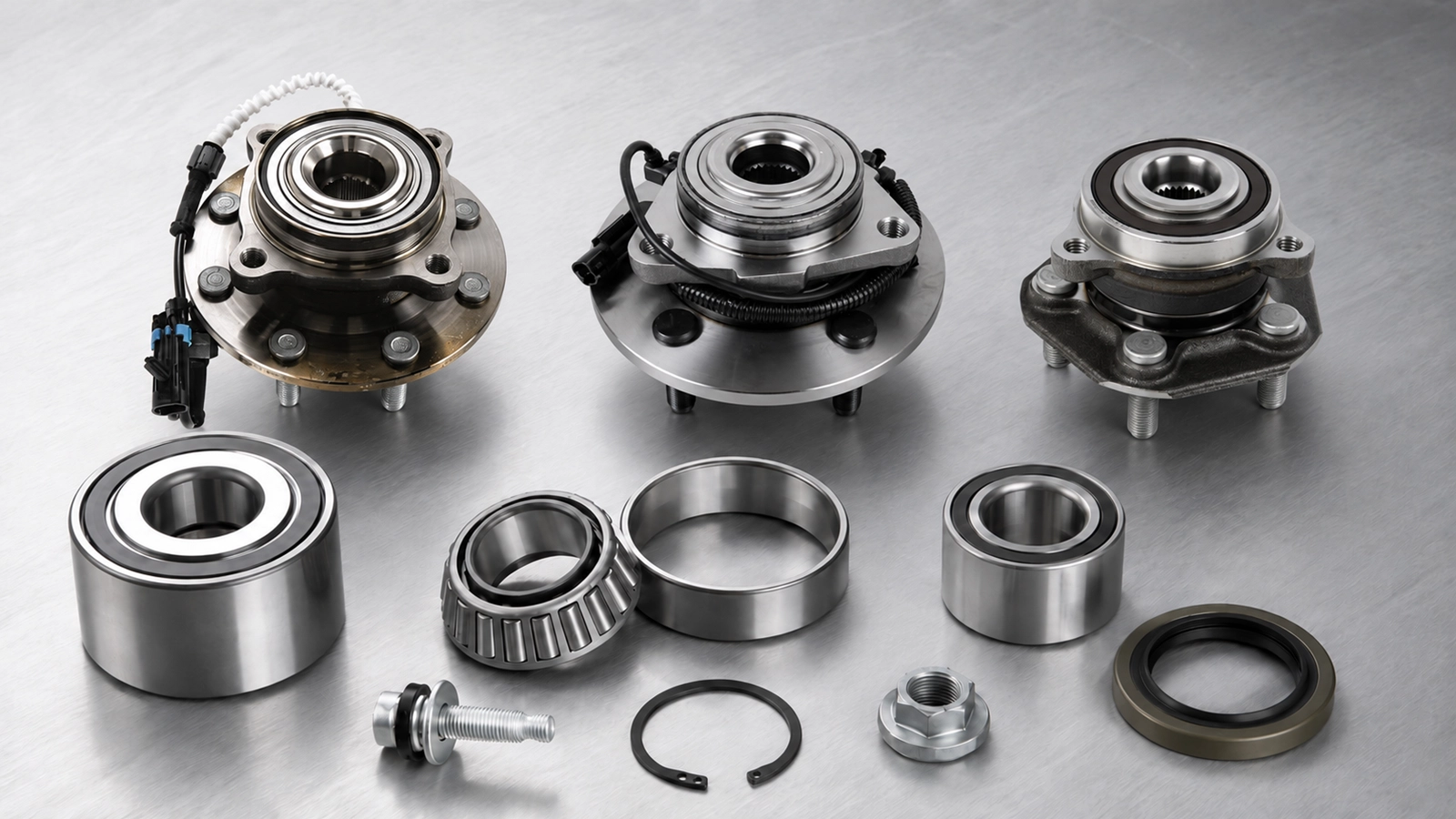
Timken wheel bearing products may appear in several forms. Buyers should identify the product type before ordering because each form has different confirmation points.
A separate wheel bearing is usually replaced as an individual component. In this case, the buyer should confirm the model number, dimensions, seal requirement, and matching parts. Wheel bearing kit may include the bearing and related components, but kit contents are not always the same.
A timken wheel bearing hub assembly is more integrated. It may include a flange, mounting holes, spline, ABS or speed sensor, and other structural details. Even when the internal bearing looks similar, the assembly may not fit if the flange, sensor, or spline is different. Some wheel-end systems also use tapered roller bearing arrangements, which require correct adjustment and installation according to the vehicle manufacturer’s procedure.
For aftermarket buyers, vehicle brand coverage is an important search entry. Timken wheel hub bearings and wheel bearing kits are commonly searched for passenger cars, light commercial vehicles, SUVs, 4x4s, and trailer axle applications from brands such as Toyota, Ford, Honda, Nissan, Hyundai, BMW, Audi, Volkswagen, Mercedes-Benz, Jeep, and Isuzu.
However, the vehicle brand alone is not enough for accurate sourcing. A Toyota Corolla, Ford Focus, Honda Civic, Nissan Altima, BMW 3 Series, Volkswagen Golf, or Mercedes-Benz E-Class may use different wheel bearing references depending on the production year, engine version, front or rear axle position, ABS system, market configuration, and hub structure.
Therefore, buyers should treat the vehicle brand as the first search clue, not the final confirmation. A safer process is to confirm the vehicle make and model, year range, engine or platform version, axle position, bearing or hub type, and old part photos or dimensions before placing an order.
A wheel bearing number does not always describe the physical size of a bearing. Some numbers are kit or application references, while other references may relate to a separate bearing or a complete hub assembly.
Wheel bearing kit references such as 1278, 3142, 2884, 1250, or 8096 should not be read directly as bore, outside diameter, or width. These numbers should be checked together with the vehicle model, production year, engine version, axle position, and ABS or non-ABS notes.
For example, a buyer who only provides a kit number may still need to confirm whether the request is for the complete kit or one component inside the kit.
Vehicle platform codes also matter. In a Toyota Corolla application, codes such as AE90, AE92, AE93, AE94, AE101, AE111, AE102, AE112, ZZE122, or ZZE123 describe vehicle versions rather than bearing dimensions.
A Corolla AE92 reference and a Corolla ZZE122 reference may lead to different kit numbers. Notes such as Inc ABS or Exc. ABS must also be checked because sensor configuration may change the correct part.
For hub assemblies, buyers should confirm flange shape, bolt hole layout, spline count, sensor type, and mounting direction. Photos of the old part help reduce mistakes. Useful photos include the marking, front view, side view, flange, spline, sensor connector, and packaging label.
Before sending an inquiry, buyers should prepare clear fitment and product information. This helps reduce wrong supply and repeated communication.
| Confirmation item | Why it matters |
| Vehicle make, model, year | Confirms fitment range |
| Engine or platform version | Avoids wrong version matching |
| Front or rear position | Avoids axle-position errors |
| ABS or sensor type | Important for hub assemblies |
| Kit or bearing reference | Confirms what should be supplied |
| Photos and dimensions | Helps verify structure |
If the old model is difficult to identify, a drawing or sample can support a more accurate replacement discussion.
HSN Bearing Group supports overseas buyers with model confirmation, sourcing discussion, and quality inspection before shipment. When customers send a Timken reference, vehicle details, or photos, HSN can help check whether the request is for a separate bearing, a kit, or a wheel bearing hub assembly.
For stock models, HSN can confirm availability according to quantity. For difficult-to-source references, HSN can discuss a replacement option after checking dimensions, structure, and application requirements.
Is a wheel bearing number the same as a hub assembly number?
No. A bearing number may refer only to the bearing, while a hub assembly number may include flange, spline, sensor, and mounting features.
Can the same kit fit different vehicles?
Sometimes, but fitment still needs to be confirmed by year, axle position, ABS system, and structure.
What information is needed for replacement discussion?
Send the complete reference, vehicle details, photos, dimensions, quantity, and working conditions.
Can HSN discuss an alternative option?
Yes. HSN can discuss an alternative option after confirming dimensions, fitment, and application conditions.
For detailed Timken wheel bearings not listed above, please contact HSN for reference confirmation and supply discussion. You can also send the bearing model number, vehicle make and model, production year, axle position, photos, dimensions, quantity, or application details for review.
This article is based on independent analysis of publicly available technical information and industry understanding for knowledge sharing. All brand names and trademarks mentioned belong to their respective owners. HSN Bearing Group is an independent bearing supplier and technical service provider.
Tel: 86.156.6578.7336 Email: service@hsnindustrial.com Website:www.rollingparts.com www.hsnbearings.com