
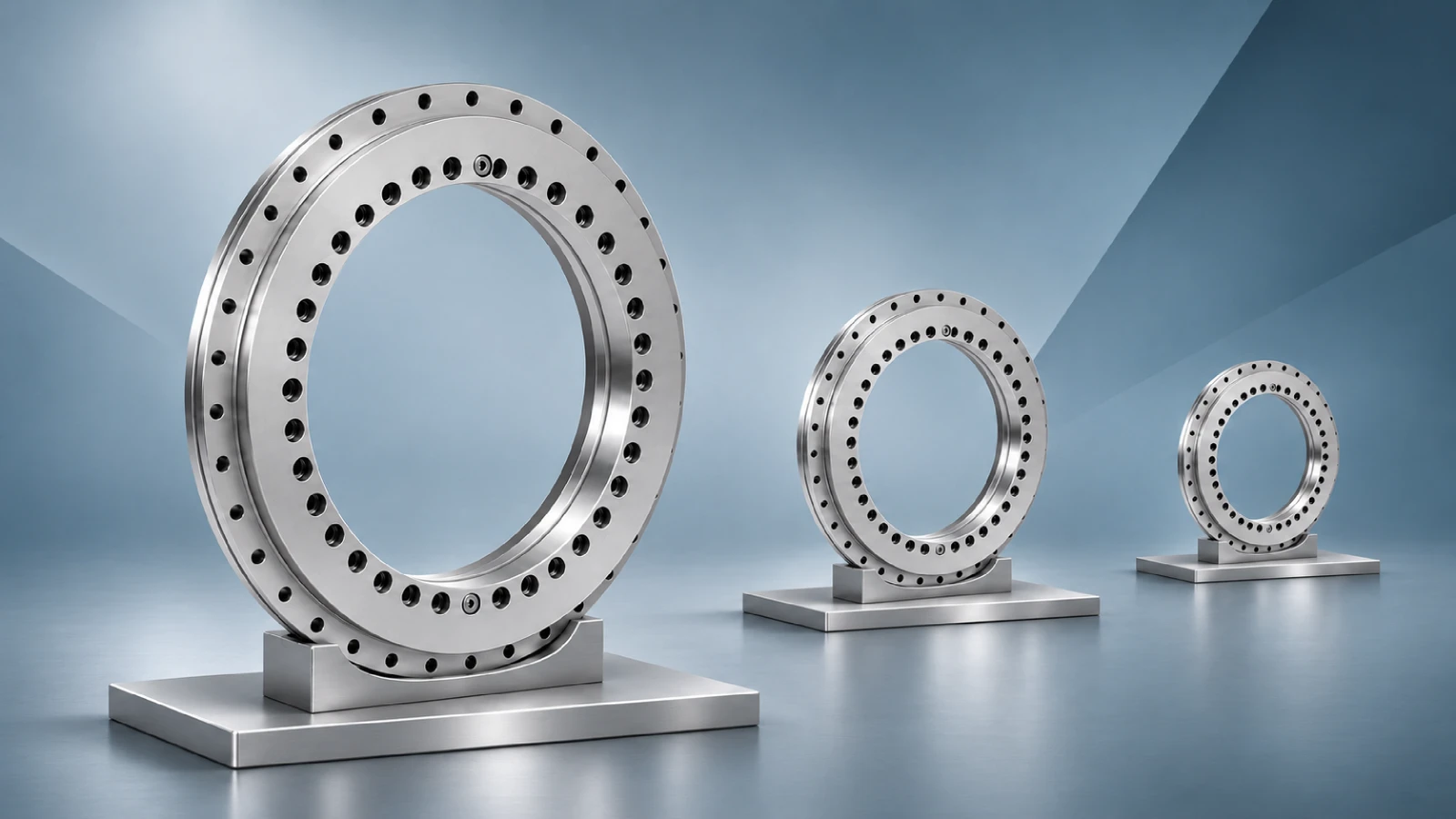
A rotary table bearing supports a rotating or indexing machine-tool table while controlling tilt, runout and axial position. A buyer must know the installed bearing architecture and table assembly, not just the table diameter. The support may use a combined axial-radial roller arrangement or a precision crossed-roller design. Those products differ in mounting and setting, so neither becomes a verified replacement from overall dimensions alone.
Once buyers identify the table support, they can compare its structure with the machine’s load and accuracy requirements. Lubrication, mounting faces and teardown measurements then define the replacement scope. This sequence turns specifications for rotary table bearings into clear inspection and RFQ requirements.
The bearing sits on the table’s rotary axis. It supports workpiece and fixture weight and resists overturning moments as cutting forces act away from the axis. Indexing tables, vertical turning or grinding tables and trunnion-style rotary axes can impose different combinations of forces. The machine drawing identifies the bearing’s exact position and what other supports or drives share the load.
A table axis is not automatically the high-speed cutting spindle. The search phrase turntable spindle bearing may refer to a table spindle or central shaft, but the buyer should point to the actual support on a sectional drawing. This avoids ordering a cutting-spindle angular contact set for a low-speed table joint.
Gear-driven, direct-drive and worm-drive tables can also place the drive forces differently. Record the assembly revision and drive interface. A bearing code from a different machine option may have the same basic size yet use another mounting, preload or measurement-system arrangement.
An axial-radial rotary table bearing can combine axial roller rows with radial guidance in a compact unit. Schaeffler’s YRT family is an example of this structural category; its particular series and options must be checked in the official catalog. A precision crossed-roller bearing alternates roller orientation to support combined loads and moments in a compact section. Timken offers crossed-roller precision designs for rotary and indexing tables. These examples describe types, not interchangeable parts.
Some tables use other precision roller or angular contact arrangements with separate setting components. The engineer’s design decides whether preload is built into a unit or established through assembly. Replacing a complete combined unit with separate bearings changes the load path and requires a full design review.
| Structure | Main design question | Quote must identify |
| Axial-radial unit | How are axial and radial loads integrated? | Series, mounting faces and preload |
| Crossed-roller unit | How is moment stiffness achieved? | Raceway design, setting and fits |
| Separate bearing set | Which element locates the axis? | Full stack and setting procedure |
Keep the bearing’s full marking and drawing revision. A family name such as YRT does not specify a size or variant, and a generic “crossed roller” label does not specify accuracy class.
Manufacturer catalog example: Schaeffler YRT 200 is listed as an axial-radial bearing for rotary tables in its product reference guide. The catalog designation illustrates one structure and size, not a substitute for a crossed-roller unit or an unverified machine axis. Confirm the exact variant, mounting interfaces, preload and accuracy specification against the machine drawing. Source: manufacturer product information.
Some rotary-axis products integrate features beyond the rolling support, such as gearing or a measuring system. If the installed unit has either, a bare bearing quote may omit a necessary interface. Separate the bearing code from the axis assembly number on the purchase request. The service drawing should identify what can be transferred and what must be supplied as a matched part.
A rotary table’s axial and radial runout depend on both the bearing and the assembled machine. Mounting-face flatness, perpendicularity and stiffness affect the installed condition. Therefore, a high catalog accuracy class cannot compensate for a damaged seat or prove the finished table’s positioning accuracy.
Separate the evidence needed at each stage:
An off-center workpiece and offset cutting forces increase the overturning moment at the bearing. The support must resist that moment while meeting the table’s stiffness and runout requirements. Nominal payload or a high axial load rating alone cannot establish suitability.
Preload helps control tilt and running accuracy, but it also affects torque and heat. Mounting-face errors or excessive clamping can alter the intended setting. Compare the specified preload and speed duty with the assembled table, rather than relying only on a catalog speed limit.
Heat also depends on speed and the specified grease or oil supply. Coolant and chips can compromise external sealing, while a changed port or cover may interfere with the encoder or drive gear. Check lubrication and seal changes against the axis drawing before approving a replacement.
Abnormal positioning error or table noise does not prove the bearing has failed. Compare drive backlash, encoder feedback, loose fasteners and lubricant condition before assigning the fault. During teardown, photograph raceway markings and fretting, then measure the table and housing seats against the approved drawing. A new bearing may not restore accuracy if the mounting faces remain damaged.
If the installed unit is obsolete, use the approved section drawing to define the custom replacement. Review material and heat treatment, raceway geometry, mounting-hole pattern, locating faces, preload method and acceptance tolerances. An old sample can help identify interfaces, but wear may obscure the original geometry. The machine owner or responsible engineer must approve the design and the complete-table acceptance method.
Group the rotary table RFQ information as follows:
HSN can review drawings or complete codes for stock, a difficult model or custom manufacturing with agreed dimensional and material checks. The table builder or qualified rebuilder must approve setting, mounting and finished-axis accuracy. A carefully specified bearing helps the buyer compare supply offers while keeping machine performance validation in the repair plan.
Can a crossed roller replace any YRT bearing?
No. Geometry, mounting, preload and table loads require engineering review; the types are not blanket substitutes.
What if a U.S. shop finds a worn mounting face?
Measure it against the approved drawing and obtain repair approval before fitting the new bearing.
Which table checks belong in a U.S. rebuild order?
Give the full code, drawing, required inspection report, receiving date and final table acceptance plan.
Can HSN review a custom table bearing?
HSN can discuss drawings and agreed checks; the responsible table engineer must approve the design.
For detailed rotary table bearing models not listed above, please contact HSN for model confirmation and supply discussion. When checking other bearing references, you can also send the complete model, photos, dimensions, quantity, application, and working conditions.
This article is based on independent analysis of publicly available technical information and industry understanding for knowledge sharing. All brand names and trademarks mentioned belong to their respective owners. HSN Bearing Group is an independent bearing supplier and technical service provider.
Tel: +86 156 6578 7336 Email: service@hsnindustrial.com Website: www.rollingparts.com www.hsnbearings.com