
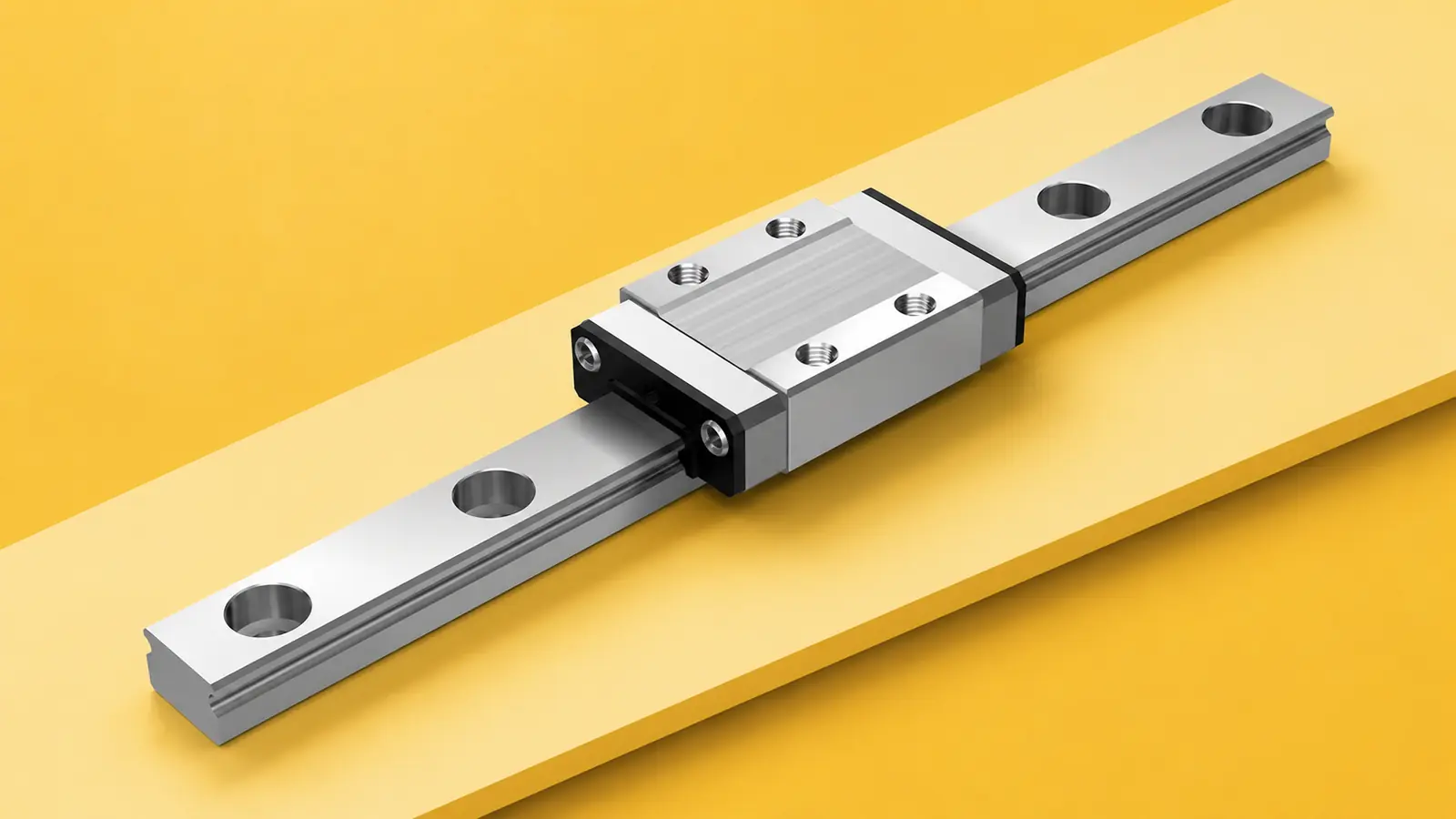
Linear bearings and rails form a matched motion system in which bearing blocks travel along profiled rails. Recirculating balls or rollers transmit loads through precision-ground raceways, giving the assembly greater rigidity and moment capacity than many unsupported round-shaft systems.
When sourcing a linear bearing slide rail, buyers should evaluate the rail and carriage together. Rail profile, block size, load direction, preload, accuracy class, sealing, and mounting-hole patterns can vary between series. Therefore, buyers should confirm the complete model, matching rail and block codes, and technical drawing instead of selecting a square linear bearing by width alone.
A typical system contains an LM block, rail, recirculating rolling elements, end caps, seals, lubrication connections, and mounting fasteners. The block provides the moving interface, while the rail establishes the straight reference path. Multiple blocks can share one rail, and two rails are often mounted in parallel.
Ball guideways offer low friction, smooth motion, and good dynamic response. Roller guideways use line contact to provide greater rigidity and load capacity, but they have different preload and alignment demands. Miniature, low-profile, wide, and flange-block arrangements solve different space and moment-load problems.
Rail length and hole layout are part of the order. A block code does not specify the complete system.
Linear guide systems can be compared by rolling-element design, guide size, rail form, and block shape. These features should be checked together because one system may combine several of them.
| Type | Main feature | Practical selection point |
| Guide design – Ball rail guide | Recirculating balls run in profiled raceways for smooth linear motion | Speed, load direction, preload, accuracy, and required rigidity |
| Guide design – Roller rail guide | Recirculating rollers provide greater contact area and high rigidity | Heavy load, moment load, rigidity, mounting accuracy, and base stiffness |
| Guide size – Miniature guide | Compact block and rail cross-section for space-limited installations | Available space, load and moment capacity, accuracy, fastener size, and environment |
| Rail form – Wide / low-profile guide | Broad or reduced-height geometry supports compact machine layouts | Moment capacity, installation height, rail width, and mounting space |
| Block form – Flange block | Wide mounting flange provides a larger connection surface | Bolt direction, mounting pattern, platform interface, and block dimensions |
| Block form – Square block | Compact block body without a wide mounting flange | Side clearance, mounting direction, carriage width, and installation space |
Before removing a block from the rail, check whether it has a ball-retaining design. Use the specified transfer or temporary rail where required to prevent ball loss and simplify reassembly.
Profiled linear bearings and rails are widely used in machine tools, automation equipment, industrial robots, packaging machinery, electronic assembly, measuring systems, medical equipment, material handling, and precision positioning systems. They provide guided linear motion where the machine requires controlled accuracy, rigidity, repeatability, or load capacity. The required rail size, block style, preload, sealing, and accuracy class therefore depend on the operating task rather than on travel length alone.
A machining center usually prioritizes rigidity, positioning accuracy, and resistance to moment loads, while a high-speed handling axis may place more emphasis on low friction, sealing, and smooth acceleration. Long-travel systems also require checks for rail joints, mounting-hole layout, alignment, and support stiffness. Vertical axes need additional measures to prevent uncontrolled descent, while contaminated environments may require stronger seals, covers, and more frequent lubrication. Buyers should therefore evaluate the complete motion system, including load direction, speed, stroke, mounting surface, accuracy, and working environment.
Provide radial, reverse-radial, and lateral loads, plus pitch, yaw, and roll moments. Identify the location of each force relative to the block centers. Then define the motion profile:
Preload can increase rigidity, but excessive preload also raises friction and installation sensitivity. The selected class must match the load and mounting accuracy. Likewise, a high accuracy grade cannot correct a distorted machine base.
Clean the reference surfaces and remove burrs, paint, rust, and raised edges. Identify the reference sides of both rail and block. Mount the master rail against its datum, tighten fasteners in the specified sequence, and use the approved torque.
Set the second rail from the master rail or from an independent machine datum. Check parallelism through the full length before installing the moving table. Tighten the block fasteners only after the carriage moves smoothly without local binding.
Do not mix blocks, rails, shims, or jointed-rail sections without identification. If a block must be removed, use the correct transfer rail and preserve its orientation. Protect exposed raceways and prevent balls, rollers, seals, or end caps from impact.
The examples below represent different designation systems. A similar size number does not establish direct interchangeability.
| Brand | Main rail-guide series | Complete model example |
| THK | SHS caged-ball and HSR full-ball LM Guides | SHS25C2SSC1+640L |
| Bosch Rexroth | High-precision ball rail system | R165111420 block with R160510431 rail |
| HIWIN | HG heavy-load ball guideway | HGW20CC |
| Schaeffler | KUVE four-row ball monorail system | KUVE25-B-ESC |
Compare rail width and height, block envelope, mounting-hole pattern, raceway geometry, preload, accuracy, seals, rail length, and load ratings. Brand codes should remain identification references until the complete technical comparison is finished.
THK model SHS25C2SSC1+640L identifies a complete single-rail unit with blocks and a defined rail length.
| Code | Code section | Meaning |
| SHS | Model series | Caged-ball LM Guide series |
| 25 | Size section | Nominal guide size 25 |
| C | Block type | Flange-type LM block configuration |
| 2 | Block quantity | Two LM blocks used on one rail |
| SS | Protection symbol | End seals and related standard contamination protection |
| C1 | Clearance symbol | THK radial-clearance class C1 |
| +640L | Rail section | LM rail with a 640 mm specified length |
Additional symbols can define lubrication, surface treatment, accuracy, material, or the number of rails used on one plane. Send the complete sequence, because omission of one symbol can change the requested assembly.
HSN Bearing Group reviews linear bearings and rails as complete motion systems. Buyers should provide the full codes, photos, drawings, rail length, and hole layout. HSN can review block spacing, preload, accuracy, seals, lubrication, loads, moments, speed, and stroke. Duty cycle, environment, quantity, and mounting conditions also guide confirmation. These details support stock and supply checks.
For difficult or discontinued systems, HSN can compare geometry and working conditions. Replacement or custom supply can follow technical confirmation. Before shipment, checks may cover dimensions, hardness, rail straightness, identification, appearance, and block movement. Clearance or preload-related checks can also be discussed. A block reference alone does not define the complete rail system or prove cross-series compatibility.
Can a block fit any rail with the same width?
No. Raceway geometry, size, preload, accuracy and matching rules must be confirmed for the complete system.
Should blocks and rails be ordered separately?
Only when the maker permits it and every code detail is known. Many assemblies require matched or specified components.
Why does rail mounting accuracy matter?
Poor flatness or parallelism can create binding, uneven load sharing, heat, noise and reduced travel accuracy.
What data is needed for a long rail?
Provide total length, hole pitch, end distances, joint restrictions, accuracy, mounting datum and shipping limits.
For detailed linear bearing and rail models not listed above, please contact HSN for model confirmation and supply discussion. When checking linear bearing rail references, you can also send the complete assembly code, photos, drawings, dimensions, rail length, quantity, and working conditions for review.
This article is based on independent analysis of publicly available technical information and industry understanding for knowledge sharing. All brand names and trademarks mentioned belong to their respective owners. HSN Bearing Group is an independent bearing supplier and technical service provider.
Tel: +86 156 6578 7336 Email: service@hsnindustrial.com Website: www.rollingparts.com www.hsnbearings.com