
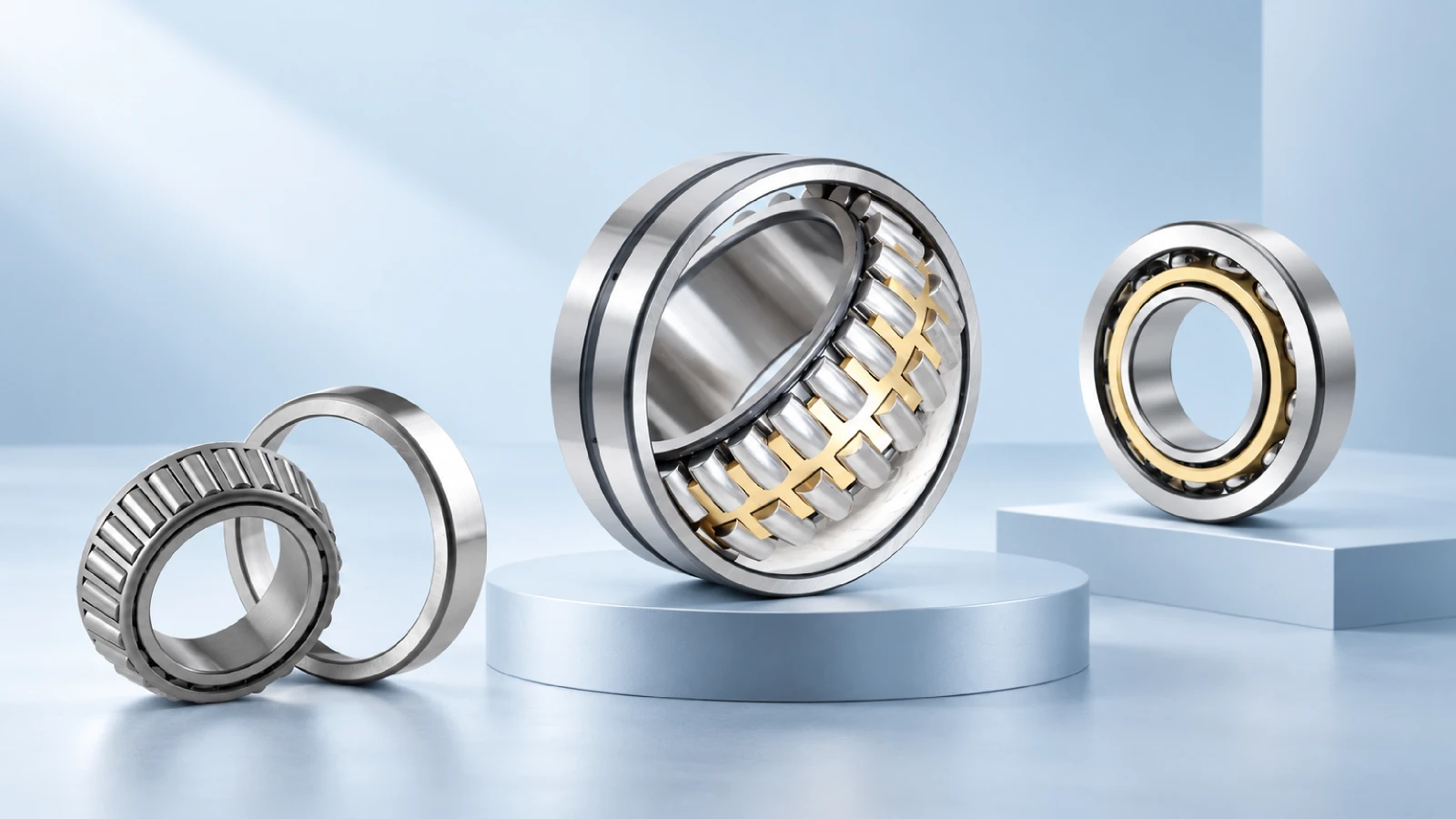
A bearing can only carry a load reliably when its structure matches the direction, magnitude, and duration of the applied force. Therefore, bearing a load safely involves more than comparing the calculated force with one catalog rating. Speed, shock, alignment, temperature, fit, and the surrounding structure can all change the load inside the bearing.
For buyers, the first task is to define how the machine applies force. The next task is to select an arrangement that supports that force without unintended preload or local stress.
Bearing loads are first classified by direction. A radial load acts across the shaft, while an axial or thrust load acts along it. When both act at the same time, the bearing carries a combined load. An eccentric force can also create a tilting moment across a single bearing or bearing pair.
The way the load changes is equally important. A conveyor pulley may have a steady radial load. By contrast, a crusher, screen, or reciprocating mechanism can introduce shock or fluctuating forces. Starts, stops, braking, belt tension, gear forces, and unbalanced components can further increase the peak load.
Buyers should also distinguish the applied load from a bearing’s basic dynamic and static load ratings. These ratings support calculation and comparison; they are not universal allowable-load limits. The required bearing size still depends on life, speed, reliability, lubrication, load distribution, and the applicable manufacturer’s calculation method.
Rolling elements transfer force between the inner and outer raceways. Balls provide low friction and suit many moderate-load and high-speed applications. Rollers create a longer contact zone, so a similar-size roller bearing can often support a heavier radial load. However, raceway geometry, roller length, internal design, and material condition still influence the actual rating.
Contact angle determines the direction of the internal load path. A deep groove ball bearing has a small effective contact angle and can carry radial load plus a limited axial component. Angular contact ball bearings and tapered roller bearings use a larger contact angle, making them more suitable for combined loads and axial location.
A larger contact angle does not automatically make a bearing better. It can change axial capacity, rigidity, internal forces, friction, and speed capability. In addition, angular contact and tapered roller bearings often need a paired or opposed arrangement when axial forces act in both directions. Buyers must therefore confirm the complete bearing arrangement, not only the individual component.
The ratio between radial and axial force helps narrow the initial bearing choice. Nevertheless, there is no universal ratio that applies to every series. Final selection must follow the load factors and limits for the exact bearing designation.
| Load condition | Bearing structures commonly considered | Main checks |
|---|---|---|
| Pure or dominant radial load | NU- or N-type cylindrical roller bearings, needle roller bearings | Axial displacement, minimum load, speed, shaft and housing accuracy |
| Radial load with a smaller axial component | Deep groove ball bearings, some spherical roller bearings | Internal design, clearance, axial direction and misalignment |
| Combined radial and axial load | Angular contact ball bearings, tapered roller bearings | Contact angle, pairing, preload or clearance and axial direction |
| Dominant axial load | Thrust ball bearings, cylindrical or spherical roller thrust bearings | Single- or double-direction load, minimum load, speed and alignment |
| Combined load with a moment | Paired single-row bearings or double-row designs | Bearing span, arrangement, housing rigidity and load distribution |
Common family examples include 6205 deep groove ball bearings, NU 205 cylindrical roller bearings, 7205 angular contact ball bearings, 30205 tapered roller bearings, and 51105 thrust ball bearings. These references only illustrate structure families. Suffixes, internal features, ratings, and permissible loads must be checked in the selected manufacturer’s current data.
When bearing a load with a large axial component, using a larger radial bearing is not always the correct answer. A bearing with a more suitable contact angle, a paired arrangement, or separate radial and axial bearings may create a clearer load path.
Calculated machine forces do not always describe the maximum stress inside the bearing. Misalignment can concentrate the load on part of a raceway or roller. Likewise, an out-of-round housing or a flexible shaft can change internal load distribution even when the nominal radial force remains unchanged.
Fit and clearance also matter. Excessive interference, excessive preload, or thermal expansion can reduce operating clearance and raise friction. Conversely, insufficient fit can allow creep between a bearing ring and its mating surface. Both conditions may generate heat and surface damage.
Operating events create additional peaks. Sudden starts, emergency stops, impact loading, belt over-tension, gear errors, and rotating imbalance can exceed the normal calculated load. Contamination and inadequate lubrication add friction, while roller skew or cage instability can increase local stress. For this reason, buyers should include abnormal but foreseeable operating conditions in the load review.
Overload prevention starts with a complete duty description. Record radial and axial forces, moment loads, shock, speed, acceleration, operating hours, temperature, and required life. If the load changes during a cycle, identify both the duration and magnitude of each stage rather than using only an average value.
Next, confirm the complete support system:
HSN can review a bearing inquiry using the complete model, drawing, dimensions, loads, speed, application, and working conditions. When an alternative is discussed, dimensions alone are not enough. The load direction, internal design, clearance, cage, lubrication, and inspection requirements must also be confirmed before ordering.
What Is the Difference Between Radial and Axial Load?
A radial load acts across the shaft. An axial load acts along it and may apply in one or both directions.
Can Load Rating Alone Confirm Bearing Suitability?
No. Buyers must also check load direction, speed, life, fit, clearance, lubrication, temperature and shock.
Why Can Preload Create Bearing Overload?
Excessive preload raises internal force, friction and heat. Thermal expansion can reduce operating clearance further.
What Load Information Should Buyers Provide?
Send radial, axial and moment loads, speed, duty cycle, shock, temperature, required life and mounting details.
.
For detailed bearing models not listed above, please contact HSN for model confirmation and supply discussion. When reviewing load requirements, send the complete model, photos, dimensions, quantity, application, and working conditions.
This article is based on independent analysis of publicly available technical information and industry understanding and is intended for knowledge sharing. All brand names and trademarks belong to their respective owners. HSN Bearing Group is an independent bearing supplier and technical service provider.
Tel: +86 156 6578 7336 Email: service@hsnindustrial.com Website: www.rollingparts.com www.hsnbearings.com