
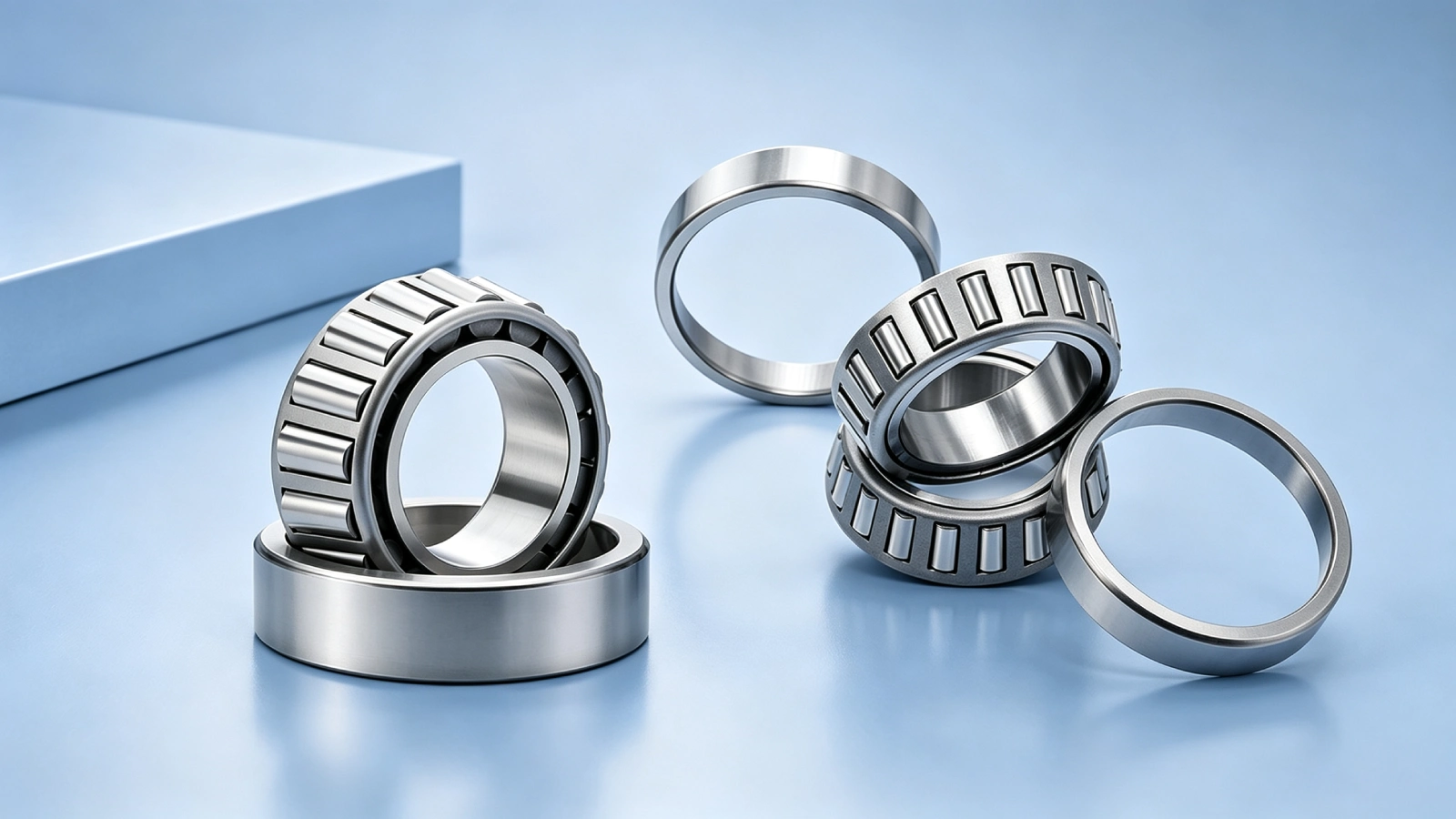
Specify a tapered rolling bearing as a complete functional arrangement. Cone, cup, contact angle, setting, shaft and housing fits, lubrication, and axial location work together. A tapered wheel bearing, gearbox, or differential especially needs complete data because an incomplete component number can lead to the wrong mating part.
The cone contains the inner ring, tapered rollers, and cage. The cup is the separate outer ring. Their tapered raceways create a combined radial and thrust load path, while the effective bearing centre lies away from the physical centreline of the ring width.
Buyers should distinguish three procurement forms:
The mounting arrangement also matters. Two single-row bearings can face each other in a direct arrangement or point away from each other in an indirect arrangement. Each arrangement changes moment stiffness, effective spread, thermal response, and the method used to control setting.
Common locations include wheel ends, axles, differentials, transmissions, gearboxes, pinions, construction machinery, agricultural equipment, rail systems, and industrial drives. A tapered wheel bearing often sees radial load, cornering thrust, braking load, shock, contamination, and temperature variation in the same duty cycle.
Therefore, buyers should provide maximum and normal radial load, thrust direction, speed, duty cycle, required life, shock, temperature, lubricant, seals, and contamination. Also identify whether the shaft or housing rotates and whether the bearing must locate the shaft axially.
For a service replacement, record the removed cone, cup, spacer, seal, and nut references separately. A cup marking alone may not identify the correct cone. Likewise, a cone code cannot define the housing outside diameter without its mating cup.
Start with both mating component numbers and the approved assembly drawing. Then confirm bore, cup outside diameter, total width, cone width, cup width, shoulder diameters, fillet radii, and effective centre. These details control fit and adjacent-part clearance.
Next, verify load ratings, contact angle, cage, accuracy class, surface finish, heat treatment, and speed data. In addition, define the assembly setting as endplay or preload at the specified measurement condition. Temperature and fit can change the operating setting after installation.
Finally, confirm suffixes and special modifications. A suffix may identify altered dimensions, tolerance, internal geometry, material, or processing. Therefore, a shortened reference can describe a different product even if the component seems to fit.
The following examples show three ways international brands identify metric tapered roller products. They are reference formats, not cross-brand replacement approvals.
| Brand | Series examples | Complete model example |
| Timken | J-Line metric-envelope TS; original metric 302/322 series | JHM33449 / JHM33410 |
| SKF | 302; 303; 320; 322; 323 single-row series | 32218 |
| NSK | HR metric tapered roller series | HR32218J |
Timken J-Line products use separate cone and cup component numbers. By contrast, many ISO-style products use one main assembly designation. Buyers should still confirm whether the supplier ships one component or the complete bearing set.
Timken lists JHM33449 as the cone and JHM33410 as its matching cup in the HM33400 series. Because J-Line references use complete component numbers, buyers should treat the cone number, cup number, and series relationship separately rather than forcing every character into a simplified code split.
| Code | Code section | Meaning |
| J | System prefix | Metric component prefix used in Timken J-Line references |
| HM33400 | Series reference | Bearing family shared by the matching cone and cup |
| JHM33449 | Cone reference | Complete cone component number for this bearing set |
| JHM33410 | Cup reference | Complete matching cup component number for this bearing set |
Keep both component numbers in the purchase description unless technical confirmation shows that only one verified service component is required. The HM33400 series reference alone does not define the complete cone-and-cup combination, lubricant, setting, or any special modification. Buyers should therefore use the complete Timken component numbers and current drawing when ordering.
Shaft and housing fits directly affect the operating clearance of an opposed bearing pair. Before assembly, confirm seat tolerances, roundness, surface finish, shoulders, and fillet radii. Keep each cone and cup clean and correctly matched, apply mounting force only through the ring receiving the fit, and seat the rings fully against the approved shoulders.
The pair also needs a defined setting. Endplay permits controlled axial movement, while preload removes free play and increases stiffness. However, excessive preload raises friction, torque, and temperature. Therefore, the target setting should reflect load, speed, system rigidity, lubrication, and thermal conditions.
Use the approved nut torque, spacer, shim, or automated setting process. A torque value alone does not always confirm the final bearing setting. After assembly, rotate the unit and measure the specified endplay, preload force, or torque. Also check runout, seal drag, lubricant quantity, and temperature during controlled commissioning.
During removal, mark the cone, cup, spacer, and mounting position. Use a suitable puller or press without damaging the shaft or housing seats. Before approving reuse or replacement, inspect the contact pattern, raceways, rollers, cage, lubricant, fits, seals, and setting components.
HSN can review the complete cone and cup codes, series, dimensions, load, speed, arrangement, setting, fits, cage, lubricant, seals, quantity, and working conditions before sourcing begins. When a wheel-end or gearbox bearing has incomplete markings, photos and measured dimensions can support an initial component review, but the final selection still needs verified mating data.
Agreed checks can cover markings, cone-and-cup matching, dimensions, hardness, rotational condition, and the specified endplay or setting where applicable. HSN can also discuss material, geometry, vibration, or other agreed inspection items when required. Before discussing an alternative, HSN compares both component drawings, ratings, suffixes, setting method, adjacent parts, and acceptance criteria rather than matching only the bore.
Can a cone be ordered without its cup number?
Only after technical review confirms the mating cup. Otherwise, provide both component numbers and the assembly drawing.
Is nut torque the same as bearing preload?
Not always. Fits, lubricant, threads, spacers, and temperature can change the resulting bearing setting.
Can a tapered wheel bearing be selected by bore alone?
No. Confirm cup diameter, width, angle, setting, seals, load data, and both complete component references.
What information should an inquiry include?
Send cone and cup codes, drawings, dimensions, load, speed, setting, lubricant, quantity, and application.
For detailed tapered rolling bearing models not listed above, or for other bearing types, contact HSN with the reference, photos or drawing, dimensions, quantity, application, and working conditions.
This article is based on independent analysis of publicly available technical information and industry understanding for knowledge sharing. All brand names and trademarks belong to their respective owners. HSN Bearing Group is an independent bearing supplier and technical service provider.
Tel: +86 156 6578 7336 Email: service@hsnindustrial.com Website: www.rollingparts.com www.hsnbearings.com