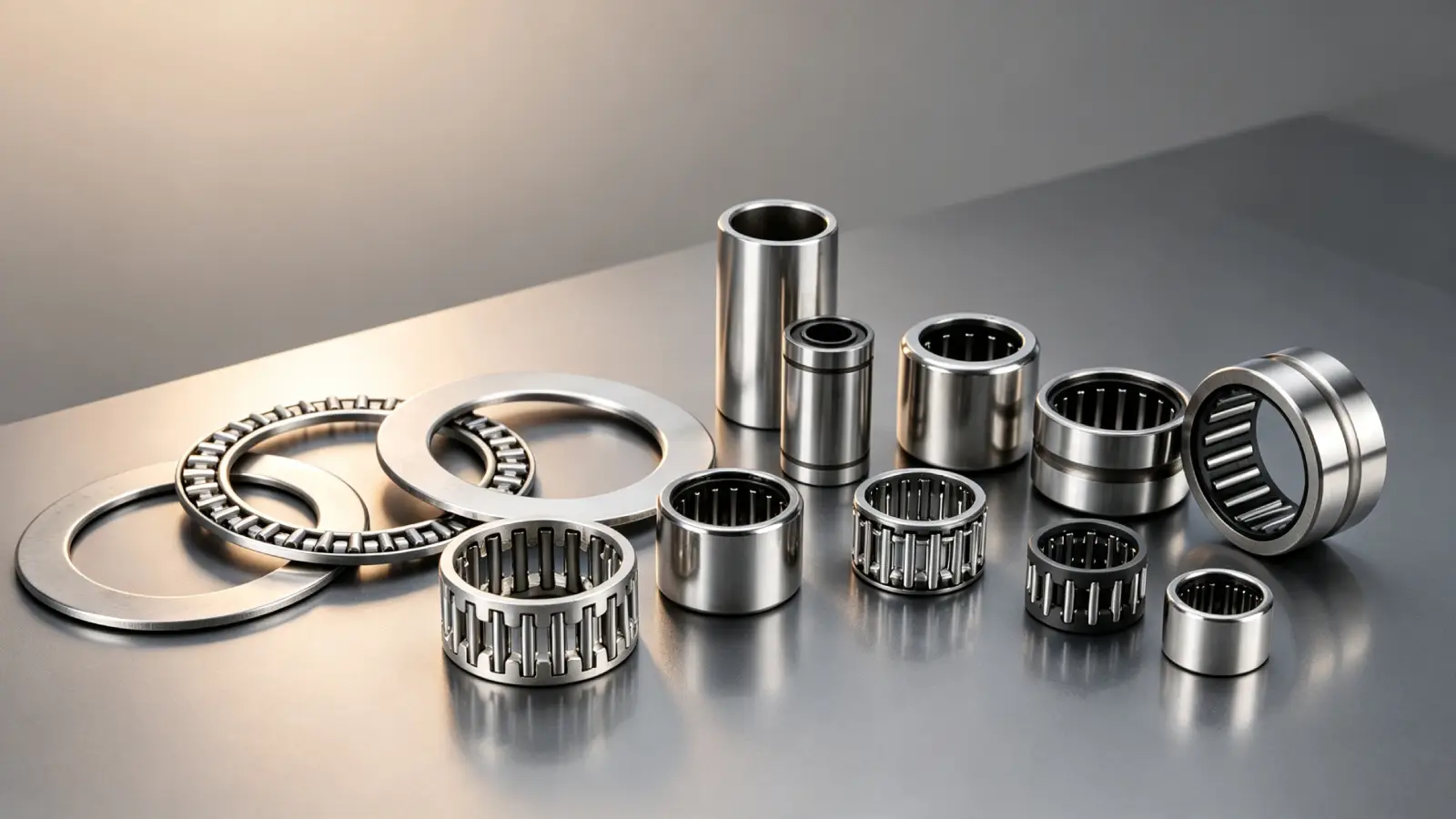
Needle bearings use long, small-diameter rollers to carry high radial loads within a compact cross-section. This geometry makes them useful when a machine cannot accept a larger conventional roller bearing. However, the phrase needle bearing covers several structures with very different ordering and installation requirements.
A unit may be only a needle roller and cage assembly, a thin drawn cup, a machined outer ring, a full-complement bearing, or a combined bearing. Some designs need a hardened shaft raceway, while others include an inner ring. Therefore, buyers should identify the complete construction before comparing model numbers.
The rollers have a high length-to-diameter ratio, so many load-carrying contacts fit around the shaft. When the shaft serves directly as the inner raceway, the bearing needs no separate inner ring. A cage keeps the rollers spaced and guided, while a full complement adds rollers for capacity at the expense of some speed capability.
Compact size does not remove the need for accuracy. The shaft and housing influence clearance, contact pattern, and load distribution. Drawn cups also take their final geometry from the installed housing bore. Consequently, a loose bearing can measure differently before and after correct press fitting.
| Type | Structure | Main ordering check |
| Needle roller and cage assembly | Rollers and cage without rings | Both raceways, guidance, and installed clearance |
| Drawn cup bearing | Thin stamped outer cup with caged or full rollers | Open or closed end, seals, and housing bore |
| Machined-ring bearing | Rigid machined outer ring, with or without inner ring | Inner-ring requirement, ribs, clearance, and lubrication |
| Full-complement bearing | Maximum roller count without a cage | Speed, lubrication, and axial guidance |
| Combined bearing | Radial needle section plus an axial bearing section | Radial and axial loads, direction, and mounting |
Thrust needle bearings form a separate axial product group. Likewise, cam followers and roller followers use needle rollers but include studs or thick outer rings for track contact. These products should not be grouped under one replacement decision simply because they contain similar rolling elements.
Needle roller bearings are widely used in transmissions, gearboxes, pumps, compressors, agricultural equipment, construction machinery, textile machines, two-wheel vehicles, and industrial linkages. Drawn cup designs fit compact housings, while machined-ring bearings provide a more rigid outer ring for demanding positions. Cage assemblies save further radial space when hardened machine surfaces can serve as raceways.
Full-complement designs suit high radial loads at moderate speeds, whereas combined bearings can support radial and axial loads within one compact arrangement. However, the application must define shock, oscillation, speed, lubrication, contamination, and temperature. Buyers should also confirm whether the shaft serves as the inner raceway because its hardness, finish, and geometry directly affect bearing performance.
Start with the complete bearing reference and suffix. Then confirm whether the design has an open end, closed end, seals, cage, inner ring, lubrication hole, or full complement. The shaft, housing, and surrounding shoulders should be shown on the installation drawing.
If the original code is unreadable, provide photos of both ends and all markings. Also measure the housing and shaft instead of only the removed bearing. A damaged drawn cup or worn shaft can mislead the dimensional check, so several independent measurements are preferable.
Press a drawn cup with a suitable mandrel that contacts the marked end or approved face evenly. Do not transmit force through the rollers, and do not hammer the thin cup. The housing entrance should be clean and chamfered, while the bore should remain round after installation.
For bearings without an inner ring, protect the finished shaft raceway from dents and burrs. Lubricate the rolling elements before operation according to the machine plan. During removal, assume the thin cup may be distorted and unsuitable for reuse. Finally, inspect the shaft, housing, seals, and lubricant for the cause of damage.
International brands use familiar series names, but suffixes and internal executions still vary. The examples below identify valid product structures; they are not automatic interchange pairs.
| Brand | Series or structure | Complete model example |
| SKF | HK drawn cup bearing with open ends | HK 2016 |
| NTN | NK machined-ring bearing without inner ring | NK80/25R |
| JTEKT / Koyo | HK metric caged drawn cup bearing | HK2016 |
| Nadella | NK machined-ring bearing | NK20/20 |
In HK 2016, HK identifies an open-ended drawn cup series, while 20 and 16 relate to the under-roller diameter and bearing width in this metric example. Nevertheless, buyers must check the complete brand designation because seals, cage, lubrication features, inner-ring references, and rating data can differ.
NTN NK80/25R is a machined-ring bearing without an inner ring, not a drawn cup. Its code belongs to a different structure even though it is also a needle roller bearing. Therefore, model comparison should begin with construction and dimensions rather than with one repeated number.
HSN Bearing Group supports model confirmation, sourcing, inspection, and custom supply discussions. First, buyers should provide the full reference, suffix, quantity, photos, and installation position. HSN can then review the bearing structure, dimensions, cage, seals, inner-ring requirement, clearance, shaft raceway, housing bore, load, speed, lubrication, and working conditions.
For obsolete or difficult models, HSN can evaluate drawings, samples, and surrounding components before discussing a replacement. Custom supply can be considered after technical confirmation. Before shipment, agreed checks may cover dimensions, hardness, clearance, material, appearance, and rotation. However, a similar base code does not prove compatibility because internal design and raceway requirements may differ.
Do all needle bearings include an inner ring?
No. Many designs run directly on a hardened shaft raceway, while others include or use a separate inner ring.
Why does the housing matter for a drawn cup?
The thin cup gains its final geometry after press fitting, so housing tolerance and roundness affect clearance.
Can HK and NK references be compared directly?
No. HK usually identifies a drawn cup, while NK identifies a machined-ring structure in these examples.
What should buyers send with an old model?
Send all markings, photos, dimensions, quantity, shaft and housing data, application and working conditions.
For needle bearing models not listed above, contact HSN for confirmation. Send the complete model, photos, dimensions, quantity, mounting position, and working conditions for review.
This article is based on independent analysis of publicly available technical information and industry understanding for knowledge sharing. All brand names and trademarks mentioned belong to their respective owners. HSN Bearing Group is an independent bearing supplier and technical service provider.
Tel: +86 156 6578 7336 Email: service@hsnindustrial.com Website: www.rollingparts.com www.hsnbearings.com