
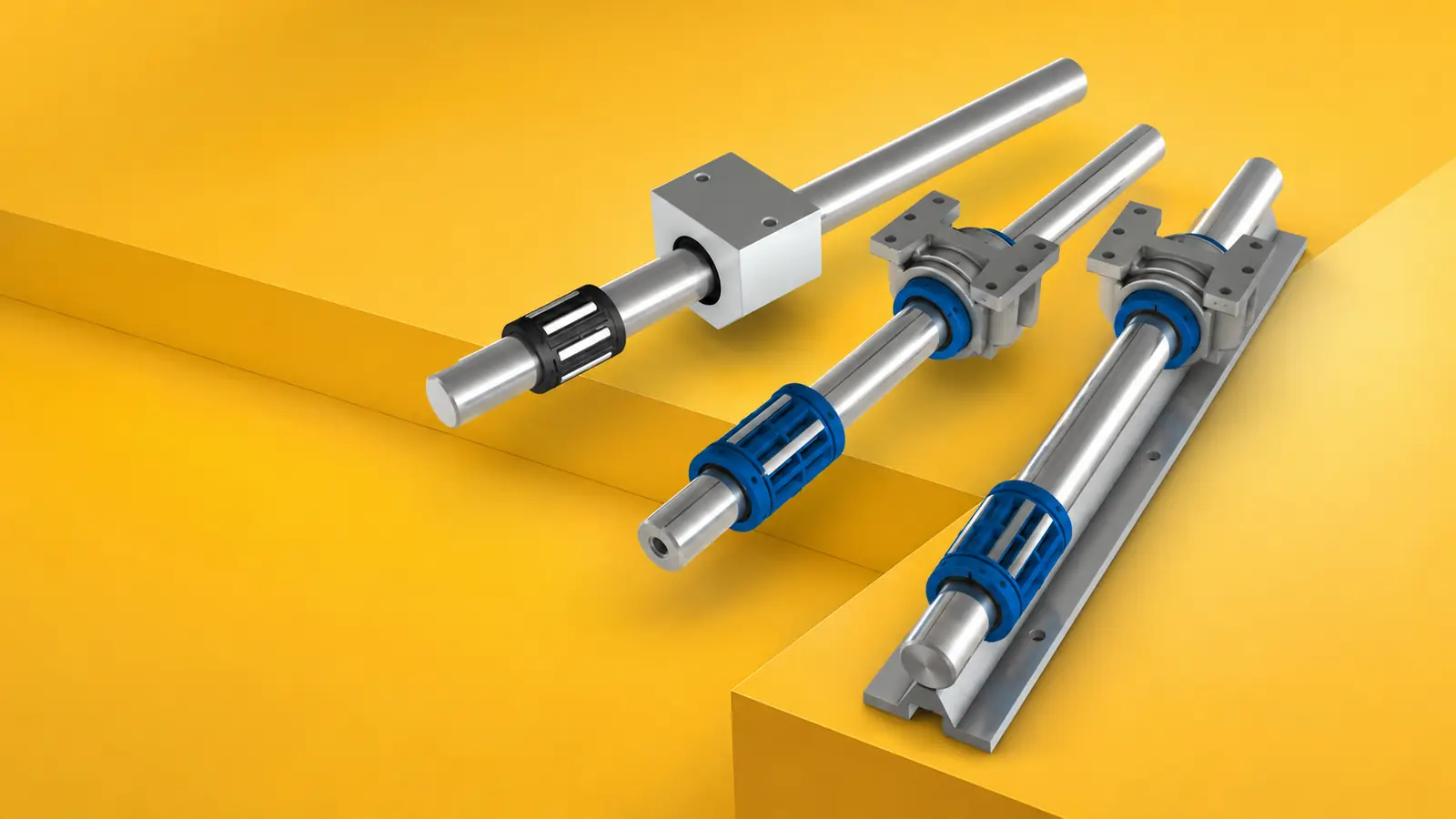
Linear bearings and shafts create a round-shaft guidance system for repeated straight motion. The bearing carries the moving load, while the shaft acts as the inner raceway or sliding surface. Because the contact occurs directly on the shaft, its condition is as important as the bearing code.
Buyers should confirm the bearing structure, shaft diameter, tolerance, hardness, surface finish, straightness, support method, and end machining. A shaft that fits through the bore can still be unsuitable for load, clearance, accuracy, or service life.
In a recirculating ball bushing, balls roll between the bearing tracks and a hardened precision shaft. In a linear plain bearing, the liner slides on the shaft. These two motion principles can use similar installation envelopes, but they have different friction, lubrication, material, and shaft-surface requirements.
An end-supported shaft can deflect under load. A continuously supported shaft increases stiffness for longer travel but normally needs an open bearing. The system also needs enough bearing and shaft spacing to control moments and rotation.
| Arrangement | Structural feature | Main ordering check |
| Closed bearing on solid shaft | Cylindrical bearing surrounds an unsupported shaft | Shaft deflection, end support, bearing spacing, and housing fit |
| Open bearing on supported shaft | Bearing opening passes over a support rail | Opening orientation, support dimensions, and load direction |
| Flanged bearing and shaft | Bearing has an integrated mounting flange | Flange shape, bolt circle, centring, seals, and axial retention |
| Housed linear unit | Bearing installed in a pillow block or carriage | Housing pattern, center height, alignment, and bearing type |
| Hollow shaft system | Reduced shaft mass with specified wall thickness | Deflection, end machining, hardness depth, and support method |
| Corrosion-resistant system | Stainless or coated shaft with compatible bearing | Material, hardness, finish, moisture, chemicals, and cleaning |
Solid and hollow shafts can share an outside diameter while having different stiffness. Likewise, stainless material does not automatically provide the same surface hardness or load life as a hardened carbon-steel shaft.
For applications that require a ready-to-mount housing, mounted linear bearings combine the linear bearing with a block or carriage. Buyers should also confirm the housing dimensions, center height, mounting pattern, shaft diameter, and complete unit code before ordering.
These systems are common in packaging machines, transfer devices, adjustable fixtures, laboratory equipment, light automation, printing machinery, food-processing equipment, doors, guards, and general industrial mechanisms. They are useful when the machine needs a modular straight-motion arrangement and convenient shaft mounting.
Unsupported shafts suit shorter spans, while supported shafts improve stiffness over longer travel. Wet areas may need corrosion-resistant materials, and hollow shafts can reduce moving mass. A guide is not a brake for a vertical axis.
Begin with the nominal diameter and tolerance class. Then confirm the material, surface hardness, case depth, roughness, roundness, straightness, and length. These factors determine the quality of the ball raceway or sliding surface.
Also provide:
Machining inside the travel zone can interrupt the raceway. If a thread, hole, or keyway must cross the bearing path, the design needs specific review and edge treatment.
Store shafts horizontally with adequate support and protect the finished surface from rust and impact. Before installation, clean the shaft and inspect it for dents, burrs, corrosion, coating damage, and transport marks. Measure diameter and straightness at relevant positions.
Align the shaft supports before tightening. On parallel-shaft systems, establish one shaft as the reference and adjust the second to avoid binding. Chamfer the shaft end and cover sharp features before passing it through seals and ball circuits.
Do not force a bearing over a damaged area. After assembly, move the carriage through the full stroke and check resistance, noise, and clearance. During removal, protect the shaft surface and retain housings, spacers, and orientation records for inspection.
The examples below show representative linear bearing and shaft references from different manufacturer designation systems. A matching nominal size can help identify a possible bearing-and-shaft combination, but it does not confirm interchangeability across brands.
| Brand | Bearing and shaft range | Complete model example |
| THK | LM linear bushing with SF LM shaft | LM20 with SF20 g6-500L |
| Ewellix (legacy SKF reference) | LBX/LBC linear bearings with LJX/LJXR shafting | LBXR 20 with LJXR 20 x 48 |
| Bosch Rexroth | Standard linear bushing with precision steel shaft | R060206010 with R100006000 |
Before comparing these references, check metric or inch dimensions, bearing construction, shaft material, shaft tolerance, housing fit, seals, support layout, and load ratings. The same nominal shaft size does not confirm that bearing and shaft references from different brands are interchangeable.
THK model SF20 g6-500L identifies an LM shaft for use with compatible THK linear bushings. The designation includes the shaft model, nominal diameter, diameter tolerance, and overall length.
| Code | Code section | Meaning |
| SF | Shaft model | THK LM shaft Model SF |
| 20 | Shaft diameter | Nominal shaft diameter of 20 mm |
| g6 | Diameter tolerance | Shaft diameter tolerance class |
| 500L | Shaft length | Overall shaft length of 500 mm |
The complete shaft designation is important because diameter tolerance and optional features can affect bearing clearance, fit, and system performance.
THK also provides precision-class shaft tolerances such as g5 or h5. Optional symbols may include K for a standard hollow shaft, M for special material, and F for surface treatment. Buyers should therefore send the complete shaft designation together with the linear bearing model and any machining drawing.
HSN Bearing Group reviews linear bearings and shafts as one matched arrangement. Buyers should provide the complete bearing and shaft codes. HSN can review diameter, length, material, hardness, finish, tolerance, straightness, and support layout. Load, speed, stroke, quantity, and environment also matter. Controlled drawings should define end machining, threads, holes, shoulders, and other special details.
For difficult or non-standard requirements, HSN can compare the bearing, shaft, housing, and support geometry. Replacement or custom supply can follow technical confirmation. Before shipment, checks may cover dimensions, hardness, material, surface condition, straightness, appearance, and clearance. Movement, accuracy, vibration, or noise checks can also be discussed. Similar shaft diameters do not automatically confirm the required fit or performance.
Can any polished bar serve as a linear shaft?
No. Diameter tolerance, hardness, finish, straightness and material must suit the bearing and expected load.
When is a supported shaft preferred?
It is useful for longer spans or higher stiffness when an open bearing and compatible support rail can be used.
Can stainless and carbon shafts be exchanged?
Not automatically. Compare hardness, finish, tolerance, corrosion needs, load, bearing type and operating environment.
What end-machining details should buyers send?
Provide a drawing with threads, flats, holes, shoulders, chamfers, tolerances, datum points and protected travel zones.
For detailed linear bearing and shaft models not listed above, please contact HSN for model confirmation and supply discussion. When checking linear bearing shaft references, you can also send the complete bearing and shaft codes, photos, drawings, dimensions, quantity, and working conditions for review.
This article is based on independent analysis of publicly available technical information and industry understanding for knowledge sharing. All brand names and trademarks mentioned belong to their respective owners. HSN Bearing Group is an independent bearing supplier and technical service provider.
Tel: +86 156 6578 7336 Email: service@hsnindustrial.com Website: www.rollingparts.com www.hsnbearings.com