
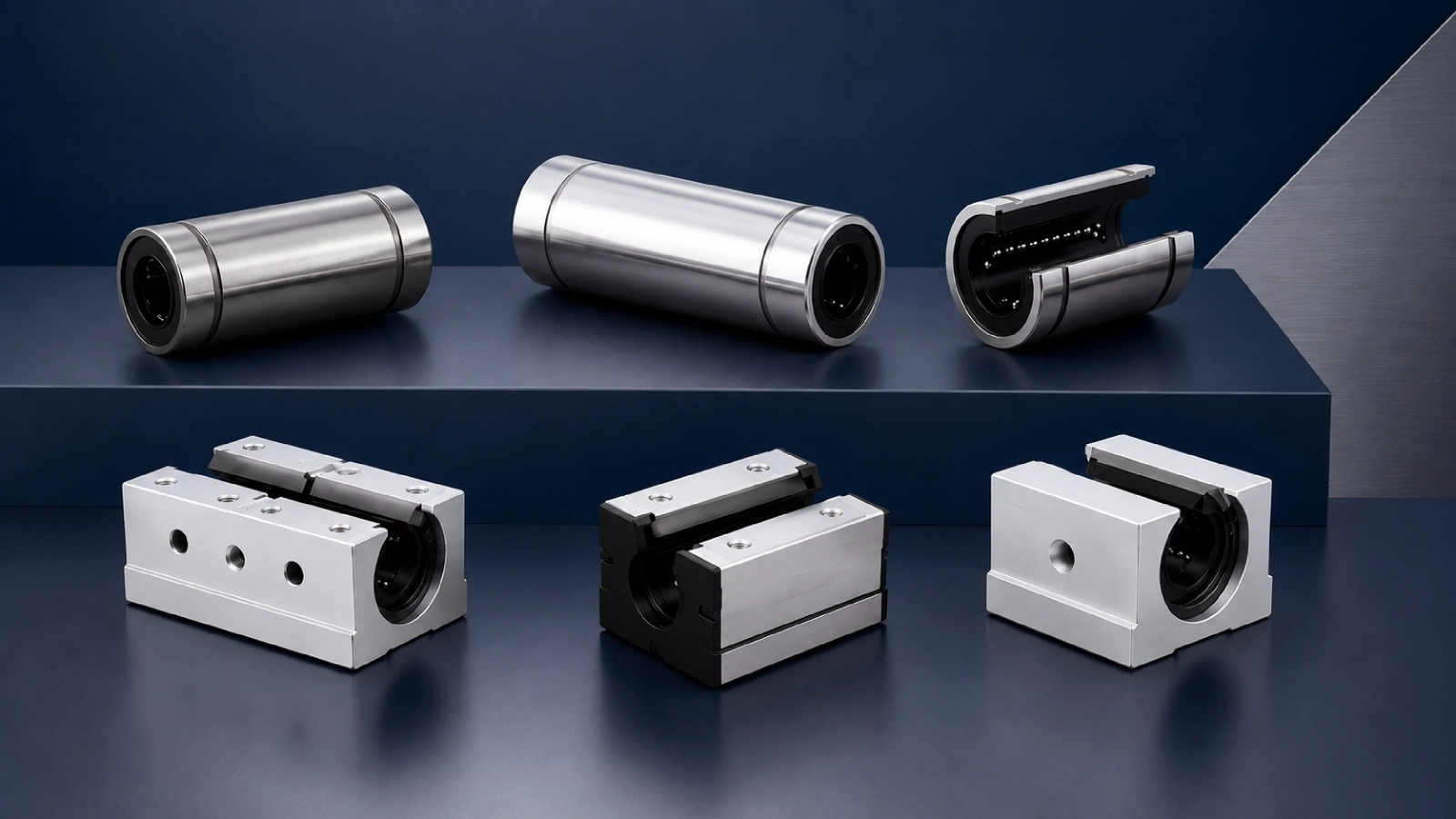
Linear ball bearings use recirculating balls to provide smooth, low-friction motion along a cylindrical shaft. Their compact round-shaft design makes them common in automation, material handling, packaging, measuring equipment, and general machinery. However, bearing performance depends not only on the bearing itself, but also on the shaft, fit, alignment, and lubrication conditions.
The basic size alone does not define the complete configuration. Closed, open, adjustable, long, flanged, housed, and sealed versions can require different shafts, mounting arrangements, and operating conditions. Before ordering, buyers should confirm the complete model, shaft diameter and tolerance, housing fit, load direction, lubrication method, and working environment.
The main components are an outer sleeve, ball tracks, recirculating balls, and a cage or retainer. Some versions also include seals. The balls roll between the bearing raceway and a hardened shaft, then return through the cage to provide continuous linear travel.
Load capacity can vary with ball-track orientation. These bearings also do not normally control rotation about the shaft, so the system may need two shafts, multiple bearings, or an anti-rotation feature.
Shaft accuracy is critical because the balls run directly on it. Diameter tolerance, hardness, surface finish, roundness, straightness, and support stiffness influence clearance, life, noise, and motion quality.
The structure should match the surrounding machine rather than only the nominal shaft diameter.
| Type | Structural feature | Main selection point |
| Standard / closed cylindrical | Full cylindrical outer sleeve around the shaft | Shaft diameter, housing fit, load direction, and available mounting space |
| Open cylindrical | Axial opening allows use with a continuously supported shaft | Opening orientation, shaft-support clearance, load direction, and housing design |
| Clearance-adjustable | Slotted outer sleeve allows clearance adjustment through a suitable housing | Initial clearance, housing adjustment range, preload, and shaft tolerance |
| Long type | Extended bearing length provides a larger loaded zone and higher load capacity | Available installation length, load capacity, and moment requirement |
| Flanged type | Integrated flange simplifies axial location and mounting | Flange shape, bolt pattern, centering, mounting face, and axial retention |
| Housed unit | Linear bearing supplied in a ready-to-mount block housing | Housing dimensions, bolt pattern, alignment, shaft height, and seal configuration |
Seals help retain lubricant and limit contamination, although they can increase running resistance. Open bearings also require a supported-shaft arrangement that leaves sufficient clearance through the bearing opening.
Linear ball bearings are commonly used in industrial automation, semiconductor equipment, electronics assembly, medical devices, food processing, automotive production lines, and laboratory equipment. Typical applications include pick-and-place units, packaging machinery, printing equipment, measuring devices, CNC positioning systems, robotic handling systems, assembly stations, and precision adjustment mechanisms. A round-shaft system can be a practical choice where a simple, modular guide solution is needed.
The suitable arrangement depends on the application conditions. A platform carrying moment loads may require multiple bearings and two parallel shafts for better stability. Long travel applications may need supported shafts and open bearings, while short strokes and repeated movements require careful review of load distribution, wear, and alignment.
When selecting linear ball bearings, buyers should consider travel distance, operating speed, load direction, accuracy requirements, contamination conditions, and maintenance needs to ensure reliable performance.
Provide the radial loads and moments in every operating direction. Then record travel speed, acceleration, stroke, cycle frequency, duty time, shock, vibration, and required service life. For the bearing interface, confirm:
Do not assume that a similar outside diameter establishes interchangeability. Cage geometry, ball-track orientation, seal friction, and permissible housing fits can differ between brands.
Keep the bearing on a clean transfer tube until assembly. Do not allow the ball circuits or seals to collect chips or dust. Chamfer the shaft end and cover sharp keyways, threads, or cross holes before sliding the bearing into position.
Press a cylindrical bearing squarely into the housing with a suitable mandrel. Apply force to the outer sleeve, not through the balls or cage. Secure the bearing axially as specified; a press fit alone may not provide adequate retention.
Align parallel shafts and housings before final tightening. Then move the carriage through its full stroke and check for binding. During removal, support the unit and avoid pulling the bearing across damaged shaft areas. Keep matched housings, shims, and orientation records together.
International brands use different prefixes and suffix logic. These examples show structural differences and should be treated as identification references only.
| Brand | Main linear ball bearing range | Complete model example |
| THK | LM cylindrical, LM-L long, LMF/LMK flanged | LM20LUU |
| SKF | LBC D-series closed, open, rigid, and self-aligning designs | LBCD 20 D-2LS |
| Schaeffler | KBO machined open bearings and sealed variants | KBO20-PP |
Bosch Rexroth | Standard closed and open linear bushings | R060202010 ( KBM-20-DD) |
The number 20 may indicate a 20 mm shaft group in several systems, but it does not prove that the outer dimensions, load ratings, seals, or housing requirements are identical.
THK model LM20LUU shows how design and sealing information is added to the basic size.
| Code | Code section | Meaning |
| LM | Model series | Standard cylindrical linear bushing family |
| 20 | Shaft-size section | Nominal 20 mm shaft diameter |
| L | Length symbol | Long-type bearing configuration |
UU | Seal symbol | Seals fitted at both ends |
The same suffix sequence should not be applied to another brand without checking its designation rules. Preserve every letter, number, hyphen, and space when sending a model inquiry.
HSN Bearing Group supports model confirmation, sourcing, inspection, and custom supply discussions. Buyers should provide the full model, quantity, and working conditions. HSN can review design, length, shaft diameter, housing dimensions, seals, preload, clearance, and load direction. Speed, stroke, mounting layout, and lubrication also matter. Supply checks focus on the exact bore and construction.
For older or difficult codes, HSN can review photos, drawings, samples, fits, and application data. Replacement supply can follow technical confirmation. Before shipment, checks may cover dimensions, hardness, clearance, appearance, movement, and material. Running accuracy, vibration, noise, or other inspections can also be discussed. Similar product numbers do not automatically confirm shaft, housing, or system compatibility.
Can a linear ball bearing run on a soft shaft?
Not reliably. The shaft needs suitable hardness, finish, diameter tolerance and straightness for the ball raceway.
Do closed and open bearings use the same housing?
Not automatically. An open bearing needs clearance for the shaft support and correct orientation under the applied load.
Can one bearing control a platform moment?
Usually not. Use suitable bearing spacing, shaft spacing or multiple bearings to control pitch, yaw and roll.
Which code details should buyers provide?
Provide the full prefix, size, length type, seals, clearance, material, housing code and every remaining suffix.
For detailed linear ball bearing models not listed above, please contact HSN for model confirmation and supply discussion. When checking linear ball bearing references, you can also send the complete model number, photos, dimensions, shaft details, quantity, and working conditions for review.
This article is based on independent analysis of publicly available technical information and industry understanding for knowledge sharing. All brand names and trademarks mentioned belong to their respective owners. HSN Bearing Group is an independent bearing supplier and technical service provider.
Tel: +86 156 6578 7336 Email: service@hsnindustrial.com Website: www.rollingparts.com www.hsnbearings.com