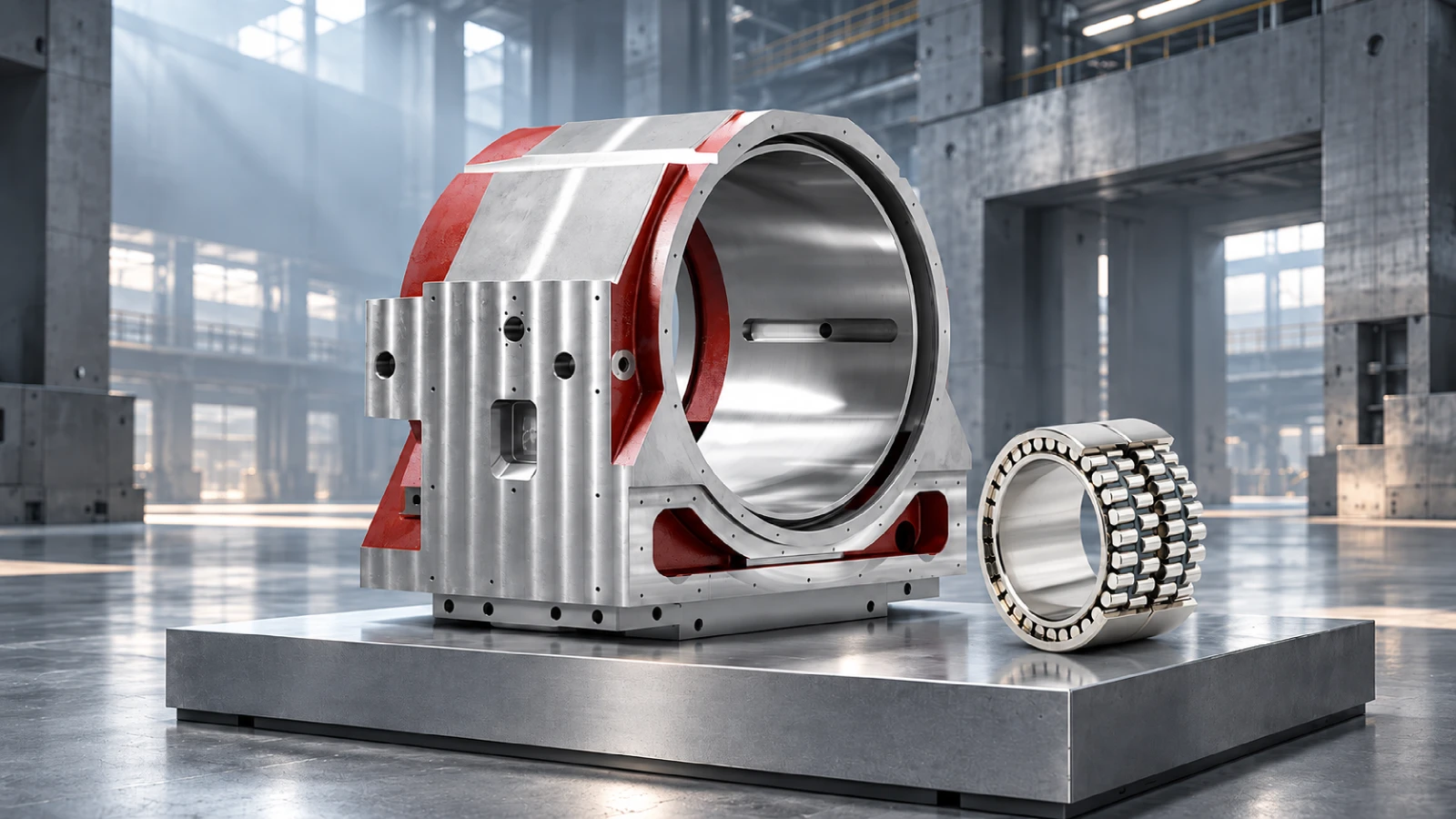
Bearing chocks in a rolling mill house and position the bearings around a roll neck. During a roll change, the chock, bearing sets, seals and retaining parts move through a defined removal and installation sequence. A buyer who requests only a bearing number may overlook a damaged bore, missing spacer or incompatible seal. The purchase scope should follow the actual assembly drawing and repair finding.
This guide addresses the chock as an equipment interface. It explains where the bearing sits, how radial and axial support are arranged, and what a plant should document before asking for stock or custom parts. The responsible mill engineer must approve any changed fit or assembly design.
The chock surrounds the neck at each roll end and transmits bearing reactions to the stand. Work, intermediate and backup rolls can use different chock envelopes. Identify the stand, roll position and drive/operator side before comparing old and proposed parts. The chock number and roll-neck drawing often distinguish assemblies that share a bearing family.
During maintenance, mark cap and body orientation, spacers, seal carriers and oil or grease ports. Some designs leave bearing inner rings on spare rolls while outer assemblies are handled with chocks. The removal sequence affects whether a buyer needs a complete bearing, a subassembly, a seal set or a repaired housing.
Check the chock bore, shoulder and retainer seats after removal. A bearing that has spun in a damaged bore may not be retained correctly by a new component. A loose purchase request for a “mill chock bearing” cannot resolve that fit problem without inspection data.
The chock review begins at the outer-ring seat, shoulders, axial locator and seal interfaces. A four-row cylindrical roller bearing carries radial load but needs a defined axial-location arrangement. A four-row tapered roller assembly can carry combined loads, with its component setting and mounting practice governed by the approved design. Record which bearing surfaces contact the chock and which parts remain on the roll during a change.
Timken 190RY1528 provides a concrete four-row cylindrical example: its catalog lists inner-ring set 190ARVS1528 and outer-ring set 212RYS1528. These are bearing subassembly numbers, not a mill chock model or a confirmed fit. If the work order names only an outer set, verify the mating inner set, radial clearance and chock seat before quoting. The chock body, seals and retainers still require their own drawings or codes.
| Assembly element | Inspection point | RFQ consequence |
|---|---|---|
| Bearing sets | Full code, clearance and component scope | Complete unit or named subassemblies |
| Chock body | Bore, shoulders, cap split and condition | Stock bearing or housing repair review |
| Seals and retainers | Interfaces, wear and orientation | Included parts and mounting sequence |
For a cylindrical arrangement, confirm where the separate thrust bearing or axial locator sits. A chock proposal that matches the radial bearing envelope but omits axial restraint is incomplete. For a tapered assembly, document the specified setting and all spacers rather than mixing old and new parts without approval.
Rolling force, neck bending, speed and load direction affect the bearing and chock together. The roll-neck fit, housing fit, shoulders and corner radii must agree with the selected assembly. Timken’s roll-neck guidance emphasizes aligning a chock with the inner-ring assemblies during mounting; this is an installation consideration, not a substitute for the mill’s own procedure.
Water, scale and cooling emulsion challenge chock seals. Trace lubricant feed, drainage and any purge route on the drawing. A blocked port or worn seal track may explain recurring bearing damage even when a new bearing meets dimensional inspection. State whether the supply request includes seals or only the bearing itself.
Record the chock bore and roll-neck seat measurements against drawing tolerances. Note out-of-roundness, fretting, corrosion and damage to the cap or retainer faces. The maintenance team should decide which features require machining or replacement before authorizing a bearing-only order.
A standard bearing purchase can proceed after the exact model and usable mating seats are confirmed. A chock repair becomes a separate engineering task when the bore, shoulder or lubrication path falls outside its specification. Measure the bore at several axial and circumferential locations and compare the results with the approved drawing. This helps distinguish local scoring from taper or out-of-roundness that affects outer-ring support. If the component is obsolete, define the complete assembly dimensions, material and tolerances before discussing custom manufacture.
Do not reconstruct an intended tolerance from a worn chock. Use the approved drawing, an undamaged counterpart and the plant’s engineering review. For a proposed repair, record the machining or replacement scope, post-repair measurements and acceptance criteria. Separate accountability for bearing supply, chock machining, assembly and final inspection on the quote. This avoids describing an unverified replacement as a drop-in solution.
HSN can review bearing codes, drawings, measured samples and service conditions for stock or custom bearing supply. It can discuss dimensional, hardness and clearance checks against agreed values. Before a scheduled U.S. roll change, the mill should identify which measured chocks are ready for assembly and provide the U.S. receiving site and required arrival date. The plant remains responsible for final fit and installation approval.
Send the mill type, stand, roll and side, chock assembly drawing, roll-neck drawing, complete bearing code and all related component markings. Include bore, shoulder and seat measurements, seal details, lubrication schematic, quantity and photographs of wear. State whether the inquiry covers a bearing set, named subassemblies, housing-related parts or an engineered replacement package.
Mark each dimension’s source. A nominal drawing size, measurement of a working chock and measurement of a failed chock have different meanings. Attach the inspection findings and any approved repair plan, with the installation date and required receipt date for purchasing.
Finally, ask for the quotation to list included parts, inspections, documentation and exclusions clearly. Buyers can then reconcile the offered scope with the maintenance work order before releasing the purchase order.
Does a bearing code identify the entire mill chock?
No. The chock body, seals, retainers and axial-location parts need their own drawings or codes.
Can I order only an outer-ring set?
Only after checking the exact model, mating inner-ring set and required clearance.
Why send a chock drawing to HSN?
HSN can review the bearing and chock interfaces, define the quoted scope, and agree on inspection criteria and feasible delivery timing.
Does HSN support shipping and customs clearance for U.S. customers?
Yes. HSN supports flexible trade terms, shipping arrangements, customs documentation, and delivery coordination for U.S. orders.
For a rolling mill bearing chock inquiry, send HSN the full model, photos, dimensions, quantity and operating conditions. Add chock and roll-neck drawings and distinguish bearing supply from any housing repair.
This article is based on independent analysis of publicly available technical information and industry understanding for knowledge sharing. All brand names and trademarks mentioned belong to their respective owners. HSN Bearing Group is an independent bearing supplier and technical service provider.
Tel: +86 156 6578 7336 Email: service@hsnindustrial.com Website: www.rollingparts.com www.hsnbearings.com