A roll neck bearing must match its mill position and the way the chock supports the roll. Within one stand, work roll and backup roll bearings can differ in construction and supply scope. Four-row cylindrical and tapered designs also handle axial location differently. Buyers therefore need the stand, roll position, and assembly drawing before comparing replacement or custom options.
A complete review then covers load, speed, internal clearance, seals, lubrication, and the condition of the mating seats. It must also establish whether the order includes inner rings, an outer assembly, or a complete bearing. This guide explains how to compare those arrangements and prepare a detailed RFQ for the next roll change.
Work rolls contact the strip or bar directly. Backup rolls support work rolls in multi-roll stands and can transmit large rolling forces through their necks. Identify the stand number, drive or operator side and roll position, since apparently similar chocks may have different shoulders, seals and lubrication paths.
Flat-product mills, long-product mills and roughing stands also differ in speed, roll changes and exposure. A work-roll bearing request may cover an inner-ring set mounted on a spare roll, an outer assembly in a chock or a complete matched bearing. A backup-roll inquiry can involve a larger envelope and a different inspection schedule. A supplier needs that scope before offering a lead time.
For backup roll bearings, note whether the drawing identifies a loose or tight inner-ring fit and whether grinding after mounting is specified. The removed bearing’s outside dimensions cannot reveal the intended roll-neck tolerance or finished inner-ring raceway condition. Keep the roll-neck and chock drawings together with the purchase request.
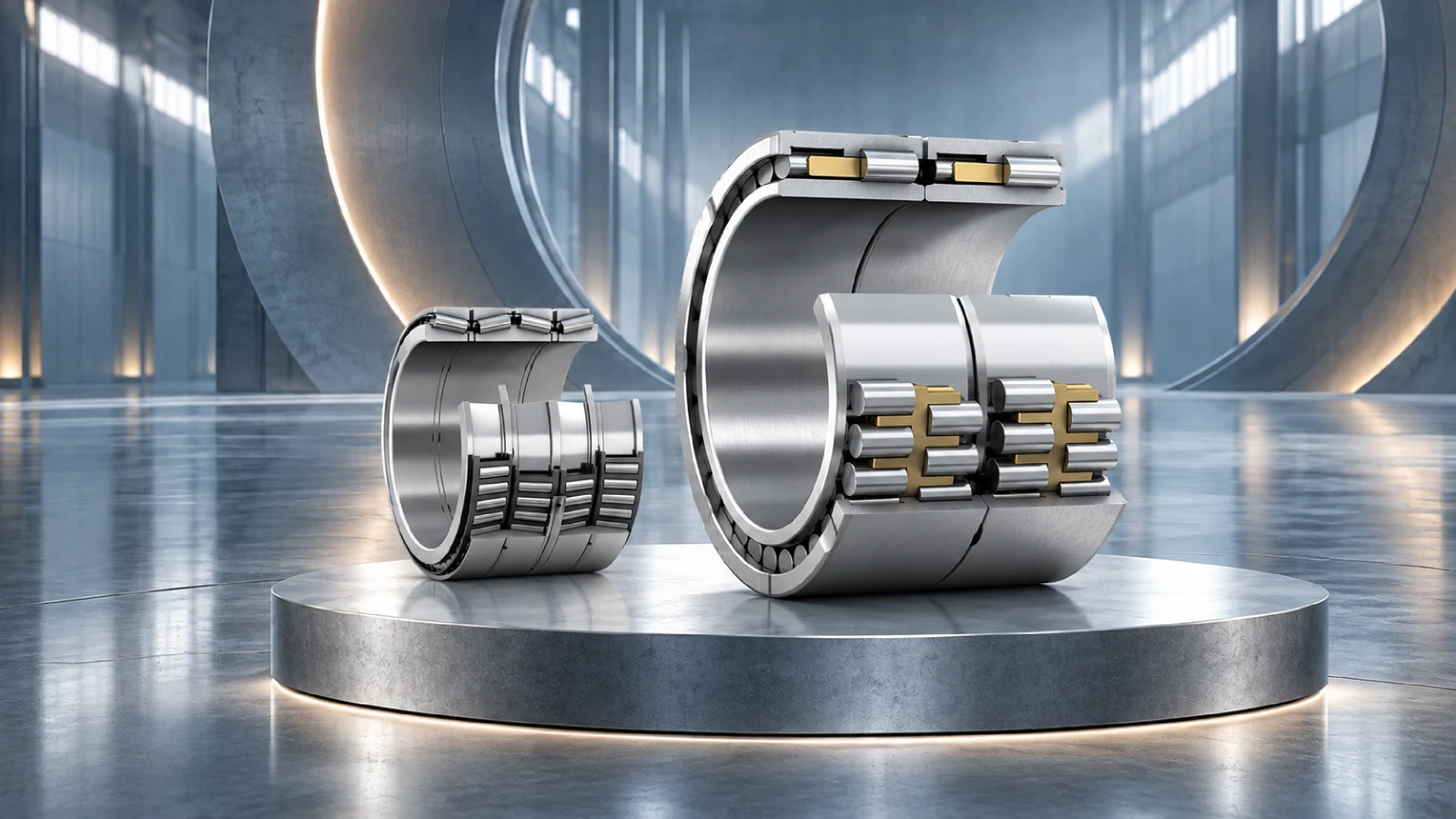
Four-row tapered roller bearings carry high combined radial and axial loads. Their cone, cup and spacer arrangement makes full assembly identification important. Four-row cylindrical roller bearings primarily carry radial load and normally require a separate thrust bearing or other defined axial-location arrangement. The two structures should not be treated as equivalent merely because they occupy similar space.
Timken 190RY1528 is a four-row cylindrical roll-neck bearing. Its inner-ring and outer-ring sets can be ordered separately, and Timken calls for the radial internal clearance when ordering the complete assembly or an inner-ring set. Timken 250RY1681 is another RY-family model, but its 250 mm bore differs from the 190 mm bore of 190RY1528; it is not a substitute or a confirmed fit for an unspecified mill. Compare the complete designation, dimensions and assembly before ordering.
Sealed four-row tapered designs introduce another distinction: integrated seals can help exclude water, debris and scale. However, their overall envelope, lubricant plan and seal interfaces still require verification. Where the installed drawing calls for a separate thrust bearing, include that part in the assembly review even if the immediate RFQ concerns only the radial bearing.
| Arrangement | Main question | Order evidence |
|---|---|---|
| Four-row tapered | What axial-load arrangement and specified bench endplay apply? | Complete assembly code, spacers and mounting drawing |
| Four-row cylindrical | What provides axial location? | Radial clearance, inner/outer sets and thrust arrangement |
| Sealed roll neck unit | Which seals and lubricant path apply? | Seal design, chock interfaces and service plan |
Rolling force, shock and speed differ between stands and roll positions. Record the plant’s operating range and the specified load basis. Inner- and outer-ring fits affect creep, clearance and dismounting. The shaft shoulder, neck fillet and chock bore must also suit the bearing’s actual geometry.
Water, cooling emulsion and mill scale can enter around the chock seals. A raceway with water etching or debris damage does not by itself establish that the bearing design was undersized. Check the seal stack, pressure washing direction, grease or oil delivery and drain paths. If contamination caused a repeated failure, address the route into the chock before replacing the bearing.
Some inner rings remain mounted on spare rolls while outer assemblies stay with chocks. Confirm whether the plant expects separate kits and whether those sets can be combined under the manufacturer’s clearance rules. Record the markings on each inner and outer set, the specified radial clearance and whether an inner-ring raceway will be finish-ground after mounting. That distinction changes the component and inspection scope of an order. A generic quotation for a “four-row bearing” leaves too much of this maintenance sequence undefined.
Start with the full designation and existing drawing. An obsolete number may require a dimensional and arrangement comparison: bore and outside diameter, width, corner radii, cage, clearance, seals, lubrication features and spacer stack. Ask who will approve any changed design and how the bearing will be mounted, inspected and run in.
Inspect the chock bore, roll-neck seat and sealing surfaces when a bearing is removed. Fretting, out-of-roundness or a damaged shoulder can defeat a correctly specified new bearing. Separate a bearing quotation from machining, chock repair and installation services; HSN should only quote the supplied and agreed scope.
HSN can review a model, drawing or sample for stock and custom possibilities, then discuss dimensional, material, hardness or clearance checks against agreed criteria. It cannot establish interchangeability from a cross-reference alone. For a scheduled U.S. roll change, give the receiving site and latest acceptable arrival date; state whether a trial unit or inspected spare set is needed before the outage. The plant engineer remains responsible for fit approval.
Send the mill type, stand and roll position, drive/operator side, complete old bearing and chock codes, quantity and required scope. Provide roll-neck and chock drawings, bearing marking photos, old and new measurements, lubricant information and service conditions. Mark whether dimensions are metric or inch based.
For a cylindrical design, identify the separate thrust component and whether the order is for inner rings, outer assemblies or a complete bearing. For a tapered design, specify every component of the assembly and its spacer or setting requirements. Include the sealing arrangement and the planned inspection of roll and chock seats.
Ask for an offer that lists the final model, included parts, checks before shipment and delivery schedule. The receiving team should compare that offer with the approved drawing, rather than assuming a matching base number describes the whole assembly.
Can cylindrical and tapered roll neck bearings interchange?
No. They handle axial location differently. Compare the complete roll-neck and chock arrangement.
Can I order an inner-ring set without the outer assembly?
Only after checking the specific model, mating set and radial clearance requirements.
Why involve HSN in a roll neck bearing inquiry?
HSN can review the drawing and scope, agree on dimensional and material checks, and confirm a feasible delivery plan before quotation.
What should a U.S. mill send for a roll-change quote?
Send the full code, stand and roll position, drawings, scope, quantity, U.S. receiving site and latest acceptable arrival date.
For detailed roll neck bearing models not listed above, please contact HSN for model confirmation and supply discussion. When checking other bearing references, you can also send the complete model, photos, dimensions, quantity, application, and working conditions.
This article is based on independent analysis of publicly available technical information and industry understanding for knowledge sharing. All brand names and trademarks mentioned belong to their respective owners. HSN Bearing Group is an independent bearing supplier and technical service provider.
Tel: +86 156 6578 7336 Email: service@hsnindustrial.com Website: www.rollingparts.com www.hsnbearings.com