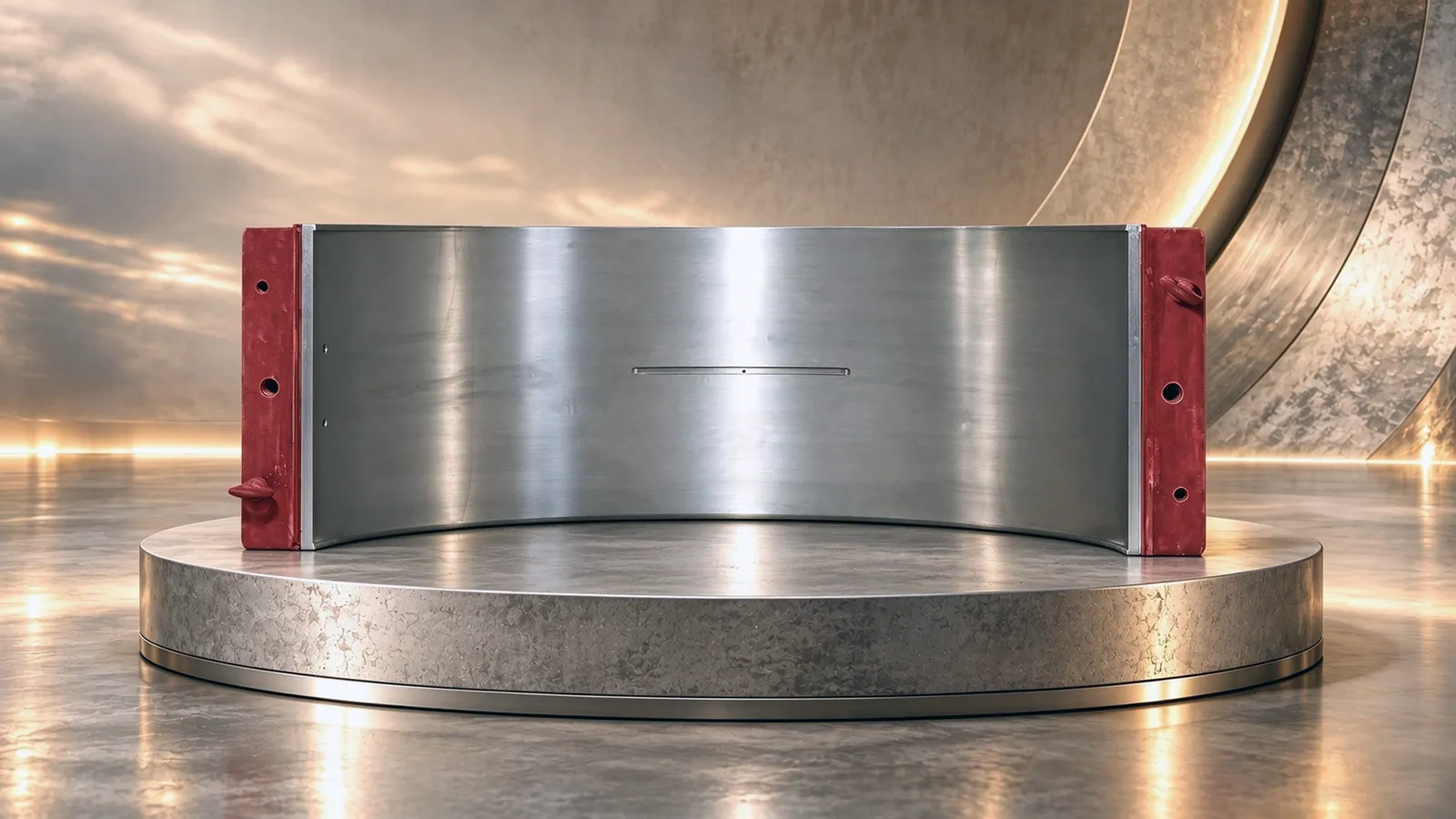
A worn ball mill white metal bearing can hold up a grinding line even when the mill itself is ready to restart. White metal, often called babbitt, forms the sliding surface of a specified bearing liner or pad. It does not identify the support position, dimensions or oil-film design by itself. Before ordering a new part or qualified repair, maintenance and purchasing need the support position, geometry and oil-film design.
On some ball mills, a white-metal-lined sleeve supports the rotating trunnion journal at the feed or discharge end. Other designs use shoes beneath a slide ring on the shell, and a ball mill slide shoe bearing may have a lining specified by the original design. These are different contact geometries. Confirm the actual support before applying a sleeve drawing to a shoe.
The bearing’s backing and lining work together: the backing holds the designed shape, while the white metal contacts the journal through an oil film in operation. The journal, bearing housing, seals and oil supply are part of the working arrangement. A new lining cannot compensate for a deeply damaged journal or missing oil supply.
| Installed position | Bearing surface to identify | Adjacent part to inspect |
| Trunnion sleeve | Curved white metal bore and split joint | Trunnion journal and housing seat |
| Shell slide shoe | White metal pad face, if specified | Slide ring, support and oil feeds |
| Axial guide surface | White metal thrust face, if fitted | Approved axial location and mating face |
The wording on a purchase request should distinguish the white metal insert from a complete bearing block. If the mill has polymer, bronze or rolling-element main support instead, do not order white metal merely because another ball mill uses it. The machine drawing and inspected part define the material.
A sleeve bears on a cylindrical trunnion journal. Its inquiry needs bore geometry, axial length, split design, backing dimensions, lining thickness and the specified oil entry or groove layout. A slide shoe bears against a ring or surface on the mill shell; its curvature, contact position, pivot or self-aligning support and oil routing follow a different drawing.
To supply a high quality ball mill sleeve bearing, measurable acceptance criteria are required. Specify the approved white metal grade, backing material, bonding or layer checks, finished dimensions and any required inspection record. Do not infer an alloy grade from color or an unreadable old part.
For a slide shoe example, Fuller’s cement ball mill design has hydrodynamically lubricated, self-aligning shoes under slide rings. That equipment configuration illustrates why shoes must be identified by position and drawing; it does not establish that every shoe uses a white metal surface. Ask the mill owner to confirm the bearing material before requesting a replacement.
Inspect an old liner before agreeing to relining. Record cracks, wiped metal, scoring, contact pattern and any signs of detachment from the backing. A repair contractor should decide whether the old backing is usable and how its geometry will be restored.
HSN Bearing Group can discuss supplying a bearing component after agreeing on drawings, samples and checks. Any on-site mill refurbishment needs a separately defined contractor and scope.
The mill’s mass and grinding charge load the main supports continuously, while start-up and shutdown challenge oil-film formation. The oil system may be hydrodynamic or hydrostatic depending on the installed design. Record the approved oil grade, supply pressure, flow and temperature alongside journal and bearing temperatures. A new lining needs the same verified system context.
Contaminants in the oil can score the sliding surface. Cooling-channel deposits can also reduce heat removal on designs with cooled shoes. Therefore, collect oil condition and cooling observations before attributing all damage to the white metal. Examine seals and the route by which dust, slurry or water might have entered the housing.
Alignment matters across the two mill supports. A localized contact pattern can point to journal condition, housing movement or the mill’s axial position. Measure the mating journal and the bearing backing while the mill is open. Document any surface machining before setting final lining dimensions; worn dimensions are not necessarily the intended manufacturing target.
An American cement or mineral-processing site should also confirm the planned shutdown window and any restart oil-system tests. If the plant cannot verify lift oil or circulation, a new sleeve or pad alone cannot establish safe operation. Its own engineer must approve the lubrication and installation procedure.
White metal mill parts are commonly tied to the mill’s drawing rather than a universal rolling-bearing designation. That makes a “customized ball mill sleeve bearing” inquiry a question of exact geometry, approved material and the full assembly boundary. Do not invent a model code from the mill name.
Repair condition | Decide with the mill engineer | Procurement scope |
Lining worn, backing sound | Whether qualified relining is permitted | Repaired insert with agreed inspection |
Backing or split joint damaged | Whether a new component is required | Custom sleeve or shoe to drawing |
Journal or support seat damaged | Machining, fit and alignment plan | Bearing plus separately defined repair |
Specify who is responsible for the backing, white metal application, machining, inspection and installation. A bearing block may also include seals, fasteners, cooling lines or oil fittings. List each included item rather than treating the block as a standard loose bearing.
HSN can review a model, drawing or sample and discuss bearing customization when the size, structure, quantity and working conditions are known. Before shipment, dimensional tolerance and hardness can be checked where applicable; clearance and other acceptance items should be defined for the actual sliding-bearing design. Any specialized lining bond or alloy test requires an agreed supplier capability and written purchase requirement.
An RFQ should let the supplier identify the exact pad or sleeve and the state of its mating surface. This is especially important when no marked model remains on the old component.
If the old part has already been scraped or machined, disclose that work and supply the original design dimensions if available. Ask the quotation to separate a new bearing component from backing refurbishment, journal machining and field installation. That makes a stock inquiry, custom quotation and repair offer technically comparable.
Acceptance records should match the agreed repair scope. Review the finished geometry, lining specification and any negotiated checks before the site schedules reassembly.
Is every ball mill slide shoe lined with white metal?
No. Confirm the installed shoe material and complete design before requesting a replacement.
Why ask HSN for a white-metal bearing quote?
HSN can review liner drawings and materials, agree applicable checks, and confirm any specialized bond test before quoting.
When should a buyer request a customized sleeve?
When the approved part lacks a stock code, send its drawing, old sample and journal condition.
What must a U.S. plant approve before relining?
Confirm the journal condition, lining specification, oil-system tests, inspection scope and planned restart date.
For detailed ball mill white metal bearing models not listed above, please contact HSN for model confirmation and supply discussion. When checking other bearing references, you can also send the complete model, photos, dimensions, quantity, application, and working conditions.
This article is based on independent analysis of publicly available technical information and industry understanding for knowledge sharing. All brand names and trademarks mentioned belong to their respective owners. HSN Bearing Group is an independent bearing supplier and technical service provider.
Tel: +86 156 6578 7336 Email: service@hsnindustrial.com Website: www.rollingparts.com www.hsnbearings.com