
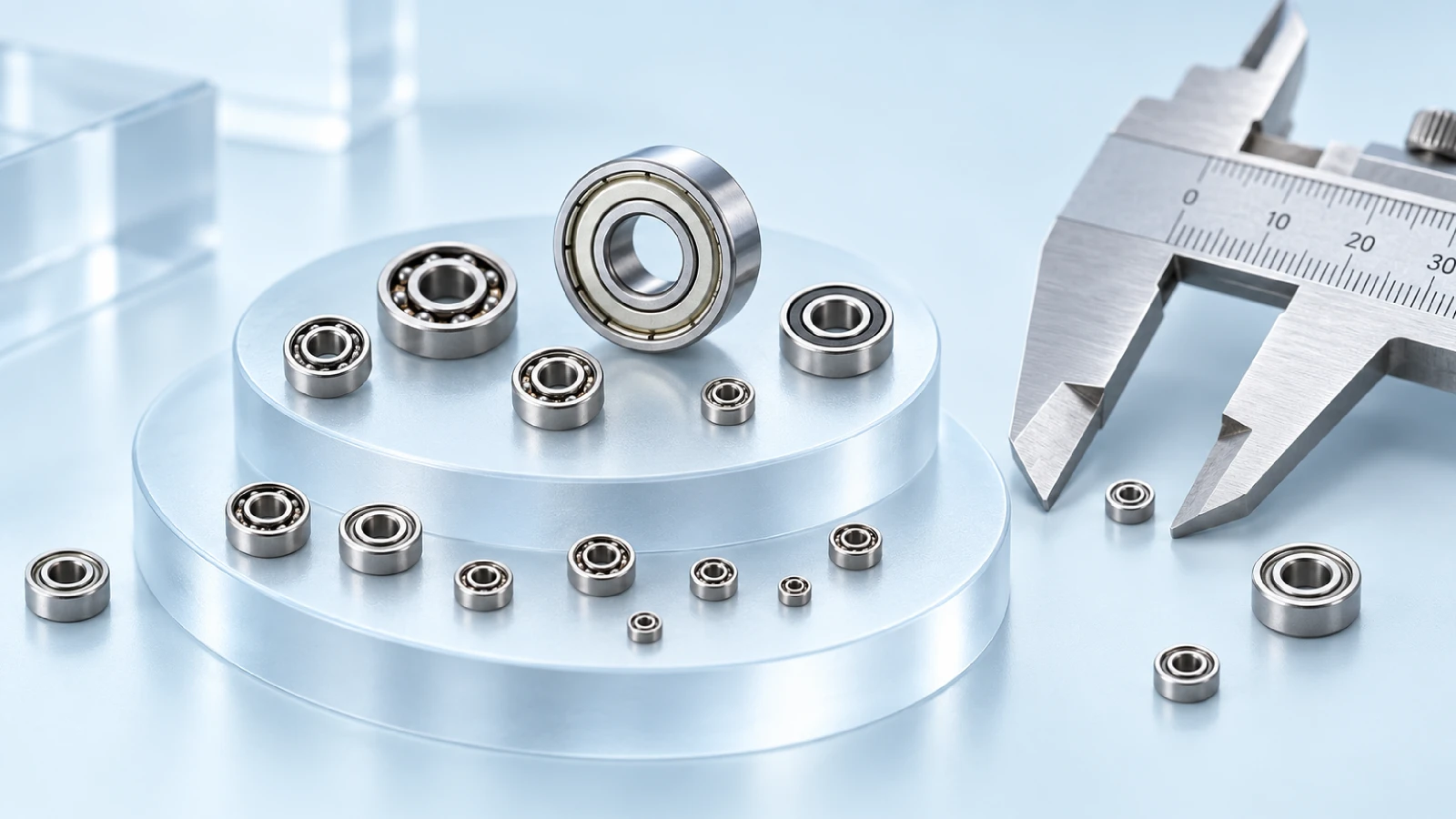
A micro miniature bearing supports motion where space, mass, torque, noise, and rotational accuracy can all be tightly controlled. Its small size does not make selection simpler. Minor changes in shaft fit, housing alignment, internal clearance, lubricant quantity, or contamination can have a large effect on running performance.
Buyers should begin with the complete model and required dimensions. They should then confirm bearing type, precision, protection, materials, lubricant, speed, load, and assembly method for the actual device.
There is no single global size boundary used identically by every manufacturer. Some catalogs group extra-small and miniature bearings by shaft diameter, while others publish miniature and small ball bearings together by outside diameter. For example, one major manufacturer presents extra-small and miniature deep groove bearings for shaft diameters from 1 to 9 mm. Another groups its miniature and small products at outside diameters of 35 mm or less.
Consequently, the word “micro” should not replace dimensional data in a purchasing inquiry. Always state the bore, outside diameter, width, flange dimensions if present, and corner or shoulder requirements. Inch and metric series must also remain separate.
Common reference families include metric 60, 62, 63, 67, 68, and 69 series, as well as manufacturer-specific ultra-small and inch-size families. Examples such as 603, 606, 693, or 696 indicate different dimensional series and sizes. A prefix or suffix may add a flange, shield, seal, clearance, precision class, or lubricant requirement, so the base number alone may be incomplete.
Deep groove ball bearings are the most common miniature form, but buyers can choose several structures and configurations.
| Type or configuration | Main purpose | Details to confirm |
| Open deep groove bearing | Provides low drag where the surrounding system controls cleanliness | Lubrication, contamination and retention |
| Shielded or sealed bearing | Protects the rolling contact and retains lubricant | Closure type, drag, temperature and grease |
| Flanged outer-ring bearing | Locates the bearing against a housing face | Flange diameter, thickness and mounting shoulder |
| Angular contact bearing | Supports combined load through a defined contact angle | Axial direction, pairing, preload and accuracy |
| Stainless-steel bearing | Improves corrosion resistance in selected environments | Ring and ball materials, lubricant and load rating |
| Hybrid bearing | Supports selected speed or electrical-insulation requirements | Ceramic ball type, speed, insulation, lubricant and load rating |
| Thin-section or special-ring design | Fits restricted radial or axial envelopes | Ring width, stiffness, fit and handling method |
However, open, shielded, and sealed versions with the same basic dimensions can still differ in torque, speed, lubricant retention, and environmental limits.
Therefore, keep model examples tied to the manufacturer. For example, F606 can identify a flanged miniature bearing, but manufacturers use different shield, seal, clearance, precision, and lubricant suffixes. Never transfer a suffix meaning from one manufacturer to another.
Small bearing rings and rolling elements react strongly to assembly error. For example, excessive shaft interference can expand the inner ring and reduce internal clearance, while a tight housing can compress the outer ring. Misaligned seats, rough shoulders, or excessive clamping force may also distort the raceways and raise torque.
First, define the required rotational accuracy, runout, noise, torque, and axial rigidity. Then select a suitable precision class and internal clearance. Preload can improve rigidity and control axial movement. However, excessive preload creates heat and reduces service life. Thermal expansion of the shaft, housing, and bearing materials also requires review.
Next, evaluate the lubricant. Viscosity, base oil, thickener, temperature range, compatibility, cleanliness, and fill quantity all affect performance. Too much grease can increase churning torque and temperature in a high-speed miniature bearing, whereas too little can reduce film formation and service life.
Finally, maintain clean handling. Small particles can be large relative to the contact surfaces. Keep bearings in protective packaging until assembly, use clean tools, and avoid transmitting mounting force through the balls. The final review should cover load direction, speed, duty cycle, shock, temperature, humidity, dust, and restricted-substance requirements.
Global purchasing teams often compare miniature bearing data from established manufacturers such as NSK, NTN, SKF, JTEKT/Koyo, and MinebeaMitsumi/NMB. Other specialist manufacturers may also serve instrument, dental, aerospace, semiconductor, or medical applications.
Brand recognition alone does not confirm suitability. Manufacturers use different series, suffixes, clearance classes, grease codes, precision options, and special-environment materials. Buyers should compare current data for the complete designation rather than combine one brand’s base number with another brand’s suffix.
For controlled equipment, confirm traceability, inspection documents, packaging, shelf-life requirements, and change-control expectations. If an alternative brand is considered, the responsible engineering authority should approve the dimensional and performance comparison before use.
Miniature deep groove ball bearings support radial load and limited axial load in both directions, making them useful in compact rotating assemblies. Their low-friction form suits applications that may require speed, smooth motion, low noise, or low torque.
| Industry or equipment | Typical bearing position | Main purchasing concern |
| Medical and measuring devices | Pumps, instruments, scanners and compact drives | Noise, accuracy, cleanliness and materials |
| Office and financial equipment | Printers, copiers and terminal mechanisms | Life, torque, noise and supply consistency |
| Computing and electronics | Fans, small motors and precision mechanisms | Speed, lubricant, vibration and contamination |
| Automotive and HVAC systems | Actuators, sensors, blowers and small motors | Temperature, vibration, sealing and life |
| Robotics and automation | End effectors, encoders and compact transmissions | Runout, rigidity, torque and mounting accuracy |
| Appliances and power tools | Motor shafts and driven mechanisms | Load, speed, dust protection and cost control |
However, these examples describe application groups rather than universal approvals. Medical, automotive, and other controlled uses may impose additional documentation, material, reliability, or validation requirements. Therefore, the equipment designer must confirm the final bearing specification.
For an inquiry, send the complete model, dimensions, drawing, shaft and housing fits, load, speed, temperature, required life, lubricant, noise or torque target, quantity, and inspection needs. HSN can review hard-to-find models and discuss alternatives after technical comparison. Agreed checks may cover dimensions, hardness, clearance, material, accuracy, vibration, and noise.
Is Every Small Ball Bearing a Micro Bearing?
No. Size definitions vary by manufacturer. Always specify bore, outside diameter, width and series.
Can Open, Shielded and Sealed Types Interchange?
Not automatically. Protection, drag, speed, lubricant retention and operating temperature may differ.
Why Does Grease Quantity Matter in a Small Bearing?
Excess grease can raise torque and heat, while too little can reduce lubrication and service life.
What Should a Miniature Bearing Inquiry Include?
Send the full code, dimensions, fits, load, speed, temperature, lubricant, accuracy, quantity and application.
For detailed micro miniature bearing models not listed above, please contact HSN for model confirmation and supply discussion. For other bearing types, send the complete model, photos, dimensions, quantity, application, and working conditions.
This article is based on independent analysis of publicly available technical information and industry understanding and is intended for knowledge sharing. All brand names and trademarks belong to their respective owners. HSN Bearing Group is an independent bearing supplier and technical service provider.
Tel: +86 156 6578 7336 Email: service@hsnindustrial.com Website: www.rollingparts.com www.hsnbearings.com