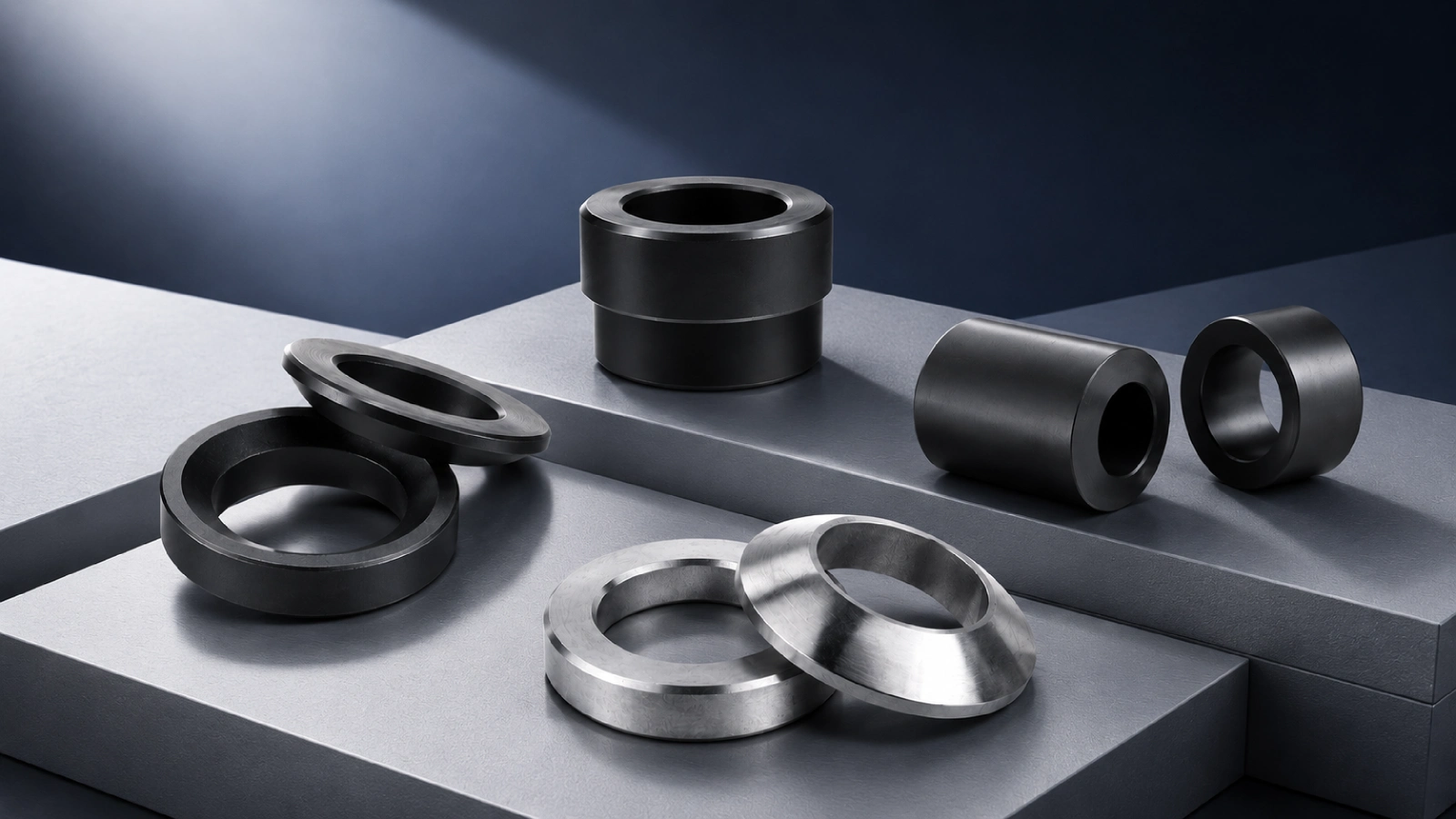
For overseas maintenance and buyers, spherical washers help create a more parallel load path between a bolt head or nut and a tilted support face. The correct pair can reduce bolt bending and distribute surface pressure more evenly. However, buyers must confirm the bolt size, available height, angle error, load, finish, and mating geometry before ordering.
An industrial spherical washer set uses a convex ring and a matching concave ring. The curved mating surfaces allow the pair to adjust to angular error. Consequently, the bolt can remain straighter even when the support face is not perfectly perpendicular to the bolt axis.
This function differs from a normal flat washer, which cannot compensate for angular misalignment. SKF spherical washers use matching convex and concave surfaces that allow the washer pair to adjust to angular error while helping distribute bolt tension more evenly and reduce bolt bending.
Buyers should classify the product by:
The washer pair should remain together as a matched geometry. Mixing one ring from another size or manufacturer can change contact, adjustment range, and bearing pressure.
Spherical washers are commonly used in heavy machinery, mining equipment, marine systems, presses, machinery foundations, equipment mountings, and other large bolted assemblies. They are especially useful where the support face is not perfectly perpendicular to the bolt axis and the joint needs more even contact under preload.
The spherical contact allows the washer set to compensate for limited angular misalignment around the bolt head or nut. This helps reduce edge loading and improves contact between the fastener and support surface. Typical applications include machine bases, structural joints, tensioned bolted connections, and equipment installed on slightly inclined or uneven mounting faces.
However, spherical washers do not correct every bolted-joint problem. Designers must still check bolt grade, preload, thread engagement, joint stiffness, fatigue, surface condition, and the strength of the clamped parts. Soft, damaged, or unstable support faces can still deform even when the washer compensates for angular error.
Start with the complete model, bolt size, hole diameter, outside diameter, overall height, and washer profile. Buyers should also confirm whether the application requires a standard-height or low-profile version, as well as which side of the joint needs angular compensation.
Next, review the support-face angle, clamp load or tightening method, available installation space, corrosion exposure, and surrounding geometry. The convex and concave surfaces must match correctly, while the bolt, nut, and washer diameters need enough contact area without interfering with nearby shoulders or components.
If the application requires height reduction or other machining, buyers should provide the drawing and technical requirements before modification. Any machining must preserve the required spherical geometry and leave enough material to carry the specified clamp load. A standard washer should not be altered based on dimensions alone without technical confirmation.
SKF spherical washers are available in standard-height and low-profile configurations. Because these are the two principal configurations, the table lists five representative size variants rather than treating each size as a separate series.
| Series or size variant | Configuration | Complete model example |
| SMSW .. -ASTR, size 16 | Standard-height spherical washer | SMSW 16 -ASTR |
| SMSW .. -ASTR, size 20 | Standard-height spherical washer | SMSW 20 -ASTR |
| SMSW .. -ASTR, size 36 | Standard-height spherical washer | SMSW 36 -ASTR |
| SMSW .. LPAST, size 20 | Low-profile spherical washer | SMSW 20LPAST |
| SMSW .. LPAST, size 42 | Low-profile spherical washer | SMSW 42LPAST |
Standard-height and low-profile versions have different installed heights and designation formats. Even when the nominal size is the same, buyers should confirm the hole diameter, outside diameter, total height, permissible angular adjustment, support geometry, and joint load requirements. Retain all spaces, hyphens, and suffix characters exactly as shown in the published model or approved drawing.
Model SMSW 20LPAST illustrates the product family, size reference, low-profile configuration, and complete version suffix. Buyers should use the full published designation rather than infer product properties from individual suffix letters.
| Code | Code section | Meaning |
| SMSW | Product family | SKF spherical washer designation |
| 20 | Size section | Nominal size reference used for the bolt joint |
| LP | Profile section | Low-profile version |
| AST | Version suffix | Retain this suffix exactly as shown in the published designation |
Standard-height designations such as SMSW 20 -ASTR use a different suffix format from low-profile versions such as SMSW 20LPAST. Therefore, buyers should copy the complete designation exactly from the product, quotation, current technical information, or approved drawing. The designation alone does not replace dimensional, angular-adjustment, and joint-load checks.
Place the convex and concave rings in their intended orientation so their spherical faces mate fully. Clean both support faces and the washer contact surfaces. Then assemble the bolt without forcing either ring against a burr or shoulder.
During tightening, keep the bolt and tool aligned while the washer pair settles. Apply the specified preload or torque method for the joint, not a generic value taken from another machine. After tightening, check that the rings remain seated and that no edge has lifted.
For removal, release bolt tension using the approved sequence. Do not strike the spherical surfaces or pry between the matched rings. Finally, inspect for brinelling, corrosion, fretting, cracks, or permanent deformation. Replace the pair if damage prevents full spherical contact.
HSN can review the complete spherical washer model, bolt size, washer dimensions, profile, finish, quantity, mounting space, load requirements, and operating conditions. If the marking is incomplete, photos and measurements can help identify the size and distinguish a standard-height washer from a low-profile version.
For replacement or custom requirements, HSN reviews the drawing, mating geometry, load path, finish, and acceptance criteria before confirming a suitable option. Agreed pre-shipment checks can cover model marking, hole and outside diameters, height, matched-ring geometry, visible surface condition, and packaging. Hardness or material verification can also be arranged when specified.
Can a spherical washer replace spot-facing?
It can compensate for controlled angle error, but the joint design, support strength, load, and available space still need approval.
Are standard and low-profile versions interchangeable?
No. Compare height, outside diameter, hole, load path, contact geometry, finish, and surrounding clearance.
Can buyers mix convex and concave rings?
Do not mix unmatched rings. Their spherical geometry and size must form the intended contact pair.
What should be checked during receiving?
Check the full model, matched pair, dimensions, finish, corrosion, contact surfaces, quantity, and packaging condition.
For detailed spherical washer models not listed above, or for other bearing types, contact HSN with the reference, photos or drawing, dimensions, quantity, application, and working conditions.
This article is based on independent analysis of publicly available technical information and industry understanding for knowledge sharing. All brand names and trademarks belong to their respective owners. HSN Bearing Group is an independent bearing supplier and technical service provider.
Tel: +86 156 6578 7336 Email: service@hsnindustrial.com Website: www.rollingparts.com www.hsnbearings.com