
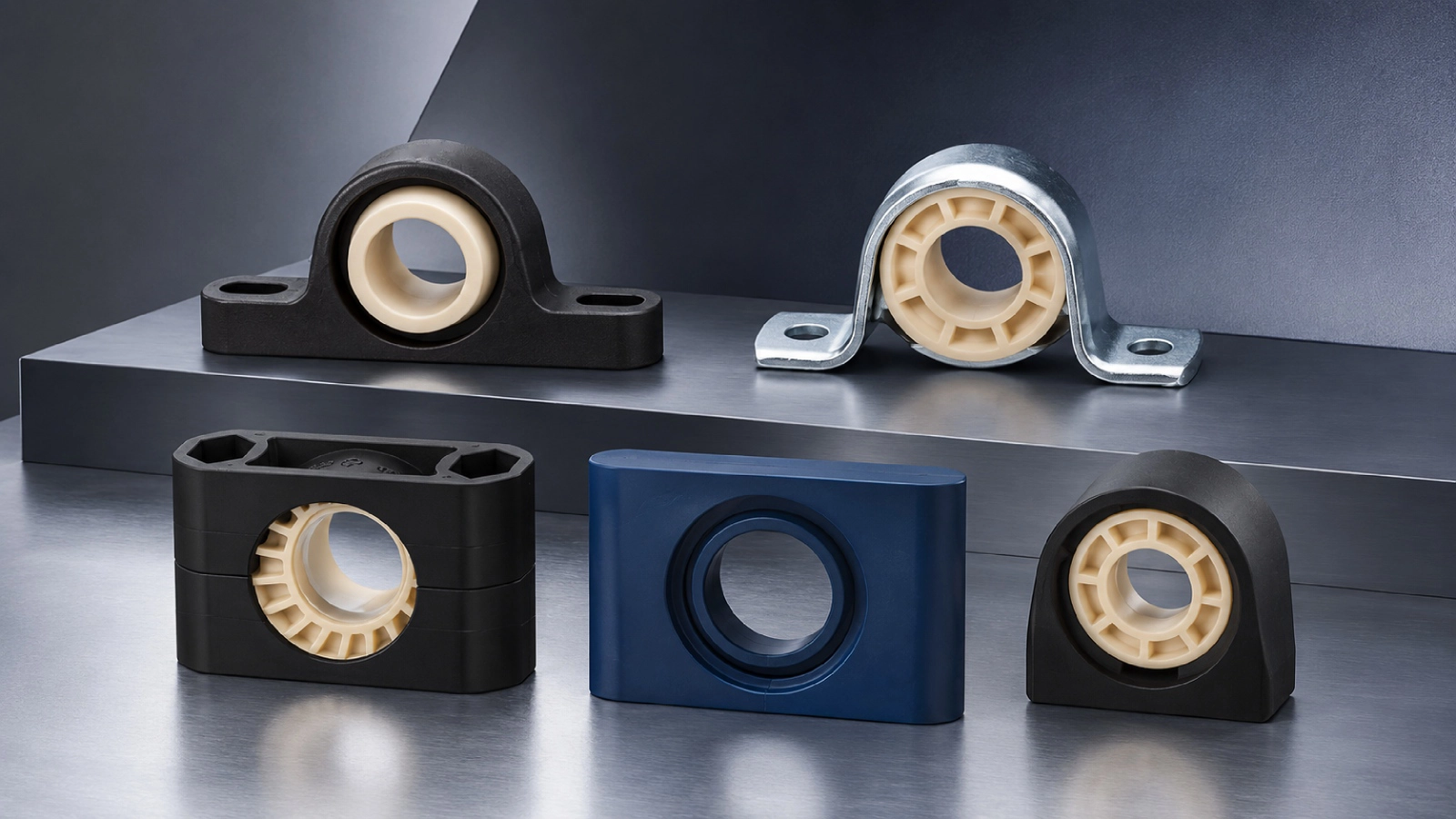
Overseas buyers should select spherical pillow block bearings by the complete unit, not by bore size alone. The housing series, measuring system, spherical insert, load direction, motion, temperature, and shaft retention method all affect the result. This guide explains the igubal polymer spherical pillow block bearings structure and model logic, so procurement teams can prepare a clearer inquiry.
An igubal pillow block combines a two-bolt housing with a spherical ball bearing insert. The spherical interface allows the insert to pivot inside the housing. Therefore, it can compensate for housing alignment errors and shaft deflection while reducing edge pressure at the sliding surface.
Unlike a conventional greased rolling-bearing unit, the standard polymer design operates without external lubrication. However, buyers should not treat every polymer unit as the same product. The full model controls the dimensional series, metric or inch system, bore, housing proportions, and any special material or low-profile feature.
Useful classifications include:
Material details can also vary by current product version. For example, the standard KSTI product description specifies an igumid G housing and an iglidur W300 spherical ball. Consequently, the buyer should confirm the complete model and current technical data before approving a material requirement.
Polymer spherical pillow block bearings suit applications that need self-alignment, corrosion resistance, or dry running without regular lubrication. Typical uses include material-handling equipment, bakery and packaging machinery, facade and sunshade systems, wash-brush mechanisms, light conveyors, and adjustment linkages. Their maintenance-free design can be especially useful where grease is undesirable, contamination must be reduced, or lubrication access is limited.
Depending on the selected igubal design, the bearing can accommodate continuous shaft rotation, oscillating movement, or limited axial displacement. However, buyers should not assume that every housing or insert supports the same type of motion. The required movement, pivot angle, speed, and duty cycle should therefore be confirmed together with the complete model.
Operating conditions also affect material and size selection. Specify the shaft diameter, normal and peak radial loads, any axial load, operating temperature, moisture, chemicals, washdown exposure, and required service life. Where the shaft must slide axially or remain fixed, also state how axial positioning will be controlled.
Finally, verify the mounting interface rather than selecting the unit from bore size alone. Important dimensions include bolt-hole spacing, base height, housing envelope, fastener size, shaft tolerance, and available surrounding clearance. For replacement inquiries, provide the complete model whenever possible, together with photos or a dimensioned drawing.
Igus organizes igubal pillow block bearings by measuring system, housing geometry, dimensional series, and application-specific design. The following examples show five distinct series and their complete model formats.
| Series example | Series description | Complete model example |
| KSTI | Inch-dimension pillow block series | KSTI-08 |
| KSTM | Metric pillow block series | KSTM-08 |
| KSTM-GT | High-rigidity metric pedestal series | KSTM-GT40-GT |
| ESTM | Metric E-series pillow block | ESTM-10-J4 |
| ESTM-SL | Low-profile metric pillow block series | ESTM-08-SL |
KSTI and KSTM identify different measuring systems, while ESTM and ESTM-SL use different housing geometries. KSTM-GT provides a more rigid pedestal structure. Therefore, buyers should compare the bore, mounting-hole spacing, base height, permissible pivot angle, load data, material, and shaft-retention method. A matching bore alone does not make these series interchangeable.
The model KSTM-08 is a useful example because each code section has a defined role.
| Code | Code section | Meaning |
| K | Dimensional series | K-series housing dimensions |
| ST | Design | Pillow block bearing unit |
| M | Measuring system | Metric dimensions; I identifies inch dimensions |
| 08 | Bore reference | 8 mm nominal inside diameter |
The code does not describe every operating limit or material option. Moreover, suffixes can identify a special housing or insert. Buyers should retain every character and confirm the current drawing when a model is old, modified, or taken from an installed machine.
These units normally mount with two bolts, and the spherical insert compensates for modest alignment error. Even so, the base must be stable, the fasteners must match the housing, and the shaft must meet the specified tolerance and surface condition. First, clean the shaft and mounting face. Then place the unit without forcing the insert against its pivot limit.
Tighten the base bolts evenly and rotate or oscillate the shaft by hand. If adjusting rings secure the shaft, set them only after the housings share a common shaft position. Avoid grease, thread compound, or cleaning chemicals on the sliding interface unless the manufacturer confirms compatibility.
For removal, release any shaft-retention parts before loosening the housing. Support the shaft so its weight does not twist the polymer housing. Finally, inspect the spherical ball, housing seat, bolt holes, and shaft for wear or deformation before approving reuse.
A complete purchase description should state the full igubal model, quantity, shaft diameter and tolerance, bolt pattern, load and motion, temperature, environment, and retention method. Add the required drawing revision if the unit fits an existing machine.
Incoming checks can cover model marking, quantity, packaging, visible damage, bore, bolt centers, base height, and free pivoting or rotation. When the order includes a special insert material, verify that material against the approved specification. A similar-looking polymer housing is not enough evidence of equivalence.
HSN can review the complete bearing model, housing dimensions, shaft size, load direction, motion, environment, quantity, and application before sourcing begins. For a hard-to-find igubal reference, the review can also compare photos and drawings to determine which dimensional series and suffixes must remain unchanged.
Before shipment, agreed checks can cover the model, bore, bolt-hole spacing, base height, visible condition, and packaging. If a replacement or custom route is requested, HSN first confirms the interfaces, materials, operating conditions, and acceptance criteria. This process reduces the risk of ordering a unit that fits the shaft but not the machine.
Are KSTM and ESTM units directly interchangeable?
Not necessarily. Compare bore, housing dimensions, bolt centers, base height, load data, and allowable pivot angle.
Do spherical pillow block bearings require lubrication?
It depends on the material and design. Standard igubal units run dry, while other bearing designs may require lubrication.
Is the bore size enough to identify a spherical pillow block bearing?
No. Confirm the complete series, housing design, bore, material, dimensions, and any suffixes before ordering.
What information should buyers provide for an inquiry?
Send the full model, drawing or photos, shaft size, load, motion, mounting dimensions, quantity, and working conditions.
For detailed spherical pillow block bearing models not listed above, or for other bearing types, contact HSN with the reference, photos or drawing, dimensions, quantity, application, and working conditions.
This article is based on independent analysis of publicly available technical information and industry understanding for knowledge sharing. All brand names and trademarks belong to their respective owners. HSN Bearing Group is an independent bearing supplier and technical service provider.
Tel: +86 156 6578 7336 Email: service@hsnindustrial.com Website: www.rollingparts.com www.hsnbearings.com