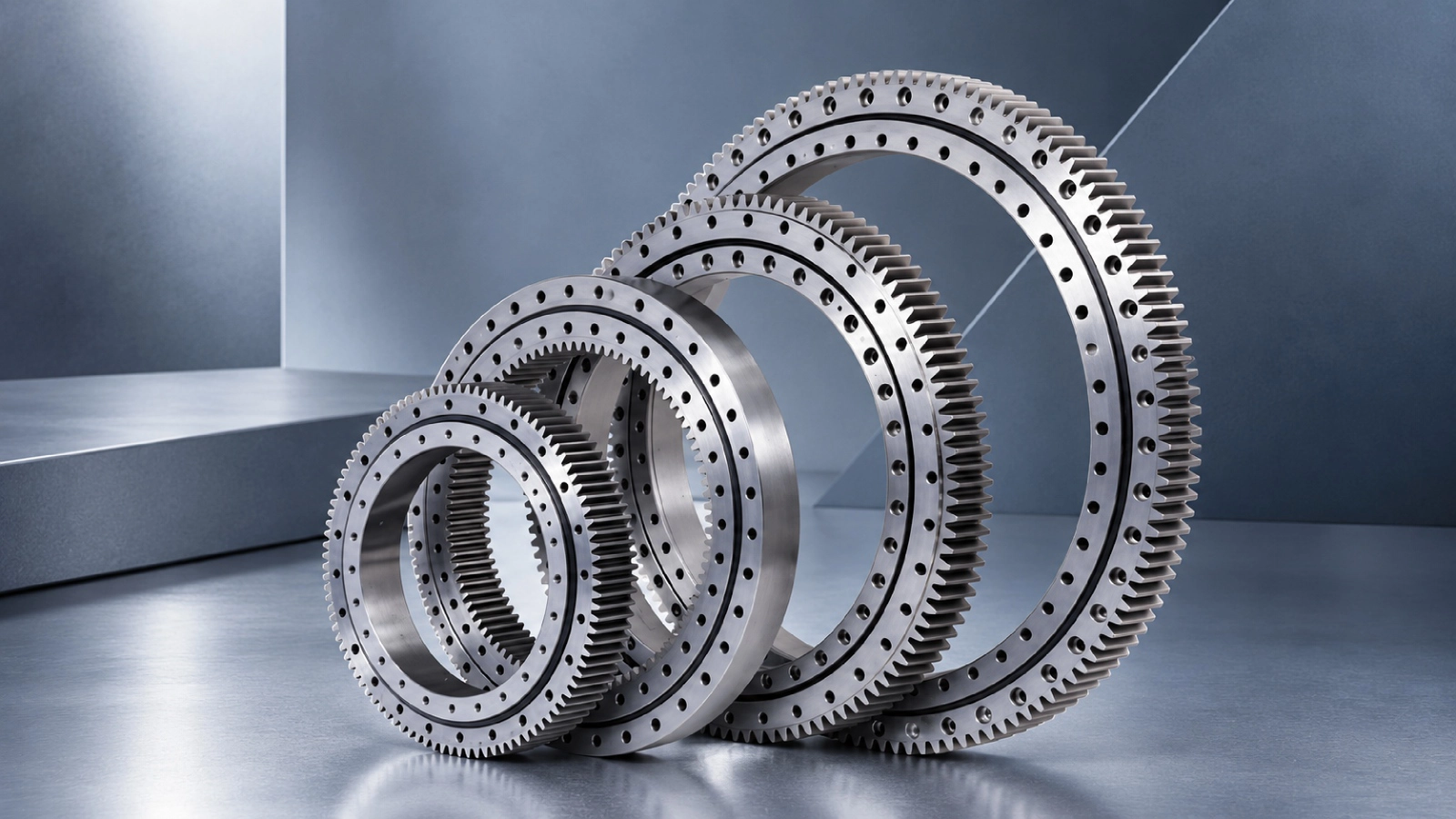
A slew ring bearing connects rotating and stationary structures while carrying axial load, radial load, and tilting moment through a large-diameter rolling interface. Unlike a conventional bearing mounted on a shaft, it is normally bolted directly to the adjacent structures and may include an internal or external gear. Selection must therefore consider the complete load path, mounting flanges, bolts, gear drive, lubrication, seals, and accuracy as one system.
The unit includes inner and outer rings, balls or rollers, raceways, spacers or a cage, seals, lubrication points, and mounting holes. One ring remains fixed while the other rotates. A geared version can transmit drive torque through teeth cut into one ring.
The surrounding structures form part of the bearing system. Flexible or uneven mounting surfaces can distort the raceways, redistribute load, increase torque, and reduce service life. A catalog rating is therefore meaningful only when the specified support stiffness, bolt preload, lubrication, and load conditions are achieved.
Buyers can first compare slewing bearings by rolling-element arrangement and gear configuration, then review load capacity, rigidity, and mounting requirements.
| Configuration | Main capability | Main engineering check |
| Single-row four-point contact ball | Combined axial, radial, and moment load in a compact section | Load point, clearance, bolt circle, and support stiffness |
| Double-row ball | Higher capacity through two ball rows | Load sharing, overall height, and mounting interface |
| Crossed roller | High rigidity and moment capacity with alternating rollers | Preload or clearance, accuracy, and flange stiffness |
| Three-row roller | Separate raceways for high axial, radial, and moment loads | Size, load distribution, lubrication, and structural deflection |
| External, internal, or no gear | Drive interface integrated into or omitted from one ring | Module or diametral pitch, tooth count, backlash, pinion, and protection |
Flanged and profile-ring versions can reduce weight. However, buyers must check allowable loads, mounting-face stiffness, hole patterns, and installation requirements against the exact series.
Slew bearings are widely used in construction machinery, wind energy, marine equipment, forestry machinery, material handling, and industrial automation. Typical applications include cranes, excavators, aerial work platforms, rotary tables, packaging and filling equipment, radar and antenna systems, ship deck machinery, and wind turbine yaw and pitch systems.
These applications combine axial, radial, and moment loads with conditions such as shock, oscillation, vibration, or continuous rotation. The required bearing design therefore depends on the actual load case, operating cycle, speed, mounting arrangement, and environmental conditions rather than the machine type alone.
Before ordering, buyers should provide the normal and maximum loads, load directions, speed, oscillation angle, cycle frequency, emergency loads, wind or inertia effects, operating temperature, contamination level, installation orientation, and required service life. This information helps engineers select the appropriate slew bearing structure and confirm the mounting and operating requirements.
Plot axial force, radial force, and tilting moment for every critical load case. Confirm whether the manufacturer’s static load curve includes the selected bolts or whether bolt capacity must be checked separately. Dynamic life may require a load spectrum rather than one peak point.
Next verify ring orientation, rotating ring, supported or suspended load, bolt size and grade, number of holes, bolt circle, flange thickness, flatness, and stiffness. For geared units, state which ring is toothed, tooth geometry, allowable tooth force, drive torque, pinion data, and required backlash. Accuracy, running torque, clearance or preload, seals, grease, and corrosion protection complete the interface specification.
The following examples show how manufacturers organize standard ranges and gear options.
| Brand | Series examples | Complete model example |
| INA | VLA/VLI/VLU light four-point series; VSA/VSI/VSU standard four-point series; XA/XI/XU crossed roller series | VLA 20 1094 N ZT RL2 |
| Kaydon | RK series with non-geared, internal-geared, and external-geared variants; MT series MTO and MTE designs | RK6-16N1Z |
| IMO | Other Standard Ball Slewing Rings; untoothed, external-toothed, and internal-toothed variants | 0309/1-03312 |
Do not compare only outside diameter. Check raceway type, load curve, gear, hole pattern, ring orientation, clearance, seals, lubrication, accuracy, torque, and mounting instructions.
INA model VLA 20 1094 N ZT RL2 shows how the ordering designation combines bearing type, series, gearing, dimensions, gear treatment, centering, and internal clearance information.
| Code | Code section | Meaning |
| V | Bearing type | Four-point contact ball bearing |
| L | Series | Light series |
| A | Gear type | External gear teeth |
| 20 | Rolling element diameter | 20 mm rolling-element diameter |
| 1094 | Rolling element pitch circle diameter | 1,094 mm rolling-element pitch-circle diameter |
| N | Gear heat-treatment suffix | Normalized gear teeth on bearing ring |
| ZT | Centering suffix | With centering |
| RL2 | Internal clearance suffix | Restricted internal clearance, class RL2 |
The complete designation should be provided in the correct character sequence because omitted or misplaced suffixes may change the bearing specification required for ordering.
Measure mounting-surface flatness and clean all contact faces. Position the ring according to the drawing, account for the hardened-zone marking where specified, and tighten approved bolts in a crosswise sequence to the required preload. Set gear backlash at the designated high point and verify free rotation before full commissioning.
Lubricate the raceway and open gear with approved products and intervals. For removal, support the ring safely, mark orientation, release bolts in a controlled sequence, and use lifting points suitable for the mass. Record backlash, torque, and condition before disassembly where fault analysis is required.
HSN reviews the complete bearing model, approved drawing, dimensions, ring orientation, load cases, gear data, mounting-hole pattern, bolt requirements, clearance, accuracy, lubrication, quantity, application, and working conditions. For obsolete, hard-to-source, or non-standard references, HSN first compares the critical interfaces and operating requirements before discussing a replacement or custom option.
Before shipment, HSN checks key items such as critical dimensions, hardness, clearance, hole position, gear condition, and overall appearance. Depending on the agreed inspection scope, additional checks can include material verification, runout, rotation torque, gear inspection, or flaw detection. This helps buyers confirm that the supplied slew ring matches the approved specification before installation.
Is a slew bearing the same as a slew drive?
No. A bearing supports rotation and loads; a slew drive adds a drive train and usually an enclosure.
Can outside diameter identify a replacement?
No. The hole pattern, raceway, gear, load capacity, height, clearance, and interfaces must also match.
Which load data are needed?
Provide axial and radial force, tilting moment, load direction, time share, shock, speed, cycles, and emergency cases.
Why does mounting flatness matter?
An uneven support can distort the raceway, change load distribution, raise torque, and shorten life.
For detailed slew bearing models beyond those listed above, or for other bearing types, contact HSN with the complete reference and technical requirements.
This article is based on independent analysis of publicly available technical information and industry understanding for knowledge sharing. All brand names and trademarks belong to their respective owners. HSN Bearing Group is an independent bearing supplier and technical service provider.
Tel: +86 156 6578 7336 Email: service@hsnindustrial.com Website: www.rollingparts.com www.hsnbearings.com