
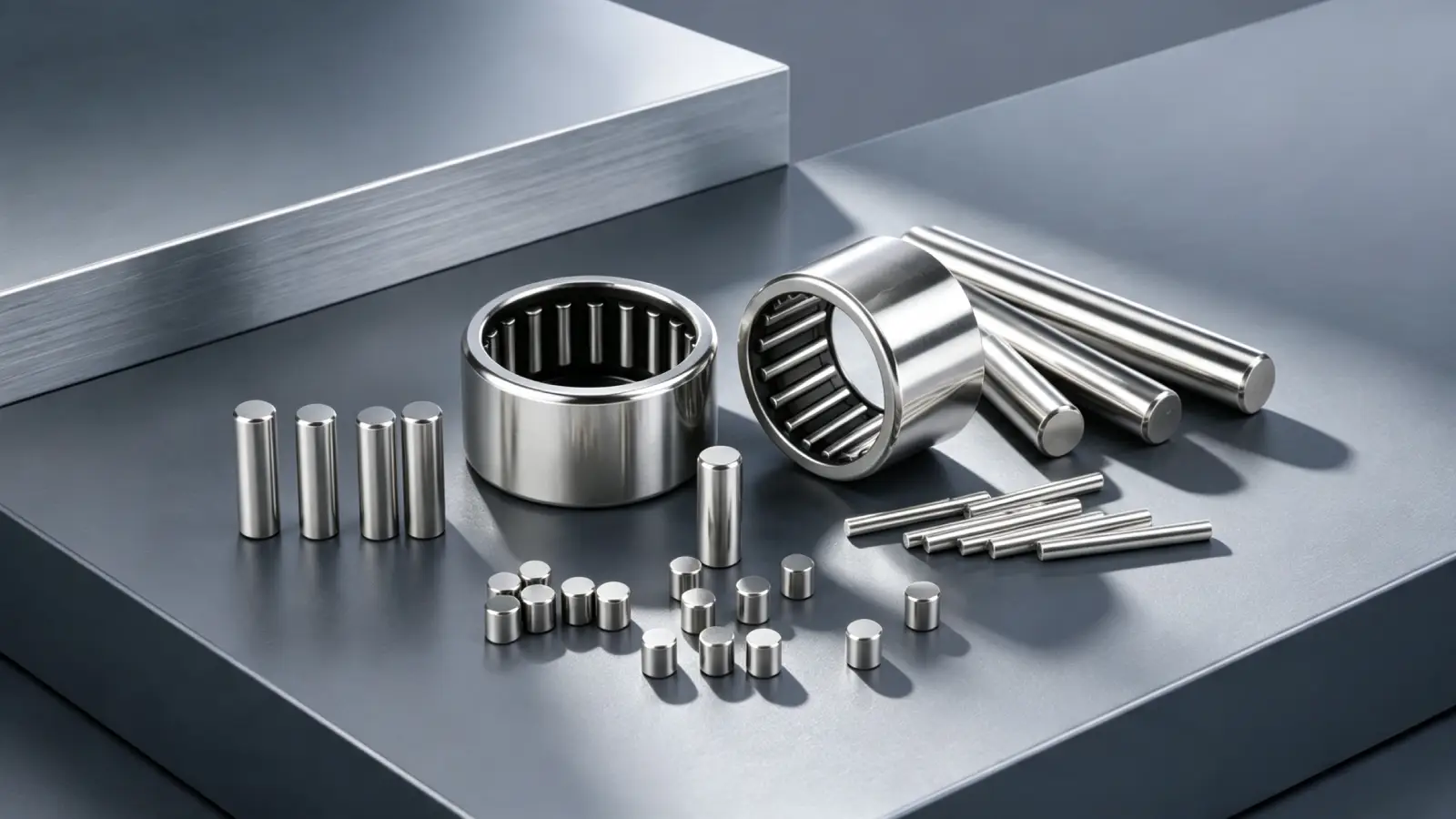
Loose needle rollers are individual precision rolling elements installed directly between a shaft and housing. They remove the inner ring, outer ring, and cage from the available radial space. Consequently, a compact journal can use a relatively large shaft while carrying substantial radial load.
However, every surrounding machine surface becomes part of the bearing system. Roller diameter, length, end form, tolerance group, raceway hardness, geometry, lubrication, and circumferential clearance all affect operation. Buyers therefore need more than a nominal roller size when requesting replacement needles.
The rollers run directly on hardened inner and outer raceways. Because many long, small-diameter rollers share the load, the arrangement provides high radial capacity within a small section. A full complement also uses the available circumference efficiently because there is no cage separating the rollers.
Nevertheless, uncaged rollers slide against neighboring rollers and require controlled circumferential play. Their ends also need lateral guidance. If long rollers are required, two equal rows separated by a spacer can improve guidance. The rollers in both rows should come from compatible diameter groups so the load is distributed evenly.
End geometry and diameter grouping are key ordering features. Nadella identifies rounded and flat-end rollers separately, while tolerance grades divide a shipment into controlled diameter bands.
| Nadella reference | Feature | Buyer confirmation |
| BR | Standard needle roller with rounded ends | Diameter, length, grade, and diameter class |
| BP | Needle roller with flat ends | End guidance and required edge geometry |
| DTN suffix | Greater relief or taper toward the roller ends | Raceway profile and edge-stress requirement |
| G2 / G3 / G5 | Diameter variation grades | Required lot grouping and permitted variation |
A special end profile should not be selected only from appearance. It must match the raceway geometry and load distribution. Likewise, rollers from different diameter classes should not be mixed during repair. Even a small difference can cause a few rollers to carry a disproportionate share of the load.
Loose needle rollers are commonly used in compact gearboxes, planetary gears, idler wheels, oscillating pivots, connecting mechanisms, and custom journals. Because the shaft and housing serve directly as raceways, this arrangement saves radial space and can support substantial radial loads. Long idlers may use two matched roller rows separated by a spacer.
However, uncaged complements require careful assembly, controlled circumferential play, reliable lateral guidance, and suitable lubrication. They are less convenient when sealing, rapid installation, or easy field replacement is essential. In those cases, a caged assembly or complete needle bearing may reduce installation risk. Buyers should therefore compare the available envelope with load, speed, maintenance access, and raceway quality.
Provide the nominal roller diameter and total length first. Then state the end form, diameter grade, selected tolerance class, quantity per assembly, number of rows, and total purchase quantity. When an old roller is measured, note whether it is new, worn, or taken from a failed position.
Do not estimate the new roller diameter from a heavily polished sample alone. Wear, debris indentation, and mixed groups can distort the measurement. Instead, compare several rollers at their central measuring zones and verify the raceways before defining a repair size.
Clean the raceways and remove all damaged particles before assembly. A light compatible grease can hold the rollers around the inner or outer raceway during installation. When a shaft must enter a blind ring of rollers, a temporary mounting shaft can retain the complement until the working shaft displaces it.
Count the rollers and confirm circumferential clearance before closing the assembly. Moreover, keep each tolerance group in a separate marked container. Never add one larger roller to remove play, and do not reuse rollers with flats, pitting, corrosion, or end damage. After assembly, rotate the journal slowly and check for tight spots.
Nadella’s needle-bearing catalogue treats loose needle rollers as a dedicated product group. Within this group, BR and BP identify the two principal end forms. In addition, Nadella uses grade and diameter-class information to control roller variation within a supplied lot. DTN is an optional profile suffix rather than a separate standard series.
| Nadella designation | Status in the catalogue | Meaning |
| 3 × 23.8 BR | Published BR designation example | 3 mm nominal diameter, 23.8 mm overall length, and rounded ends |
| 3 × 23.8 BP | Published BP designation example | 3 mm nominal diameter, 23.8 mm overall length, and flat ends |
| 2.5 × 15.8 BR/G2-2-4 | Published tolerance example | Rounded-end roller with G2 grade and selected 2-4 diameter class |
| … DTN | On-request suffix, not a standalone model | Greater taper or relief toward the roller ends |
In these examples, the number before the multiplication sign gives the nominal roller diameter, while the following number gives the overall length. BR or BP then identifies the end form. When specified, /G2-2-4 defines the diameter-variation grade and the selected class within that grade.
A complete example is 2.5 x 15.8 BR/G2-2-4:
| Code section | Example | Meaning |
| Diameter | 2.5 | Nominal roller diameter in millimetres |
| Length | 15.8 | Nominal overall roller length in millimetres |
| End form | BR | Rounded-end standard needle roller |
| Grade | G2 | Two-micrometre diameter-variation grade |
| Class | 2-4 | Selected diameter-deviation band within that grade |
By contrast, BP identifies a flat-end roller. The complete designation should remain unchanged during an inquiry because the end form and diameter class affect guidance and load sharing. Moreover, buyers should not add DTN mechanically to a standard BR or BP reference. Nadella lists DTN as an on-request suffix for greater end taper, so buyers should confirm the complete dimensions and profile before ordering.
HSN Bearing Group supports model confirmation, sourcing, inspection, and custom supply discussions. First, buyers should provide the full roller reference, dimensions, end form, tolerance group, quantity, and application. HSN can then review the roller diameter, length, end geometry, tolerance class, roller count, diameter grouping, lubrication, load, speed, and assembly method. Several unworn samples are useful when no drawing exists.
For difficult or non-standard requirements, HSN can evaluate controlled drawings and measured samples before discussing production. Before shipment, agreed checks may cover diameter, length, end geometry, hardness, material, appearance, and grouping. However, loose rollers should not be selected from size alone because diameter tolerance grouping and raceway condition together determine load sharing.
Can rollers from different groups be mixed?
No. Mixed diameter groups can create uneven load sharing, heat and early surface damage.
Why are loose rollers measured at the center?
Their profiles may be relieved near the ends, so the central zone gives the controlled diameter.
Can worn samples define a new roller size?
Not alone. Measure several samples and verify the shaft, housing, clearance and original drawing.
What should accompany a roller inquiry?
Send diameter, length, end form, grade, class, roller count, quantity, raceways and working conditions.
For loose needle roller sizes not listed above, contact HSN for confirmation. Send the complete reference, photos, dimensions, quantity, roller count, and working conditions for review.
This article is based on independent analysis of publicly available technical information and industry understanding for knowledge sharing. All brand names and trademarks mentioned belong to their respective owners. HSN Bearing Group is an independent bearing supplier and technical service provider.