
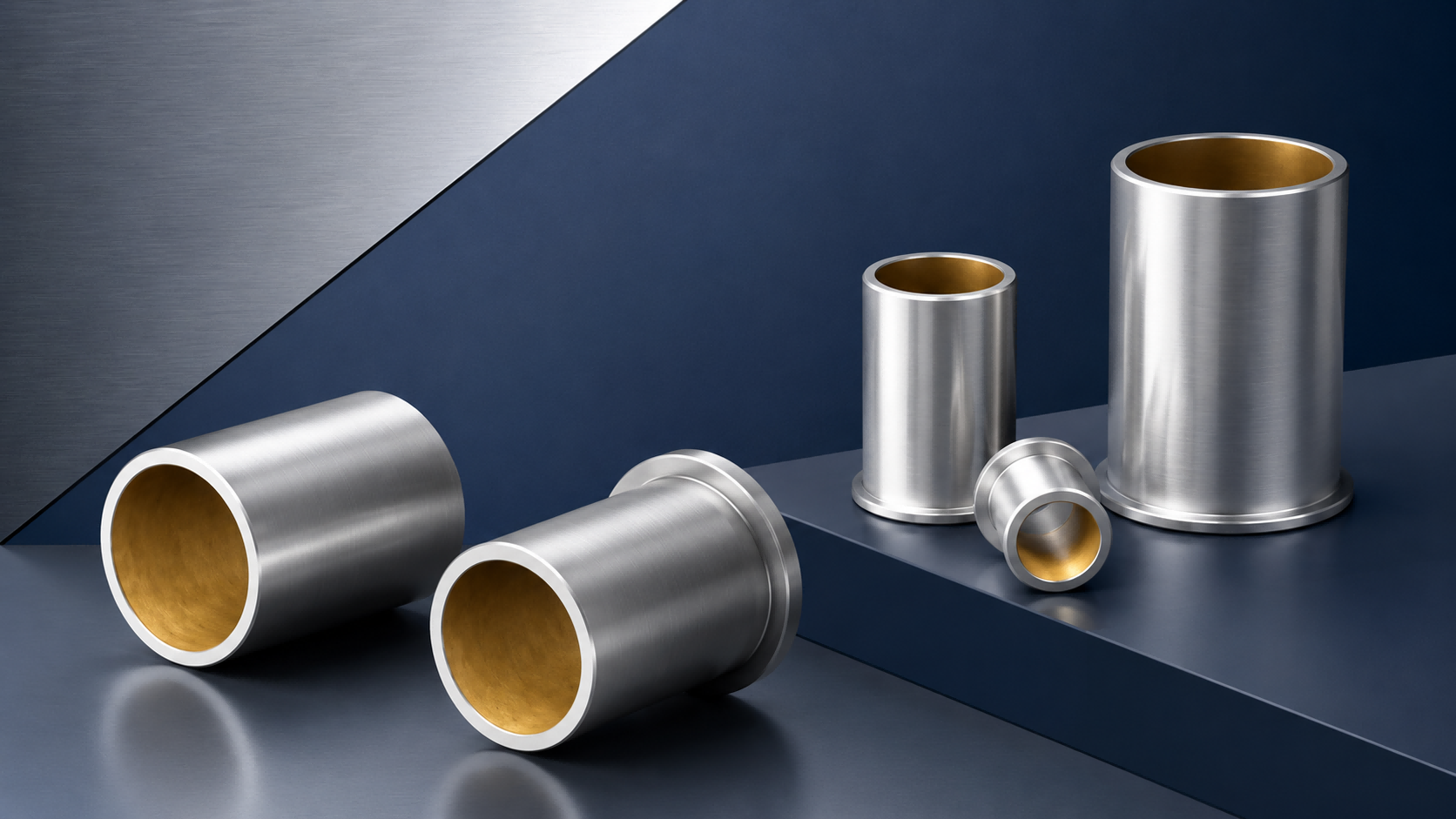
A linear sleeve bearing guides straight motion by sliding along a round shaft instead of recirculating balls. Its compact shape can simplify a machine, while polymer liners can reduce noise and remove the need for routine relubrication. However, performance depends on the complete bearing, shaft, housing, load, and environment.
Buyers should not select a sleeve only because its bore matches an existing shaft. The liner material, adapter design, clearance, shaft finish, temperature, contamination, and mounting arrangement can change friction and service life. Therefore, the full model code and application data should be reviewed together.
The bearing liner creates a controlled sliding interface around the shaft. Unlike a ball bushing, it has no circulating rolling elements. As a result, it can tolerate dirt differently, operate quietly, and suit short or intermittent strokes. At the same time, sliding friction and wear depend directly on contact pressure and shaft speed.
A closed sleeve surrounds the shaft and normally runs on an end-supported round shaft. An open sleeve has a longitudinal opening, so it can pass over a support rail. Housed versions add a mounting body, while replaceable liners separate the wear element from the adapter. Each arrangement needs its own housing and alignment checks.
The main design choice is not only metric versus inch sizing. Buyers should also distinguish the liner construction, outer adapter, opening, alignment function, and required clearance.
| Design | Structural feature | Main ordering check |
| Closed sleeve | Full cylindrical sliding surface | Shaft support, housing fit, length, and clearance |
| Open sleeve | Longitudinal opening over a support rail | Opening angle, rail geometry, and load direction |
| All-polymer sleeve | Bearing body and liner use polymer construction | Shaft material, temperature, load, and retention |
| Metal-adapter sleeve | Polymer liner inside a metal adapter | Outer diameter, circlip grooves, and alignment |
| Low-clearance sleeve | Reduced running play for controlled motion | Shaft tolerance, parallelism, and thermal change |
A design described as dimensionally similar to a ball bushing should still be checked carefully. The required shaft material, recommended clearance, load direction, and mounting method may differ. In addition, a plain bearing normally needs a suitable counterface rather than any polished bar.
Linear sleeve bearings are used in packaging equipment, laboratory devices, light automation, adjustment mechanisms, guarding systems, food-handling machinery, and material-transfer equipment. Their quiet movement, low mass, and dry-running capability are useful where routine relubrication is difficult or lubricant could attract dust.
However, each application must remain within the selected liner’s load, speed, temperature, and shaft limits. Oscillating motion can concentrate wear over a short stroke, while long unsupported shafts may deflect. Abrasive particles can also damage the liner and shaft. Therefore, buyers should state the actual stroke, duty cycle, shaft material, cleaning method, and contamination level before selection.
Start with the complete model and confirm whether the unit is a bare sleeve, an adapter bearing, or a housed assembly. Then provide the shaft diameter, bearing length, outside diameter, retention method, quantity, and available mounting space.
The load should be considered together with its direction and the bearing spacing. A sleeve can carry radial load, but it does not restrain rotation around the shaft by itself. Two shafts, a torque arm, or another guide element may be needed when the carriage must not rotate.
Before installation, clean the housing and inspect the shaft for burrs, dents, corrosion, and damaged coatings. Chamfer the shaft end so it cannot cut the liner. Press only on the approved bearing surface, and do not drive the sleeve through the housing with uncontrolled impact.
For parallel shafts, establish one reference side before tightening the second guide. Move the carriage through the full stroke and check for binding or uneven resistance. Moreover, avoid adding grease unless the selected liner and supplier instructions allow it. Some dry-running polymer systems can collect abrasive contamination when unsuitable lubricants are introduced.
Igus drylin R products include several round-shaft plain-bearing constructions. The complete part number identifies the family, design variant, and shaft size, so the base letters should never be ordered alone.
| Complete Igus model | Confirmed construction | Ordering meaning |
| RJUM-01-10 | Metric, standard, closed bearing with aluminum adapter | Standard closed design for a 10 mm shaft |
| RJUM-11-16 | Metric, low-clearance, closed bearing | Reduced-clearance design for a 16 mm shaft |
| RJ4JP-01-08 | Japanese-metric, all-polymer bearing | All-polymer standard design for an 8 mm shaft |
For example, RJUM identifies a drylin R metric linear plain-bearing family, while the middle design number distinguishes the execution. The final number identifies the nominal shaft size in these examples. However, buyers should use the complete current part number because material, alignment, and construction options are not interchangeable by bore alone.
HSN Bearing Group supports model confirmation, sourcing, inspection, and custom supply discussions. First, buyers should provide the complete bearing code, shaft details, quantity, mounting layout, and working conditions. HSN can then review the sleeve construction, dimensions, liner material, clearance, housing fit, load direction, speed, stroke, and environment. This process helps separate a bare liner from an adapter or housed unit.
For difficult or discontinued models, HSN can evaluate photos, drawings, samples, and installation dimensions. Replacement options or custom production can then be discussed after technical confirmation. Before shipment, agreed checks may cover dimensions, material, appearance, fit, and movement. However, a matching bore does not automatically confirm shaft or housing compatibility.
Can a sleeve bearing use any polished shaft?
No. Shaft material, finish, tolerance, straightness and hardness must suit the selected liner and load.
Do dry-running sleeves need added grease?
Not normally. Follow the liner supplier’s guidance because unsuitable grease can attract abrasive contamination.
When is an open sleeve design required?
Use it when the bearing must pass over a continuous shaft support, after checking opening and load direction.
Does the same bore confirm interchangeability?
No. Compare length, outside diameter, liner, clearance, housing fit, retention and operating limits.
For linear sleeve bearing models not listed above, contact HSN for confirmation. Send the complete model, photos, dimensions, quantity, and working conditions for review.
This article is based on independent analysis of publicly available technical information and industry understanding for knowledge sharing. All brand names and trademarks mentioned belong to their respective owners. HSN Bearing Group is an independent bearing supplier and technical service provider.
Tel: +86 156 6578 7336 Email: service@hsnindustrial.com Website: www.rollingparts.com www.hsnbearings.com